
I love it when I learn something new, even after doing this for twenty years
Ever since Twitter/X died, Threads has been my social media channel of choice (just in case you want to follow me 😁. Admittedly, I’ve drifted away from the pure Shakespeare thing ever since my last layoff, when I had to start leaning more heavily on the developer-dad thing. But I’m still on the lookout for the good stuff, and it does not disappoint when it does come.
So I spotted this thread about a Shakespeare meet-cute gone awry. The first party opens with “Oh, Horatio!” instead of “Alas, poor Yorick.” Only for the second party to correct(?) him with, “Alas, poor Yorick, I knew him well.” The embarrassment came from realizing that this, too, was incorrect. The Folio says, as I’m sure most readers know, “Alas poore Yorick, I knew him Horatio, a fellow of infinite Iest; of most excellent fancy, he hath borne me on his backe a thousand times…” (I looked that up and copied it, lest we continue the misquoting trend 🧐 )
But wait! That wouldn’t be worthy of a blog post. What caught my eye was the follow-up saying:
“I knew him well” is perfectly fine. LOADS of versions since the 18th century have included the word “well”.
Excuse me? Since when? I was all set to call up my scans of both Quarto and Folio to assure people that it was not, in fact, perfectly fine…. and then I kept reading.
OP brought receipts!
In Bell’s Edition of “Shakespeare’s Plays as They are Now Performed at the Theatres Royal in London” By William Shakespeare, John Bell, Francis Gentleman · 1773
Page 75:
Including a screenshot. Well, color me intrigued! Time to do my own research and see if I can come to the same conclusion. After all, this is the internet in the age of AI. Just because somebody cites a reference and purports to have a screenshot doesn’t guarantee that either is accurate.
I Knew Him Well, Horatio
And would you look at that!
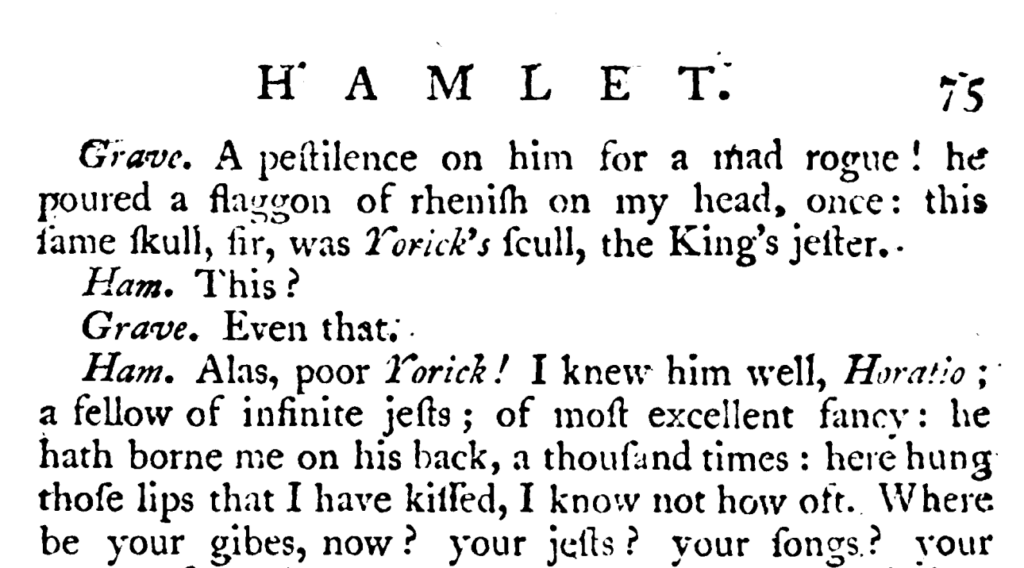
Thank you, Google Books! (Want to hear a funny story? When Google first put the works of Shakespeare online? They quoted me. I’m so happy that link still exists.)
But anyway. I’m not sure how much I’m willing to allow the original poster’s “it’s totally fine” and that LOADS of versions print it that way — this is literally the first time I’m seeing “I knew him well, Horatio,” and I’ve seen my fair share of Shakespeare editions. But it’s not wrong, it’s right there for us to see, going all the way back to 1774.
It is acknowledged that Bell’s edition is not an academic resource:
The editions of Shakespeare’s plays produced by the printer/publisher John Bell were rather different form the scholarly editions being produced at the same period by Samuel Johnson, George Steevens and others. They were acting editions, based on the text actually used in the playhouses, and came complete with current cast lists and illustrations (which could also be bought separately).
My first thought was that this presents us with a bit of a time machine problem. We quote it that way today, assuming that it’s correct. Well, there’s at least one version going back as early as 1774, proving that people were saying it that way. But! That edition is just a written version of how the plays were being acted at the time, so the actors were already saying, “I knew him well, Horatio” before this edition existed! So we’re still left with the question: how did it start?
The reason for doing it is pretty straightforward: the line’s meter feels off. If you’ve got iambic everything on the brain, then i KNEW him …<beat>…Ho-RA-ti-O feels like it’s missing something. It’s only 7 syllables. Text purists will say, “Well, yes – everything in Shakespeare’s work, right down to the pauses and punctuation, are there for a reason.”
But it’s also true that actors and directors have been running with the words in their own way ever since. So there is a certain logic to adding in that well. i KNEW him WELL, ho-RA-ti-O. Bam, 8 syllables, balanced. Sure, it’s not 10-syllable pentameter, but guess what? Neither is that whole passage. That’s not the point. Some actor at some point felt that the line was out of joint (arguably, misunderstood the line), made that adjustment, and it stuck.
So there you go. Did we answer the mystery of where “I knew him well” came from and why? Nope. But we confirmed, it has definitely been a “valid” interpretation of the line for a few hundred years. People saying it that way aren’t misquoting it; they’re just quoting a much lesser-known version that has worked its way into the public’s subconscious. (Much like the debate over whether a tiny candle shines its beams in a naughty world, or a weary one. But, that’s another post.)