Silent Hamlet

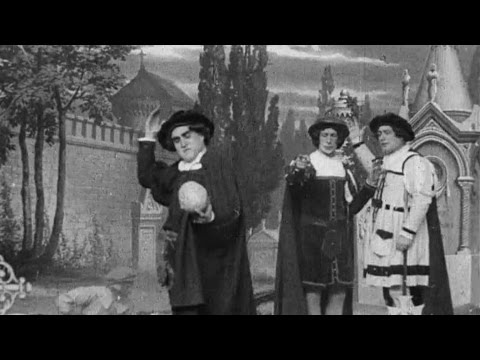
What did Hamlet look like in 1910?  I’m not talking about the Sarah Bernhardt version (1900), although it’s awesome that we have that.

No, I’m talking about this Italian production, which at first confused the heck out of me until I realized that it is just a collection of scenes, and not the whole play:

How many scenes do you recognize? I see Hamlet enter, reading. I see crazy Ophelia with her flowers. The special effects for the ghost scenes are lovely!  Wonderful to get an example of how they were experimenting with the medium over a century ago. There’s not even any sound, but they’re making ghosts.  Awesome.

The YouTube description calls this an Italian production, so I was surprised to see a card that reads “Der Wahnsinn Der Ophelia,” which I’m gonna go ahead and guess is actually German. Google translate happily tells me it means, “The madness of Ophelia.”

I could sit and watch this all night.  They actually add a scene where Ophelia discovers the dead body of her father!  How cool is that, that even without any text to work with, they’re still open to the interpretation of adding new scenes?

I tried to get more details on who these people are, but would you believe that IMDB lists two different 1910 Hamlets?

Data Mining Shakespeare with Wolfram

I love finding stuff like this, it really bring out my inner geek.

The people over at Wolfram, who are perhaps best known these days as the acolytes in charge of the Wolfram Alpha search and research engine, have unleashed a tool to do word analysis on Shakespeare’s plays.  The sample make it pretty plain – they point to the MIT version of the text, then count words, then graph words. You’ve seen graphs like this often, I’m sure — how often are the words “love and death” used in Romeo and Juliet? What about darkness in Macbeth? Or blood?

The best part is that they didn’t just unleash a raw textual analyzer and say have at it like we’re all still college students looking for a thesis topic.  They’re crowd sourcing it.  They ask, “Could you think of data mining analysis or visualizations to apply to Shakespeare’s works?”


I bet we could! Who’s got ideas?

Sir Ian Just Released A Series of Shakespeare Apps. I Can Die Now.

I had to read this article several times before it sank in.

I saw the headline “Hear Sir Ian McKellen Read The Tempest” and I thought, “Oh cool, my favorite, I’ll bookmark that.”

Then in the picture he’s wearing a t-shirt that says “Heuristic Tempest” and I thought, “That’s odd, I’d like more information about that.”

Then he tweeted, “I hope you’ll enjoy our new Shakespeare app.”

So then I started reading again from the beginning and saw, ” Sir Ian McKellen is launching a series of apps that will allow users to listen to various actors read the Bard’s plays aloud.”

SHUT UP AND TAKE MY MONEY.

SHUT UP SHUT UP SHUT UP.

TAKE ALL OF IT.

GIVE ME, QUOTH SHAKESPEARE GEEK.  GIVE ME NOW.

I’m intrigued. “Based on the premise that the plays are meant to be seen” is one phrase from one article, but “The app concentrates entirely on the language and is stripped of staging, sets, costumes, make-up, etc.”  Curiouser and curiouser!

UPDATE:  Here’s the link!  I think it’s iPad only now (definitely no Android).  Will report back after I’ve played with it.

What’s Angelo Doing There?

Ask anybody to start naming Shakespeare’s “best” villains and you’re going to round up the usual suspects: Iago, Claudius, Richard III, etc…

How long until you think about Goneril and Regan?  They don’t even get a full credit each on this list, they’re made to share.  Which is weird when you think about it, because they spend much of the play fighting and ultimately kill each other.  So it’s not like they’re working together (except in shunning their father).  Does Cornwall, the guy that does the actual eye gouging, even rate?  Nope.  What’s a guy gotta do to get some evil credit around here?

The inclusion of Angelo is interesting.  It’s not like they were trying to round out a list of 10 or something.  It’s always weird to associate comedies with true villains (though I do realize that M4M is a bit of a problem to classify).  I wouldn’t expect to see Don John on this list, so how does Angelo make it over, say, Cassius? Tybalt? Is there an “official” definition of villain that we’re supposed to use, like how the academy separates “lead” and “supporting” actors?