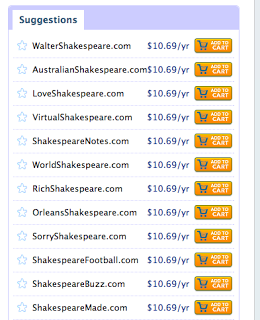
Who Needs a Shakespeare Domain?

No, not one of mine! 🙂
I was on one of the domain registration sites today for a different project and for kicks and giggles I just typed in “shakespeare”.  Of course www.shakespeare.com and all its variants were taken, but what I found interesting was the list of suggestions on the side.  Check it out!

Some of those look pretty good if somebody’s up for a project.  LoveShakespeare?  Virtual Shakespeare? ShakespeareNotes?    Personally I’ve already got too many projects and not enough time (as the above links will attest to), so I’m not rushing to do little more than add $$ to my hosting costs every year.
If you grab one (and plan to do something with it!) let me know!  I’d love to help drive traffic to the finished product.
UPDATE : I also noticed that while “ShakespeareDay.com” is taken (and on the auction block for over $2000!), “ShakespeareDay.org” is wide open.  So if somebody’d liked to camp on that and set it up as a home for the movement to change “Shakespeare’s Kind of Birthday But Definitely The Day He Died So We Just Tell People He Was Born and Died On The Same Day To Make It Easier Day” to “Shakespeare Day” in the hearts and minds of the people, you go right and and go for it, you know I’ll be the first one to sign the petition.

Wait, Is Richard "Selfish Gene" Dawkins a Shakespeare Denier?

Spotted the headline Richard Dawkins Criticizes Shakespeare for Lacking Elite Education this weekend and thought, “Aw man, here we go again.  And I liked Dawkins’ work, too.”  And by “liked” I mean, “Read The Selfish Gene in college.”  I have no personal experience with his well-known views on atheism.
Well, here’s the quote in question:

Sorry to be boringly predictable, but Shakespeare. Who are you? And how did a humble country boy like you become the greatest genius, and part creator, of our beloved English language. Might you have been even better if you’d studied at Oxford or Cambridge?

That’s it?  Hmmm.
The Atlantic Wire article I’m linking to goes on to say stuff like, “It remains unclear what Dawkins could have meant by ‘even better’.”  Really?  How unclear is that?  Are we arguing now that Shakespeare truly achieved perfection and that to even suggest that he could have been better is sin? Would he had blotted a thousand!
Seriously, though, the article is attacking Dawkins’ reference to Oxford (where he himself went) and the insinuation that Oxford or Cambridge alone would of course have made even Shakespeare that much better.
At least he doesn’t go off the deep end and suggest that without this education Shakespeare couldn’t have existed.  If anything this seems to me like a positive quote, doesn’t it?  Here you’ve got an Oxford-educated man who willingly admits that the “mystery” fascinates him, and he wants answers.  He’s spent his life with the belief that only those with elite education can change the world, and yet Shakespeare is the obvious exception to that rule, and Dawkins wants answers.
I suppose if you’re in a grumpy cynical mood you can read between the lines and argue that this is indeed an authorship attack, and that the sentence following the quote above could easily be, “Perhaps you weren’t a humble country boy after all, perhaps you did study at Oxford…”
What do you think, does Dawkins go into the Denier camp, or is he just being attacked for daring to approach the question?

Let’s Talk Cymbeline

[So, how was everybody’s summer? Sorry I haven’t been posting as much as I used to, many projects have pulled me in many directions that are not Shakespearean.  I shall try to return to a better pace now that the kids are back in school.]


Who’s excited about the new Cymbeline movie?  It’s getting primarily billed as Ethan Hawke’s project, and I know that when we hear Ethan Hawke we think Hamlet(2000), a movie I still haven’t been able to sit through.   But it appears young Mr. Hawke is quite the up and coming Shakespearean – not only did he tackle Macbeth, he documented his research for PBS’s Shakespeare Uncovered series.  And now Cymbeline.  Maybe he’s just doing it backwards?  Maybe he should have worked his way up to Hamlet? 🙂
Now let’s look at the supporting cast.  Ed Harris!  I love him in just the right supporting role.  Apollo 13 (“We’ve never lost an American in space, we’re sure as hell not gonna lose one on my watch! Failure is not an option.”)? The Truman Show (“Cue the sun.”)? The Rock (“You’ve been asked by an old friend.  You’re being ordered by a superior officer. Now you’re being given your last chance by a man with a gun.”)?  He always gets the best line in the movie, and nails it every time.
And how about John Leguizamo?  He’s got some Shakespeare under his belt, having playing Tybalt to Leo DiCaprio’s Romeo.  Whether you liked that movie or not, I think most people will agree that Leguizamo can bring the villain out whenever he needs to.
The funny thing is I know nothing about Cymbeline.  I know there’s a king, but that king is Ed Harris and is a relatively minor role.  So, rather than have me look it up on Wikipedia or Sparknotes, how about somebody tells us the story?  I’ll ask the same questions I skim for whenever I’m about to watch a play for the first time:
  • High level plot overview.  Everybody needs some plot.
  • Famous quotes or moments the play is known for?  I learned the importance of this when I saw As You Like It in the park.  The crowd was all noisy and buzzing, like crowds are, until Jaques boomed, “All the world’s a stage…” and it was like you could hear a pin drop.  As if the entire crowd in unison said, “Oh hey, I recognize that!” and started listening.
  • Important scenes / subject to interpretation that will make for interesting “Why did they do it that way?” discussion afterward.  Every production of every Shakespeare play is different, and that’s why we love them.  Once you’re an expert in any given play you can pick out every last detail – but when you’re seeing it for the first time you’re not going to have much to compare it against.  So we pick some scenes to stick in our memory.  For instance I once saw  a King Lear who actually bargained with the storm in his big scene, if you can believe it. I’ll never forget him cowering from the thunder while he gave his big speech as if he was complimenting nature on how big and powerful she was.
So who knows their Cymbeline?

Shakespeare Swifties #ShakespeareSwifties

Do people still remember “swifties”?  Taking its name from the old Tom Swift series of adventure books, a swiftie has Tom making a statement that’s described by the adverb that comes along for the ride, making for an awful (or, depending on where you sit, genius) pun.

Some examples?

“I’m just over here putting an edge on my new knife,” Tom said sharply

“Can you find the light switch? I can’t see a thing,” Tom said darkly.

Get the idea? Part of the fun is seeing how deep you can bury the pun, so a bunch of these you’re likely going to have to work at.

Both Bardfilm and Shakespeare Geek were surprised to realize that they’d never done this one.  There was some argument, some hair pulling, some kicking and some scratching, but the finished product was well worth it.  Without further ado, we give you …

Shakespeare Swifties

  • “I miss Banquo,” Macbeth said hauntedly.
  • “I know where Juliet is,” said Paris cryptically.
  • “Now what am I going to do with all these flowers Ophelia gave me?” thought Gertrude ruefully.
  • “This production of Winter’s Tale is never going to end,” Tom said unbearably.
  • “Don’t worry, Bottom, I can change you back,” said Oberon reassuringly.
  • “God sends a curst cow short horns; but to a cow too curst he sends none,” said Beatrice utterly.
  • “I wish I could kill King Edward, but I can’t,” said Richard, abashedly.
  • “What, you need another signature on my will?” asked Shakespeare resignedly.
  • “I am so angry that you wrecked that ship with all those people on it!” said Miranda tempestuously.
  • “I am thy father’s ghost,” said the figure transparently.
  • “What’s coming toward the castle?” asked Macbeth woodenly.
  • “Ten more sonnets will ruin it, this is the perfect amount of sonnets!” said Shakespeare grossly.
  • “Don’t worry, Miranda–none of the ships were lost at sea,” said Prospero recklessly.
  • “Wait—weren’t there two people attending Lady Macbeth?” asked Macbeth paradoxically.
  • “When I said I would die a bachelor, I did not think I should live till I were married,” Benedick said singly.
  • “The problem with Bottom the Weaver is deep in his subconscious,” said the literary critic acidly.
  • “I think I’ll put King Edward on my list of people who stand in my way to the throne,” said Richard markedly.
  • “Poor Tom’s a-cold,” said Tom chilly.
  • “My name is Cesario,” Viola said disguisedly.
  • “I don’t think I have enough melancholy bile,” said Hamlet humourlessly.
  • “Let’s have a brief, silent part before the play-within-the-play,” said Hamlet dumbly.
  • “Quick, Jack, hide in the laundry!” said Mistress Ford tidily.
  • “Have another beer,” said Titania assailingly.
  • “I’m invisible through most of the play, and I’m ok with it!” said Ariel spritely.
  • “I’ve finally been convinced that the Earl of Oxford wrote the works ascribed to Shakespeare” said Tom unwillingly.
  • “I get very upset when I see you look at other men,” Othello said smotheringly.
  • “Isn’t it a great day to pick flowers down by the river?” said Ophelia buoyantly.
  • (Or, if you prefer…)  “What do you mean my Uncle Ganymede is really my Aunt Rosalind?” asked Tom buoyantly.
  • “Yes, I suppose Lavinia is attractive,” Tom said off-handedly.
As with all of our lists, if you cleft this one in twain and threw away the worser half you’d be left with Bardfilm’s amazing and invaluable contributions to the cause.  Seriously, people, if you’re not following his blog and his twitter you’re missing out on, like, 51% of the good stuff.

Do You Recommend Shakespeare Movies?

Yesterday my boss told me that he’d watched the ending of Ralph Fiennes’ Coriolanus with his wife the previous night.  Apparently it was on one of the movie channels, or they were channel surfing or something, but the general gist was that he only saw the ending.

He then asked me whether he should take the time to watch the whole thing.

It’s a trickier question than you might first think.  I am careful in my Shakespeare recommendations.  I do not blindly say “ABSOLUTELY YES ALL MUST SEE ALL PLAYS AT ALL OPPORTUNITIES.”  On the contrary, I’m well aware that to the unitiated, sitting through a Shakespeare play can be a chore.

Here’s what I told him, first about Coriolanus and then about Shakespeare recommendations in general:

“Keep in mind that the ending is different from the source text, and this upset some people greatly.  If you don’t know the text that may not matter, but keep in mind that your expectations are now set for the movie, not for what Shakespeare wrote.  Having said that, I think the ending is the best part.  I love the way Coriolanus stands up to Aufidius at the end and hurls his ‘Boy!’ back in his face in legendary fashion.

“Whether you should watch the whole thing? That’s different.  See, I watch them to see different interpretations of my knowledge of the text.  I mean, I don’t know the text inside and out, but I do know enough to compare one version to another and the focus in on why they are different.  I have my scenes that I look for and pay close attention to.  Without that? For the casual movie goer who has no knowledge of the text?  Then I’m not really sure I recommend sitting through it. I think it will be difficult to follow.”

Is that sacrilege?  Even now writing it I feel bad, like I should go seek out the boss and say “I changed my mind.”

Note a couple things.  I’m not talking about live theatre.  I think the experience of live Shakespeare is a must see and I always recommend going.  But we’re talking about movies here, and I think that sitting on your couch with a remote control sitting through two hours of special effects and soundtrack and camera cuts is a different beast.

Second, I would not say the same about Romeo and Juliet or Hamlet.  I think that both those places are so deeply ingrained in popular culture that even if you’ve never read them, you’ve got a significant head start on what’s going on.  But Coriolanus?  That’s a different story.  If somebody hasn’t explained it to you up front (or, even better, while you’re watching it), I think it’s a harder sell.

Thoughts?  Somebody with no knowledge of play X asks whether he should watch a movie of play X.  What do you say?