Assist In This Shakespearean Scavenger Hunt!

Jill writes in with a request I’d love to see my loyal readers help fulfill. She’s part of a scavenger hunt team who is tasked with the following:

I must go to a fast food restaurant and express these things:
1) greet the attendant at the drive-through
2) explain how hungry I am
3) tell and what I want to eat and how good it will make me feel.
I must speak as the Bard wrote. That is where I need you, kind sir. The more creative and funnier it is, the better. Feel free to go wild. I guess I would order a bucket of wings and thighs, mashed potatoes, and a diet coke. If there is an order that would make things easier, please feel free.

Sounds like fun!  Who wants to help her out?  They have until Sunday (the 18th?) to complete the task.

So, Then, You’re Saying That Shakespeare is Universal?

I can’t help but point out the timing on this one.  It seems that the Globe is taking Hamlet to every country in the world, in celebration of Shakespeare’s 450th birthday.

You think they’ll do something crazy, like market a t-shirt with “To be or not to be” translated into a whole bunch of languages? 🙂

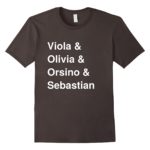
Hey Globe, if you’re reading this, I’ve got a ready-made t-shirt all set for you!

The earth has music for those who listen.

Also “The earth has music for those who will listen,” “The earth has its music for those who listen,” and so on.

This one is easily mistaken as Shakespeare because the words remind us of “If music be the food of love play on” while the sentiment closely echoes Caliban’s “Be not afeard, the isle is full of noises, sounds and sweet airs, that give delight and hurt not.”


However, this one is George Santayana:

“The earth has its music for those who will listen,
Its bright variations forever abound;
With all the wonders that God has bequeathed us,
There is nothing that thrills like the magic of sound.”

Thanks to “That’s Not Shakespeare,” who looks to be as upset about misattributed Shakespeare as I am 🙂

UPDATED September 8, 2014: I was asked to provide a citation that this is Santayana. And you know what? I can’t. It’s quite possible that this quote has fallen victim to that same logic that gets us so many “Not by Shakespeare” quotes, where you find a couple of blogs saying something so it must be true.  I can’t speak for the entirety of Santayana’s work but I can safely say that it’s definitely not in Shakespeare’s work. If anybody can cite exactly where it occurs, we’d all be very grateful!

UPDATED August 2018:  Several commenters below point us to Reginald Holmes in his collection “Fireside Fancies”.  Have we finally solved it??

Explore more posts in the Not by Shakespeare category.

“This Did Something To Me” : Authors’ Favorite First Lines

When I see articles like The Atlantic’s “‘This Did Something Powerful to Me’: Authors’ Favorite First Lines of Books,” the first thing I think is, of course, “Anybody going to mention Shakespeare?”

Yup.  I don’t know who Lydia Davis is but she’s my new best pal because not only does she bring Shakespeare into a discussion where no less than 3 others went with “Call me Ishmael”, she goes where you wouldn’t expect:

That time of year thou mayst in me behold
When yellow leaves, or none, or few, do hang
Upon those boughs which shake against the cold,
Bare ruin’d choirs, where late the sweet birds sang.

That’s the opening to Sonnet 73, in case you don’t recognize it.  How about that?  38 or so plays to choose from and 153 other sonnets, and she reaches right into the middle of the pack to pluck that one.

But wait, there’s more!  Look at what she says about why that choice:  “the interesting order of the second line.”  I love how specific she gets.  I assume she’s referring to the “none, or few” bit rather than “few, or none”.  It’s a good point.  Had Shakespeare said “leaves, or few, or none” there’s a linear (and therefore anticipated) sequence there.  But to go the other way like he did makes it more random and unpredictable.  Some trees will still have their leaves. Some will have none, some will have few.  There’s no pattern.

What do you think?  Even if you kept it to the realm of Shakespeare and somebody asked you to name your favorite first line, what would your choice be?

I quite like Sonnet 104’s “To me fair friend you never can be old,” though I’m not sure I’d so quickly throw it out there as my absolute favorite. Have to think more about it.