
Inside The Vault #2 : Quartos Quartos Quartos

So there we are in the vault.  Georgianna goes digging for something to show us next, and Garland tells me, “Around the corner are the Quartos.”  I take my oldest, and we head around the corner.  Yes, you could say that there are Quartos.

Since we were just looking and no one was explaining the significance of these particular volumes, I can’t really say what we are looking at.  I highly doubt that “original” (or close to it) editions are shoved on top of each other like that.  If you look carefully you will see a Romeo and Juliet dated 1599, however.  That’s pretty cool!  These are almost certainly not original bindings, so maybe it’s not such a big deal to have them rubbing up against each other.  It’s what’s on the inside that counts. Don’t judge a quarto by its cover!
Oh, and Bardfilm also suggested that I ask about the only known Q1 edition of Titus Andronicus in existence.  There’s a big Titus on the far right end of that first picture. Think that’s it?
 
I had no idea they were so small.  Well, I mean, I knew they were small, but after having seen the Folios all spaced out on their own shelves with nothing else surrounding, to turn the corner and see all these tiny books at once.
 
“You can’t be back there!” I hear Georgianna call.  “Sorry, it’s the rules, I’m not back there with you.  That’s actually why there’s two of us here, Garland is my backup.”
 
“Yes,” says Garland, “Technically I’m supposed to tackle you if you make a break for it.”
 
What’s funny is that I don’t know if this is really a rule, or if they didn’t appreciate my sense of humor.  See, in arranging this visit I was going back and forth over email with Garland, and conferring with Bardfilm (who has been to Folger) on what I should see.  What he jokingly suggested, and what I jokingly wrote back to Garland, was

Oh, and @Bardfilm said you’ve got Quartos just lying around and asked me to grab him one on the way out. 🙂

Now it all makes sense!The trip continues…
 

Shakespeare Under Water

Dr. Carl Atkins, a regular contributor to this site, sent me a link to this amusing article that he was sure I would not have seen.  What kind of article do you get when you’re friends with a legit medical doctor who is also an author of Shakespeare books?

Why, an article from one of his medical journals, of course.  About drownings in Shakespeare.

Starting with the story of 5yr old Jane Shaxspere (who may have been the inspiration for Ophelia?) the article moves on through Twelfth Night, The Tempest, Richard III, Merchant of Venice and even King John, all of which demonstrate their own variations on drowning, falling, submerging, and the fear of these things.  Just how prevalent was drowning in Shakespeare’s day? Was it the sort of thing where you woke up in the morning and thought, “I hope I don’t drown today!”

This posting marathon, in celebration of Shakespeare Day, is brought to you by nothing but my time, my resources, and my love for the subject. While we’ll always be the original Shakespeare blog, it takes a significant amount of effort to make us the best in the digital universe.  If you’ve not yet seen how you can show your support, now’s a great opportunity.  If you’ve already done so, thanks very much!

Inside The Vault #1 : Folios Folios Folios

Through a bank vault door, down a haunted elevator, and we were there.  Led by Georgianna and backed up by Garland we made our way into what appeared to be another average library room.  Shelf after shelf of books.  A table that runs the length of the room, on which several books are strewn about.

“Back there are the Folios,” Georgianna says.

There, along the back wall of the room and around a corner, is a wall of books, all laying flat.  Various colors, sizes and bindings.  First Folios.  I was there.

As Bard as my witness I had an honest to goodness weak in the knees moment.  I grabbed the shoulders of whichever child I’d been leading into the room a little tighter. My eyes widened. My smile widened.  I whipped my head around to look at Garland, in what I can only hope was the wordless “Oh My God I’m Actually Here” face I was attempting, and then whipped back around to look at my wife with the pure and utter bliss I had in that moment.  Center of the universe.

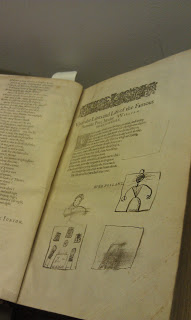
Georgianna had chosen a particular Folio for us to look at – #78.  Why?


This particular Folio has a number of child’s drawings throughout.  I love it.  I love the idea that all 82 of their copies has its own individual story.  Also shows that my tour guides knew a little something about how to keep children occupied, always showing them things that children would find interesting (not something you might expect in a Shakespeare research center!) and keeping them in the conversation.

And this was just the first of many memorable moments.  To be continued….

Shakespeare and the Presidents : Thomas Jefferson

Next up in our series comes Thomas Jefferson (as always, brought to us by Folger Shakespeare Library’s Shakespeare in American Life series).

Jefferson sounds like my kind of guy:

Still, like John Adams, Jefferson usually treated Shakespeare’s plays as something to be read. In one letter, he recommended Shakespeare for reading in the evening, explaining that “Shakespeare must be singled out by one who wishes to learn the full powers of the English language.” When a friend asked him to recommend books to buy, Jefferson encouraged him to include some works of fiction, like Shakespeare’s plays, as a guide to virtue, arguing that “a lively and lasting sense of filial duty is more effectually impressed on the mind of a son or daughter by reading King Lear, than by all the dry volumes of ethics, and divinity that were ever written.”

Did everybody catch that “something to be read?”  I’m just sayin.

Seriously, though, I love how that passage nails what I’ve been trying to say for years — if you want to know what it means to be a human, look to what Shakespeare put on the stage.

I noted in a previous post that, when Adams and Jefferson went to visit Shakespeare’s birthplace, Adams was disappointed. What did Jefferson think?  He “noted the costs of going there, including the entry fees.”  Which lead to a later biographer imagining “Jefferson’s teeth obviously grating” as he jotted down the fees.

That’s interesting to me.  You mean to tell me that in 1786 they were already charging fees to visit the birthplace of Shakespeare, as a tourist attraction? I had no idea.  I suppose we can trace it directly back to the influence of David Garrick, a few decades before this, who made Shakespeare such an attraction?

This posting marathon, in celebration of Shakespeare Day, is brought to you by nothing but my time, my resources, and my love for the subject. While we’ll always be the original Shakespeare blog, it takes a significant amount of effort to make us the best in the digital universe.  If you’ve not yet seen how you can show your support, now’s a great opportunity.  If you’ve already done so, thanks very much!

Shakespeare and the Presidents : George Washington

Since I was vacationing in Washington D.C, Home of the Presidents, I thought it would be fun to go hunting for Shakespeare connections.

Washington, as you could well imagine, was all over the place.  We spent our Friday at Mt. Vernon, as a matter of fact.  Toured his house, saw his study.  Spoke with a lady doing her best Martha impression. No Shakespeare to be found at all.
Disappointing, really, especially given how much we know that Lincoln did with Shakespeare.
I went googling when I got back to the hotel, and low and behold I found Folger’s Shakespeare in American Life series, so I’ll just let them do the talking:

 As president, Washington lived in Philadelphia, the nation’s temporary capital. There he once hosted an amateur Shakespeare production, probably in the winter of 1790. William Duer, assistant to the treasury secretary, wrote that Duer “had the honor of appearing before him as one of the dramatis personae in the tragedy of Julius Caesar… in the garret of the Presidential mansion, wherein before the magnates of the land and the elite of the city, I performed the part of Brutus to the Cassius of my old school-fellow, Washington Custis.”

There’s also record of his attendance at a Hamlet, and I believe a Tempest as well.  Not too much of a connection with the father of my country.

This posting marathon, in celebration of Shakespeare Day, is brought to you by nothing but my time, my resources, and my love for the subject. While we’ll always be the original Shakespeare blog, it takes a significant amount of effort to make us the best in the digital universe.  If you’ve not yet seen how you can show your support, now’s a great opportunity.  If you’ve already done so, thanks very much!