
When comparing Shakespeare’s body of work to Robert De Niro’s (“frayed at both edges”) I failed to account for a particular factor that Frank Skinner points out in his comparison to Michael Jackson: Once the artist is dead, our attitude toward his work changes. http://www.timesonline.co.uk/tol/comment/columnists/frank_skinner/article7067745.ece So it is with Cardenio, or a new Michael Jackson CD, or a new Dr. Seuss book or Frank Herbert or Robert Heinlein, or a new John Hughes movie. When a creator of things we like is taken from us, we’re sad because something in our brain says, “No more stuff from that person.” So then we hear that there might still be more stuff and we’re all, “Hurray! More stuff!” We are so excited, in fact, that we are more willing to overlook the obvious (which kinda gets back to my point) – there may be a reason why this “lost” material was lost to begin with. Maybe it’s just not any good. Maybe the creator never intended for it to be produced. Maybe it wasn’t finished. An even worse fate that the publishing of unpublished work is when somebody continues it for you. We are so desperate for that new work that, when we hear it is unfinished and therefore we can’t have it, somebody steps up and says, “I’ll finish it!” At this point it’s easy to be torn, because one side of your brain says “Hurray, I get more stuff after all!” but the other side is still able to say, “Hey wait a second, Eoin Colfer, you’re no Douglas Adams !” But still, partial new content is better than nothing, right? Maybe? I expect this is where Cardenio ends up. Assuming it is real, who knows what state it was in when Theobald got his hands on it? He “punched it up” a bit. It appears now that Brean Hammond and the folks at Arden have done the same thing. So no, it’s not like somebody opened up a desk drawer and found a complete script for “Cardenio, by William Shakespeare ” sitting there waiting for the world to see. But we knew that was never going to happen. Heck, we don’t have *any* of the plays in that sort of form. If it’s legit, this is really the closest we’d ever come to a “new” Shakespeare play.
Author: duane
How'd you get here? This page is boring. Did you find the easter egg yet? (Click on that banner over my head!)
Yay for Being Right
Just to complete a thought from yesterday ..
P.S I hope it turns out that Geoffrey Rush’s lucky charm is the Daffy Duck, I like the idea of Daffy hanging out on the set of Shakespeare in Love.
Today I get to see the answers, and I was right? Geoffrey Rush : Daffy Duck figurine
Cate Blanchett : elf ears
Robin Williams : ivory trinket
Meat Loaf : two stuffed bears
Sharon Stone : crystal This post has nothing to do with Shakespeare, I just felt obliged to close that loop from yesterday’s post.
3 R’s : Readin’,’Riting and … Regicide???
My 5yr old needs to work on her letter formation. We’ve been encouraging her to copy sentences, monk-like, to practice word formation, spacing, punctuation and so on (as opposed to just writing the same letter repeated over and over). Hmmm…. I need something that my daughter can work on copying, a short sequence of short words. Whatever shall we pick? No bonus points awarded for guessing the answer to this most obvious of questions:  🙂 This is actually the second copy that she did. The first, where I sat next to her and went over every letter, was accidentally thrown out. I said “Can you make me another one?” and this is the version I got, without a single bit of help from any grown ups. I think it looks even better. The story gets even better when you imagine the scene in my kitchen. My wife and I are cleaning up after dinner, my 5yr old is at work on her letters, repeating to herself “To be, or not to be.” Her 3yr old brother wanders in, hears her and says, “To be or not to be? That is the question.” Love it! UPDATE : You know what? It’s only just now, some 8 hours after getting this, that I notice the extra “to” in there. I love it even more.
Does Memorizing Do More Harm Than Good?
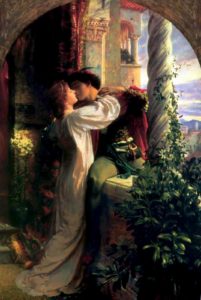 I’m not talking about actors who memorize as part of their job, or geeks who memorize just by experiencing the same passages over and over again. I’m talking about the legions of school-age children who stop by, having been tasked with memorizing the balcony scene or a sonnet or even a passage of their choice, just for the sake of memorizing it.
As I work my way through Playing Shakespeare I’m becoming a convert to the “there are clues in the text about how Shakespeare wanted you to play it” school. Why is this word emphasized while this one is not? Why is there a comma here, or a line break? When do we breathe, and what does that mean? I wonder, outside of theatre school, does any teacher bother mentioning any of that to the students when assign the memorize assignment? Or, to the hapless pupil, is it all just a stream of words on the page?
What I fear is that even after memorizing a passage, if you asked most students what it means they’d say “I have no idea.” Maybe, hopefully, I’m wrong. But I know that I listen to my children learn how to read and it’s very important to work on the comprehension part, because it is not just a given. It is quite possible to read a stream of words and then come to the end with no understanding at all of what happened. I can totally see that happening with Shakespeare.
So instead, what if we made students act it out? What if instead of reciting the balcony scene just to prove you can, what if your homework was to actually become Romeo and deliver the speech as he did? To pay attention to the stresses and pauses, maybe not as deeply as a professional actor might, but enough to get an idea for how you might play the character? Maybe Romeo is still the overdramatic boy from the earlier scenes, tripping over himself to find the right phrase. Maybe he’s impatient (read: horny) that he can’t just be with Juliet right now. Maybe angry, that he’s fallen in love with his enemy? I don’t expect the performances would be anything to write home about. But I bet that if you gave those kids a quiz about what’s going on in that scene, the discussion would be far more interesting.
Thoughts? Where my teachers at? Am I projecting a memory from 20 years ago of how this stuff used to be taught, and nobody’s doing that anymore? Are we all about the performance now? Getting the words up and off the page?
Forget Catholic, Shakespeare Was A Creationist!
I just stumbled across something which in context is perfectly obvious, but still it made me laugh. From As You Like It, Act IV, Scene 1: ROSALIND
No, faith, die by attorney. The poor world is
almost six thousand years old, and in all this time
there was not any man died in his own person,
videlicit, in a love-cause. Troilus had his brains
dashed out with a Grecian club; yet he did what he
could to die before, and he is one of the patterns
of love. Leander, he would have lived many a fair
year, though Hero had turned nun, if it had not been
for a hot midsummer night; for, good youth, he went
but forth to wash him in the Hellespont and being
taken with the cramp was drowned and the foolish
coroners of that age found it was ‘Hero of Sestos.’
But these are all lies: men have died from time to
time and worms have eaten them, but not for love.
I say it’s obvious in context because Mr. Shakespeare certainly didn’t have the benefit of modern science, evolution and all that good stuff to work with. He’s got Rosalind pretty much quoting the Bible on this point, best I can tell. I just found it funny. If anybody today tried to argue that the world is six thousand years old (“almost”, at that!) I wouldn’t have much more for them than a sad sigh and directions to the nearest elementary school science classroom, whether they were vice presidential material or not. So naturally when our beloved Mr. S says it, it makes you pause and say “Wait, what?” Wondering if I can get the Creationists to claim Shakespeare as one of their own? 🙂