
King Lear : Lebanon, NH

So today, Kerry and I drove 100 miles (each way!) to go see a performance of King Lear.  

I’d never seen an actual production of the play – I’ve certainly read it and read about it, and in college, I had a movie version that I honestly can’t remember watching through to completion.  But to repeat a phrase I found myself saying to friends and coworkers for the past month, “But it’s King Lear for God’s sake!”  How could I miss that?

Having never seen a production before, I have no frame of reference to really explain what I saw.  The King was portrayed as very….frail?  Downright skeletal, really.  A very gaunt old man.  Trembled quite badly.  I’m not sure that’s what I expected.  I thought that there would be flashes of a true king (particularly when he was angry), but really, he was pretty much a very old and weak man from the very first scene.  When he did get angry, it was more or less “indignant”, if that makes sense. 

Let me put it as a question.  The famous quote, “Blow, winds, and crack your cheeks!”…how is it typically portrayed?  I always thought such a line would be strong, forceful, and defiant.  What I got was….well, bargaining.  “Go ahead and blow, wind.  Nice wind.”  That sort of thing. I was much more impressed with the acting of Gloucester, Burgundy, Kent, and Edgar.  Those four, in particular, were not afraid to put a little energy (and volume!) into their performance.  You knew when they were angry or sad.  The actor doing Edgar, I thought, did a particularly fine job of conveying emotion via facial expressions.
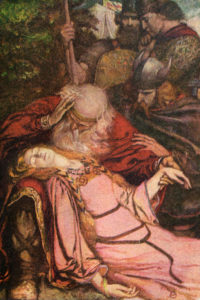
At over 3 hours, it was longer than I expected, but maybe that’s my fault.  I think the audience was a little desperate for a laugh – during the very final scene when Edgar announces that Edmund is dead and Burgundy says, “That is a mere trifle to us now” (or something similar to that), that was actually one of the bigger laughs of the night.  During the final scene of a great Shakespearean tragedy.  Hmmmm. I was trying to listen closely to Lear’s last words.  Nobody was making much of an effort to project to the back row, so when he whispered, you practically had to read his lips.  I was watching for references to a feather but heard none.  I did hear “Look on her, look, her lips, look there!” and I could swear one of the lines was “Her lips move”, but that’s not in my copy of the script so I’m not sure if I heard it wrong. 

Somebody tell me – does Lear die thinking that Cordelia is still alive, or merely wishing that she were?  Or is that dependent on how the last line is played? I know that Rosenbaum had much to say on the different versions, but I don’t have the time right now to dig through that audio interview to find the actual comments (and my book is not at hand). All in all I’m glad I saw the play, because now I have a baseline from which to look at other Lears.   

Casting for Boston Common 'Dream

http://www.playbill.com/news/article/108994.html As I’ve mentioned before, I’m not exactly thrilled that my local free Shakespeare in the Park is doing Midsummer, a play that I’ve seen almost as many times as I’ve seen Hamlet.  Don’t get me wrong, all Shakespeare is good Shakespeare, and “free Shakespeare in the park” might darned well be 5 of the most beautiful words in the English language.  But come on, the man wrote a good 38 plays or more, why do we have to keep doing the same ones over and over again? How about a nice Anthony and Cleopatra?  Never actually seen that one live, and it’s one of the “big ones”. Anyway, the linked Playbill article shows all the casting information, in case anybody is up on their local theatre talent and recognizes any names.

Can You Be 42 and Play Romeo?

http://www.kansascity.com/entertainment/performing_arts/story/151113.html I like this article for not just commenting on the respective ages of Romeo (around 17) and Juliet (13) and how you have to cast those roles relative to the actors’ ages, but for going into a pretty cool history about how other famous actors have played the roles. Basil Rathbone?  42 when he played Romeo. Orson Welles was a 19yr old Tybalt, which the article comments “must have looked a little out of place.” Norma Shearer was a 34yr old Juliet, alongside John Barrymore’s 54yr old Mercutio. But who’s the goofball quoted near the end who says that some people might call Romeo and Juliet one of the “lesser” plays?  It’s no King Lear, but it’s no Timon of Athens, either, people.

Meant To Be Performed, Not Read? Nonsense.

For the umpteenth time today I saw that old cliche about how Shakespeare’s works were intended to be performed, not read. I don’t, quite frankly, care a whit was Shakespeare intended.  He’s long dead.  So, newsflash.  Every performance of Shakespeare does not imply that he intended it to be performed in that particular way. Do we think that he intended Oberon to speak in Klingon?  Or Lady Macbeth to drag Macbeth across the stage by his ear?  Or Hamlet to jump in a child’s wading pool, complete with goggles and swim fins?  Yes, I’ve seen productions that included all those things.  When you see a performance of Shakespeare you are separating yourself from the original (what Shakespeare did actually mean, to the best of our ability to figure it out) by a few dozen other people’s opinions – the director, the actors, the costume designers, the set builders, the production company…  At any time, any of them could make a decision that would have Shakespeare spinning in his grave.  You could see ten productions of A Midsummer Night’s Dream, each substantially different from the rest, and have no closer clue about what Shakespeare intended for you to take away from it. That is unless, of course, you read the play.  Even then you’ll have no idea what Shakespeare meant, but at least you’ll be able to make up your own mind.  Then, go see it.