Naught Without Mustard

Sometimes you find yourself in those situations that make you feel like more of a geek than usual.

A reddit user had asked about Touchstone in As You Like It and I was going through some quotes when I found this:

Of a certain knight that swore by his honour they
were good pancakes and swore by his honour the
mustard was naught: now I’ll stand to it, the
pancakes were naught and the mustard was good, and
yet was not the knight forsworn.

Hmmm, that rang  a bell. I immediately thought of, “Not without mustard,” and had to go do some research.

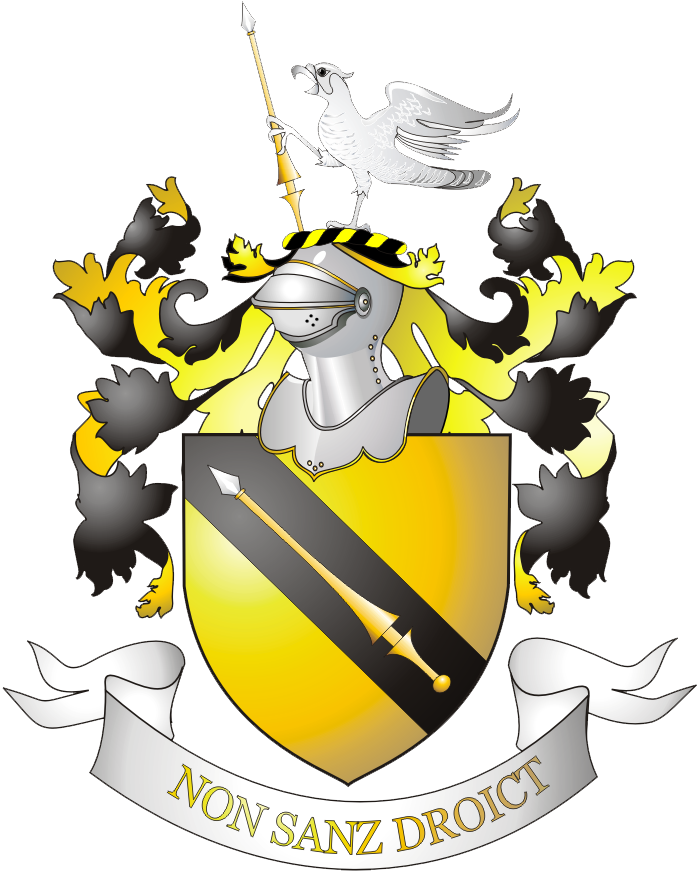
For those that don’t get it, “Not without mustard” is a line from Ben Jonson’s Every Man out of His Humor, and is thought by some to be a joke reference to the coat of arms that Shakespeare had recently acquired for himself bearing the motto Non Sans Droit, or, “Not Without Right.”


So, then, is Touchstone’s line a response to Jonson’s? It’s unlikely we’d ever truly know for sure, but it can be fun to pursue the line of reasoning.

Dating the plays is already notoriously tricky, not to mention answering the question of who knew what when.  Would Shakespeare have had to see a performance of Jonson’s play to know the line, or would they have been sharing scripts while it was being written?

Jonson’s play was acted by the Lord Chamberlain’s Men in 1599, and it is technically a sequel to the 1598 Every Man in His Humour, so we have a pretty small window to work with there.

But what about As You Like It?  The Wikipedia entry reads, “believed to have been written in 1599 and first published in the First Folio, 1623.” Even if we don’t always trust Wikipedia, the Royal Shakespeare Company page says, “Typically dated late 1599.”

Not Without Right
Not without mustard.

Looks like it’s certainly possible.  After some cursory research I called in Bardfilm, who is much better at this sort of thing than I, and has access to all the best resources. He tells me that the Arden edition offers no notes on the connection, but then goes on to find this amusingly “relevant” article from an author named Mustard.

So who knows.  Either we’ve uncovered a joke between playwrights that nobody else has thought to mention, or it’s just a coincidence.  This is why we’re geeks about this stuff!


Small Shakespeare World

So, I’m trying to get the family to Disney World this year.  We’ve been in the past, but it’s a whole thing where my girls were old enough to remember it but the boy wasn’t, so we’d like to get back for a trip where it’s more about him and he’s not just the one being pushed around in a stroller.
Mickey MouseBut I digress.  Helping us set up the trip is a travel agent who turns out to be a friend of my in-laws.  In fact I may even have met her at a random gathering at one point or another, but it’s not like we see or speak regularly.
Anyway, the other day during the snow storm I’m working from home when my daughter comes into my office and says, “Did you know about a new teen Shakespeare program coming to town?”

“No,” I say, “And I’m surprised I didn’t hear about it sooner? Where did you hear this, what’s the details? Wait, are you talking about Rebel Shakespeare?”

“I think that was the name.”

“Honey you’ve been to a number of their shows.  They’re not new.”

I’ve been writing about Rebel Shakespeare for years. They’re a children’s Shakespeare group from a couple of towns over that’s been running for something like thirty years. We try to get to their shows when we can, and I even helped organize getting them to do a show in my own town.

Unfortunately this year their founder had to retire, and for a little while we thought they were done. But a bunch of parents and former participants have taken it over, and Rebel Shakespeare lives again!  So I figured that’s what my daughter was talking about, that one of their new marketing links.

Then she tells me that our new travel agent, who my wife is friends with on Facebook, posted it.

It just got interesting.

It turns out that her son has been part of that group for the last five years!  I may even have seen him perform, we’d have to sit down and compare notes.

I told them all about us (“Next time you’re with them, if the name Shakespeare Geek comes up, they’re talking about me.”) and they seemed quite excited to join our little family. In fact, they may be reading right now.  So, hi there 🙂 Welcome!

O small new world, that has such people in it!


Rough, Rug Headed Bunch o’ Forgers

I didn’t have time to put together a real piece on Shakespeare for St. Patrick’s Day, so I thought we’d do more of a smorgasbord 🙂

Old Castle, but not Oldcastle.
An Old Castle, But Not An Oldcastle

When I went googling for Shakespeare and the Irish, I found that Shakespeare created the Irish stereotype. I also learned that Shakespeare apparently wrote a play called The History of Sir John Oldcastle, which was a new one on me.  That is the true name, of course, of Sir John Falstaff. But I don’t recall him having his own play.

But, according to the link, this is where Shakespeare refers to the Irish as “rough rug headed kerns,” whatever that means.  That line is actually in Richard II [II.i], so I’m not sure where the Oldcastle / Falstaff connection comes in.

For something completely different we have the William Henry Ireland, who was so set on discovering lost Shakespeare manuscripts that he just sat down and wrote a bunch of them himself.

Lastly, is Macmorris in Henry V really the only Irish character Shakespeare ever wrote?  I’ve never really looked into it.  And if that’s the case, why does he sound so much like Sean Connery, who is Scottish?

What ish my nation? Ish a villain,
and a bastard, and a knave, and a rascal. What ish
my nation? Who talks of my nation?

Where else does Ireland (or anything having to do with Ireland) show up in the works?  I could swear that there’s more crossover in King Lear but I haven’t gone and dug into it.

Happy St. Patrick’s Day, everybody!


What is Iago’s motive?

What is Iago's motive?

I first experienced Othello in high school. I remember the teacher explaining to us that Iago’s motive isn’t what we think it is. He may say, “I want revenge because Othello slept with my wife,” but that’s just his justification for his actions. The real reason is that he’s the embodiment of pure evil, and that’s what makes him such a scary character. He has no reason for doing the things that he does.

It makes sense, and I like that interpretation. It makes Iago more interesting. I’ve never really questioned it.

When did this become the accepted interpretation?  Iago gives us a motive:

I hate the Moor:
And it is thought abroad, that ‘twixt my sheets
He has done my office: I know not if’t be true;
But I, for mere suspicion in that kind,
Will do as if for surety.

He does say, “I don’t even care if it’s true,” which I suppose is evidence, but it could just as easily mean that Iago is the jealous type and doesn’t even want the rumor circulating that he’s a cuckold. He’ll later go on to imply that Cassio slept with his wife as well (“I fear Cassio with my night-cap too”) so maybe that’s just his thing.

Then there’s the racism angle.  Iago goes right for the racist epithets when he’s trying to get Desdemona’s father upset:

Even now, now, very now, an old black ram
Is topping your white ewe.

the devil will make a grandsire of you:

you’ll have your daughter covered with a Barbary horse;
you’ll have your nephews neigh to you; you’ll have
coursers for cousins and gennets for germans.

(I’ve always attributed the “thick lips” comment to Iago as well, but that’s actually Roderigo.)

So is Iago racist? Is that why he hates Othello, because of the color of his skin? Or, again, is he just saying these things because he knows they’ll drive Brabantio crazy?

I get how we can read between the lines and paint a picture of an Iago who says and does exactly what he needs to get what he wants without ever actually explaining why he wants it. I’m wondering when that became the standard interpretation of Iago’s motive and whether there are other clues in the text to support it.  Why don’t we just say Iago is paranoid and call it a day? How come we watch the play and say, “Whoa, that dude is evil” instead of “Whoa, that dude is nuts”?

Why is Egeus Angry With His Daughter?

Question: Why is Egeus angry with his daughter Hermia?

A Midsummer Night’s Dream opens with Theseus, Duke of Athens, planning his wedding to Hippolyta. Shakespeare actually lifted this part of the story straight out of Greek mythology, if you’re interested. But that doesn’t answer the question.

Enter Egeus, and he does not look happy. I’ve seen productions where he marches Lysander, Demetrius, Hermia and Helena in at the point of his shotgun. And he says…

Full of vexation come I, with complaint
Against my child, my daughter Hermia.
Stand forth, Demetrius. My noble lord,
This man hath my consent to marry her.
Stand forth, Lysander: and my gracious duke,
This man hath bewitch’d the bosom of my child;
Thou, thou, Lysander, thou hast given her rhymes,
And interchanged love-tokens with my child:
Thou hast by moonlight at her window sung,
With feigning voice verses of feigning love,
And stolen the impression of her fantasy
With bracelets of thy hair, rings, gawds, conceits,
Knacks, trifles, nosegays, sweetmeats, messengers
Of strong prevailment in unharden’d youth:
With cunning hast thou filch’d my daughter’s heart,
Turn’d her obedience, which is due to me,
To stubborn harshness: and, my gracious duke,
Be it so she; will not here before your grace
Consent to marry with Demetrius,
I beg the ancient privilege of Athens,
As she is mine, I may dispose of her:
Which shall be either to this gentleman
Or to her death, according to our law
Immediately provided in that case.

What’s it all mean?  If you want the short answer, he’s saying, “I want my daughter Hermia to marry Demetrius, and if she won’t, then I want her executed.”

Yes, this comedy opens up with a father threatening to kill his daughter.

The longer version goes a little something like this (but ends the same way):  Lysander is the boy that Hermia actually wants to marry, but Egeus doesn’t blame her, he blames Lysander.  Lysander has “bewitched” his child by showering her with gifts, singing love songs at her window, that sort of thing. Otherwise she would know better than to disobey the will of her father.

Egeus isn’t the kind of father who is going to negotiate with his child. In the old days if you were a teenage boy acting up, your parents my threaten to enlist you in the army.  I only had a brother so I’m not sure what parents threatened teenage girls with, putting them in a nunnery?  Egeus knows the law, however, and goes straight to “dispose of her” if she doesn’t do what he wants.

I beg the ancient privilege of AthensThe good news is that Theseus has a calmer head on his shoulders, and after listening to Hermia’s side of the story offers her another alternative — a nunnery.  But luckily this is a comedy and everything works out in the end, everybody marries the right person, nobody ends up dead or locked away.

An interesting question to consider is whether Egeus actually meant to go through with his threat.  Plenty of old school parents drove their kids to the recruitment center and then turned around to come home. What would he have done if Theseus said, “Absolutely! Get the axe, we’ll have her head right now.” If you prefer your comedies without such a dark edge, you can imagine Hermia’s home life with a father that threatens her with the ancient privilege of Athens at the slightest infraction.  “Hermia, is dinner ready yet? I swear, I’ll dispose of you!  I mean it this time!”


Having been around for a dozen years at this point, the site attracts a good deal of traffic on the subject of Shakespeare. Much of it comes in the form of questions about the plays. Is this students looking for answers to their homework? Probably. But if they’re going to get the answers anyway I’d rather have them get the answer here, along with an explanation, in the hopes that we can make them interested in the topic.