The World Needs Shakespeare Baby Books

This blog started in 2005, when my first child was just barely three years old.  She’s now entering high school and has two younger siblings.  They’ve grown up with Shakespeare.  It goes without saying that if I could have found age appropriate Shakespeare material for them since birth, I would have been all over it.  True there was that short lived “Baby Einstein” series that had a “Baby Shakespeare” offering, but that was really just random poetry and nothing especially Shakespeare.

My kids are grown now and reading Shakespeare on their own, but I think about all the new and soon to be parents out there that are in the same situation that I was, that maybe want some Shakespeare stuff for baby, and aren’t finding it, but don’t have a great soapbox like I do 🙂

So that is the reason I’m very excited about this Kickstarter for Behowl the Moon,  a “board book” based on A Midsummer Night’s Dream and aimed at ages 0-3.

It’s important to get the word out about a project like this.  It’s not the kind of thing that goes straight to viral and makes its goal in half an hour.  At the time of this post they’re about 1/3rd of the way there, and I seriously hope that they make it.  I keep saying my kids are too old, but as my pal Bardfilm reminded me, one day I’ll need something to read to the grand babies.  Can you just imagine?  Passing our love of Shakespeare down two generations?  I just can’t even.

Projects like this seeing the light of day pave the way for other projects to do the same, and the world gets more Shakespeare for all ages, and before you know it there’s generations of geeklets growing up with love, rather than fear, of the greatest writer the world has ever known.  Who says you can’t change the world? Go big or go home.

I know that money’s a funny thing and not all of us have the kind of disposable income we wish we had.  But I also know that I’ve got well over ten thousand followers, all with friends and family and followers of their own, so take a moment and hit whatever version of the “share” button you prefer and keep spreading the word! Let’s push them over their goal and get this thing made!
Behowl the Moon: An Ageless Story from Shakespeare’s MSND

Review : Heuristic Shakespeare with Sir Ian McKellen

This review is all kinds of late, given that the app was released back in April for Shakespeare’s 400th anniversary. But an app this complex takes time to review properly, and.I wanted to do it justice. I really, really wanted to like this app. I just don’t, and it makes me sad.

I’ve imagined an app like Heuristic Shakespeare forever. A true multimedia creation that allows you to explore Shakespeare’s work in the way that works for you. Do you want to read, or watch video? Do you want it paraphrased and explained to you, or do you want the original text? How about both? How about actors like Sir Derek Jacobi and Sir Ian McKellen reading the text to you? I think that alone is part of the genius of this app. They’re not acting it, this is not a performance. They’re reading it like an audio book – but, this being an iPad, there’s still video. So it’s like the greatest Shakespeare talent of our generation is your own personal tutor, reading alongside you.

The problem that there is just oh so much packed into the app, that the interface is a mess. Half the time I find myself just pressing random buttons, never sure what comes up next. Sometimes I’ve got the text, sometimes I’ve got a character map telling me (with little thumbnail faces) which characters appear in which scenes. Oh, wait, now it’s a modern English translation. Hold on, now I’ve got essays and videos *about* the play.

I love that all of this stuff is in there. Imagine it, you’re on a particular scene you’ve always liked. First you have Sir Ian reading it to you. All the hard words are highlighted and footnoted so you an always pause and make sure you understand what’s being said. Do you understand what’s happening in the scene? Flip to the modern translation and get a quick refresher. How has this scene been performed? Click somewhere else and you get a historic list of famous performances, complete with images. If you’re into the academic side (maybe you’re doing your homework), there’s also a mode where you can learn all about character development and themes and all that fun stuff your teacher requires that sucks the life out of just sitting back and enjoying the show 🙂

I have a perfect example of my frustration. I’ve mentioned several times that our greatest Shakespeareans can read the text along with you, in video, right? I lost that. I cannot find it, and I want it. I can get audio, but my video has disappeared. I don’t know if it’s a bug in the app where it’s legitimately no longer showing me an option that it’s supposed to, or if I’m doing something wrong, or what. And I think my regular readers probably know that I’m not exactly a newbie at this stuff. If I can’t figure it out, something’s wrong.

[UPDATE – I found it!  The videos only appear when the app is in portrait mode.  I was reading in landscape.  Very happy to have found my videos again.  Of course, my iPad is in a keyboard case so it’s much more convenient to keep it in landscape but I guess I’ll live.]


This app needs to exist. It’s the closest I’ve ever seen to the ideal Shakespeare browser. If I recall it’s on the expensive side for a mobile app — did they want $5.99 for it? But if you told me that’s the “player” price and that I can add content for additional plays at a lower amount, it’s a no brainer.I just hope that they rethink large parts of the interface. I don’t know how, exactly, but it needs something. This is an app that even has a built in “What level of detail would you like?” feature so that it can be enjoyed by amateurs and scholars alike, so you’d think that a great amount of effort went into the design of the interface. Unfortunately I think it all went into trying to cram in as many trees as possible, and they lost track of the forest.


I Think I Resent This Article

I’ve often said “The mission is working” when random friends and coworkers bring me Shakespeare references.  I smile and think, “I’ve had an impact on this person’s life. If they didn’t know me, they would never have recognized and paid special attention to that Shakespeare.”

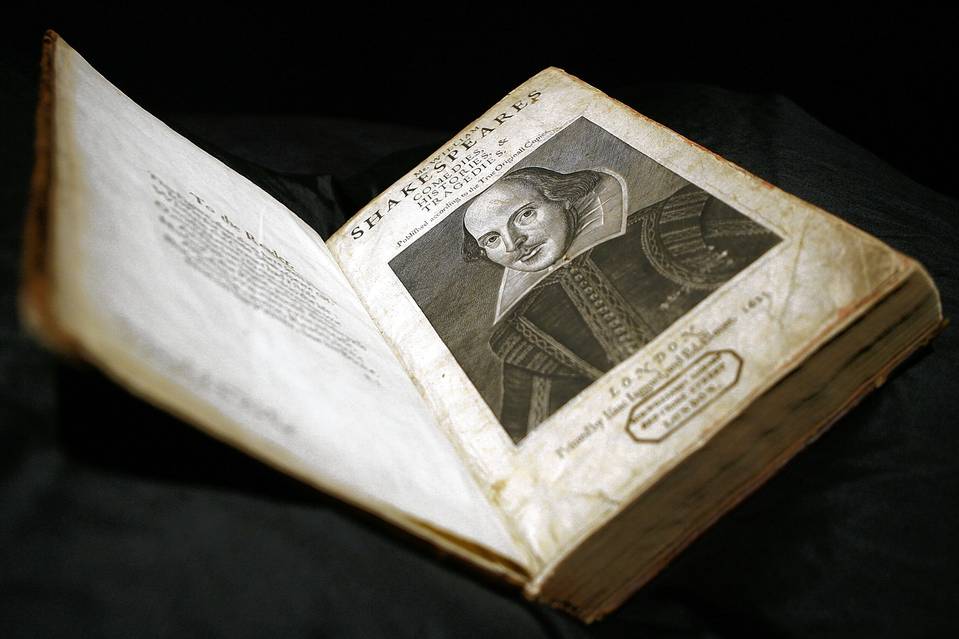
So it was when my coworker Bryce tapped on the aquarium-like glass wall of my cubicle this morning, holding up a copy of the Wall Street Journal emblazoned with a huge First Folio image.  I immediately waved him over.

Conspicuous Consumption for Shakespeare Junkies

I don’t know how to describe the tone of the article, but I don’t like it.  “It’s called one of the rarest books in the world,” it begins, “but it’s not – not by a longshot.”  After all, 233 copies exist and “more are always turning up.”

If you cringe at the term “bardolatry” you’re going to have a conniption over “bibliographic fetishization” that “can’t be explained in rational terms.” Because, you see, most modern editions of Shakespeare don’t even follow the First Folio, because it’s so full of printing errors. The theory that all the punctuation and spelling choices are Shakespearean directorial choices is a “dubious” one at best, you see, because Shakespeare died before the FF was published and no original manuscripts exist.

It goes on like that, questioning whether there’s any scholarly purpose for the Folger collection to even exist, and making it a point to let the reader know that Charlton Hinman’s implausible theory of five compositors is “nothing of cosmic importance” and can only lead to the conclusion, “So what?”

I feel like the entire article is trolling us, and I’m not going to respond. I’m going to forget the author’s name (which I have not bothered to include here), and will promptly forget it myself in the morning.  If Shakespeare makes life better, as we believe, I hope the author is happy with his average life. He doesn’t understand what he’s missing.

No, you know what? I’m not going to end there.  I’m going to remind my readers of the time I got to see the Most Beautiful Book in the World, and something a different co-worker said to me:

“You look so happy!” she said. “Look how happy you look! It must be amazing to be that passionate about something that it can make you that happy.”

The author of this article will never understand that.

How To Think Like Shakespeare

Scott Newstok is a name I recognize. He was one of the very first contributors to Shakespeare Geek, dating all the way back to January 2008 when he sent me a copy of his book about Kenneth Burke.  This was at a time when I was still re-blogging links to Wikipedia pages and pretending that I knew anything at all about the subject 🙂

So when I saw everybody sharing How To Think Like Shakespeare by Scott Newstok I thought, “Hey, I know him!” Sure enough, by the time I got home from work there was an email from Scott waiting for me.

Scott’s article, taken from a convocation address he delivered, is what I mean when I say, “Shakespeare makes life better.” I’ve always seen our mission statement as having a great deal in common with “The unexamined life is not worth living.” It’s not about “How will memorizing passage X, Y and Z get me a job that pays 10% more than the other guy?” That’s such small thinking, I’ve never understood what to do with that. It’s about a picture so much bigger than that, and I love pointing to places where people smarter than I have said it better than I can.

Through Shakespeare, Scott reminds the class of 2020 that they have “an enviable chance to undertake a serious, sustained intellectual apprenticeship. You will prove your craft every time you choose to open a book; every time you choose to settle down to write without distraction; every time you choose to listen, to consider, and to contribute to a difficult yet open conversation.”

“Do not cheat yourselves,” he tells them. I tell that to everyone I meet, whenever the subject comes up. Oh, you never paid attention to Shakespeare in school? So what, what’s stopping you now? There comes a time when you are in charge of your own education, and it never ever stops. Why would you ever miss an opportunity to make your life worth living?

Great job, Scott! Always happy to show off your stuff.


We Are The Music Makers, and We Are The Dreamers of Dreams

You’ve likely heard by now that Gene Wilder has passed away. He was 83.  As has become tradition here on the blog, we like to look back at those icons of stage and screen who made life better with the help of Shakespeare.

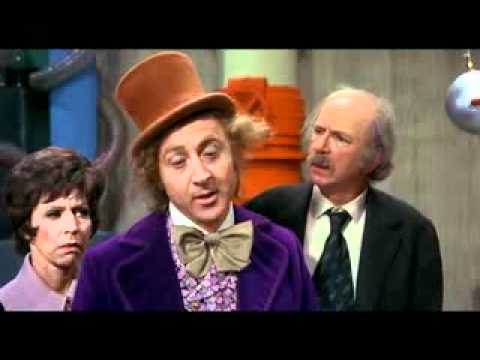
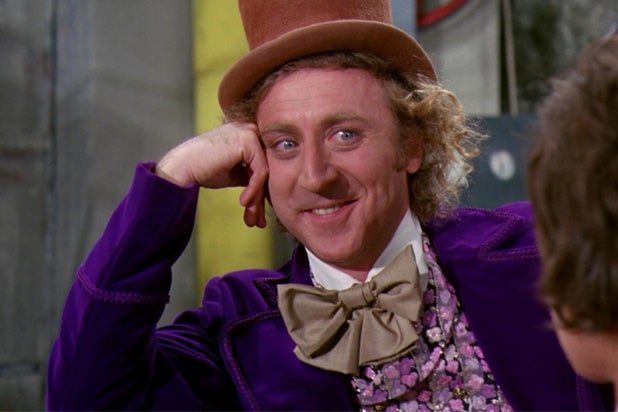
Mr. Wilder’s most famous role must surely be that of the original, the one and only Willy Wonka.  Here’s our good friend @Bardfilm’s video take on all the Shakespeare references in this masterpiece from our childhood:

Did you know that Wilder’s first performance in front of a paying audience was in a production of Romeo and Juliet when he was 15?  He played Balthasar.  (That’s ok, I didn’t know that either until I read his wikipedia page :))

But wait! There’s more.  Gene Wilder was actually born Jerome Silberman. Where and why did he get Gene Wilder?  “Jerry Silberman as Macbeth didn’t have the right ring to it,” he thought when he joined the Actor’s Studio, choosing Wilder from Thornton Wilder and Gene from Thomas Wolfe’s Look Homeward, Angel. He later said that he couldn’t imagine Gene Wilder playing Macbeth either :).  Our loss – I can’t find any record of him ever trying.

Though it has nothing to do with Shakespeare, I love the trivia that Gene Wilder basically rewrote the part that made him famous, Willy Wonka, including such specifics as the entrance where his cane sticks in the cobblestones and he does his little somersault entrance. He also entirely redesigned the costume.  So shines a good deed in a weary world…

Those who know a little more about Wilder’s personal story know that he never fully got over the death of his wife Gilda Radner from ovarian cancer.  At last they’re reunited.

Good night, sweet prince. Flights of angels sing thee to thy rest.