How Sharper Than A Serpent’s Tooth, To Have A Thankless Geeklet

My children have literally grown up with Shakespeare, from the time my oldest was five, my middle three, and my son one.  Of course it was much more prevalent when they were younger and I could read/sing/show them whatever I wanted. As they’ve gotten older, life gets in the way and other responsibilities and activities take over.  So I’ve often wondered how much of what I tell them remains.

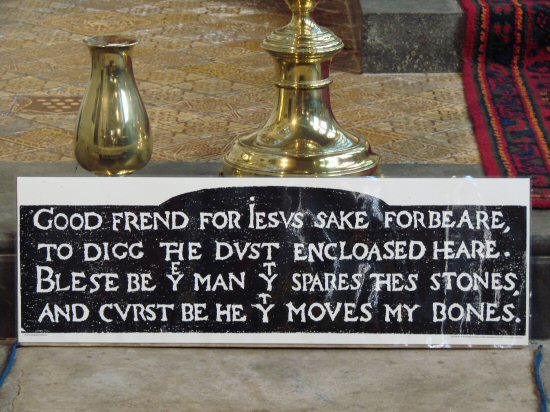
The other day I was telling them about the plan to scan Shakespeare’s grave, despite the curse.

“What did they find?” asked my oldest.

“They haven’t said yet,” I told them. “Apparently it’s a big deal for the 400th anniversary of his death, so we have to wait until then.”

“When did he die?” my middle child asked.

“I have no middle child,” I said, mouth agape.

She froze, realizing that Shakespeare Day is something I may have mentioned two or three thousand times in their lives. “Give me a hint,” she asked.

“Did he die on my birthday, or close to my birthday?” I asked. Embarrassed silence.  “Oldest child,” I said, “Help her out, would you?”

“When’s your birthday?” asked oldest child.

I’m changing my will and giving everything to the boy.  Also, changing his name to Cordelia.

Watch Empty Space. Seriously. Right Now. Go.

OK, stop what you’re doing.

“Empty Space” is a love-letter to live theater, a nine-episode web comedy that explores and glorifies the world of diehard thespians, those hardcore beasts of the theater who soldier on against the slings and arrows of outrageous fortune because, after all, the show must go on.

That’s direct from their About page, and I don’t think I could describe it any better. Remember Slings & Arrows? Of course you do.  The love of Shakespeare extends beyond the text. We love to be around other people who love Shakespeare.  Put me in the audience, or let me watch from backstage or heck, let me hang out with these people in their normal lives. We all have a shared passion, and it’s great to be around.  (And let me tell you, having hung out with theatre people back in college, “we all have a shared passion” has a whole double meaning I hadn’t even considered when I wrote it!)

We open with Kira, our Juliet, speaking directly to the audience while she sits in makeup. She’s open in her criticism of the crew, and we clearly see one of them flip her off in the background.  “This is a mirror,” she says, “I can see you!”
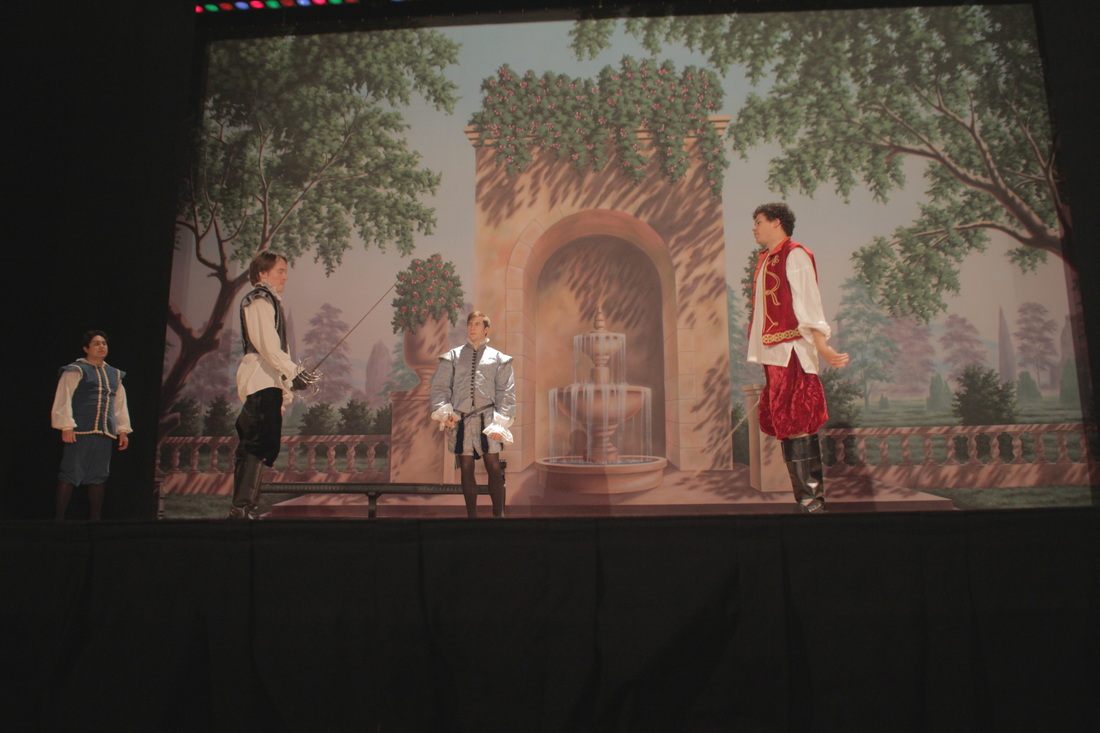
Our story then parallels Mr. Shakespeare as we quickly see the two houses – “Montacrews” and “Castalets”, as the director dubs them – hate each other. The actors claim that crew are just has beens and wannabes.  The crew claims that actors are, and I love this line, “Props with dialogue.” The feud escalates into a literal sword fight (albeit with prop swords) until the Prince/Director steps in to declare that the next time anybody starts something, they’re fired, banished from the theatre, you name it.  Get the picture?
You can probably see where it’s going.  We introduce Orson, a new Mercutio, after the old one falls off the stage and breaks himself.  Orson then starts fraternizing with a pretty costume designer.  How long before he’s off to the drug store for poison?
Ok,  maybe it doesn’t go that far. I think that most of the parallels were just their way of showing that they could go there if they wanted to. This whole production – just ten episodes, running around ten minutes each – is wonderfully self aware, and I’m sure the theatre geeks who’ve actually gotten up there and done the half speed stage combat and the overly dramatized back stage romances will find even more inside jokes than I did.  Heck I laughed out loud when they dropped in a random reference to a production being “post apocalyptic” like that explained everything.
The whole point is, as I quoted above, a love letter to live theatre. Everything but the kitchen sink is thrown at actors, director and crew. People are fired. Replacements do not live up to expectations. Props are switched. Russian mafia come looking for the stage combat guy. Yet the idea of the show not going on just never materializes. Everybody rolls with it. Because at curtain call, when the audience applauds? It’s all worth it. Always.
Oh, and if it sounds like I enjoyed the series? The epilogue (of course there’s an epilogue, haven’t you been paying attention?) knocked me out of my seat.  Our Mercutio, who also happens to have written the show, comes out to address us.  “I can take any empty space and call it a bare stage,” he begins. “A man walks across this space whilst someone else is watching him and this is all that is needed for an act of theatre to be engaged.”
“Damn,” I think. “That’s really good. I mean, I get that, immediately. I understand that sentiment completely.”
“Peter Brook,” he continues.
“Oh, well, there you go,” I say to my empty living room.
He then continues his … what should we call it? A call to arms? A mission? About the actors’ duty to fill the empty spaces of the world with theatre at every opportunity. Seriously, it made me want to go enlist. I want to go find some guerilla Shakespeare now.  Maybe I should start some…

…oh, and did I mention this is all entirely free online? Not on Netflix, not on Amazon Prime, not coming to a theatre near you.  Just hanging out on a web page, every episode, just waiting for you to fill up some empty space in your day by binge watching it.  So why are you still reading?  Go!
Watch Empty Space

 

Does Scanning Bones Count As Disturbing Them?

There’s been talk for years about excavating Shakespeare’s grave, and of course that’s never going to happen, but plan B has always been to scan the ground and see what’s under there because we just can’t leave well enough alone.  Apparently it’s finally been done, and we have to wait to learn the results.

I’m not sure how I feel about this. On the one hand I want to know everything.  But on the other, I mean, the man’s dead, what right do we have to go checking him out in his final resting place? Why exactly is taking a quick peek any better than breaking out the shovels?  I prefer the Schrodinger’s Cat interpretation of Shakespeare’s curse:

Good friend, for Jesus’ sake forebeare,
To digg the dust enclosed heare;
Bleste be the man that spares thes stones,
And curst be he that moves my bones.

Forget the literal dig and move nonsense, since certainly those were the only methods of disturbance that the author (likely not Shakespeare, of course) could imagine.  Clearly the desire, as really it should be with all graves, is to leave it the hell alone.

Shakespeare’s Insults : Educating Your Wit

Came in to work the other day and a coworker presented me with a book from her collection, Shakespeare’s Insults : Educating Your Wit. I had to admit, I do not have this one in my collection. Bit of history, when I wanted to teach myself Android app development I actually started out with a Shakespeare insult generator.

The book is definitely for reference, rather an a “How to Insult People With Shakespeare” sort of thing. Most of the chapters are a walk through play by play (or is it play-by-play?) listing everything that could be considered an insult. Unfortunately this ends up a case of “quantity over quality” and you get quotes like, “It out-Herods Herod” in the Hamlet section. An insult? Technically, sure, yes.  Does it sound like an insult out of context? Just barely. Or “Get thee to a nunnery?”  “If thou dost marry I’ll give thee this plague for thy dowry?”  Not so much insults and generally negative things.

You do what you’ve got to do to up the page count, I guess. I know that when I made my own statement against “love quote” collections by hand picking only those love quotes that could be used in weddings, I only managed about a 50 page ebook out of it. If a publisher told me to knock out 300 pages I’d probably do the same thing these guys did.

There’s about a dozen pages dedicated to insults for particular occasions – including fat, skinny, ugly, burping, farting….you get the idea. Not really what I’d think of as “occasions” but I’m just repeating what they called it.

There’s also a section in the beginning that’s more about how Shakespeare’s language worked in general, such as the few paragraphs on what exactly it meant to call somebody a “knave” and a “villain” and all the different variations Shakespeare used.  This part made me recall a conversation with Bardfilm over Coriolanus’ use of, “boy!” at the end of the play, how significant that was and how it might be played today.

Certainly a very good reference to add to the collection. There’s always opportunity to pull out some Shakespeare insults (just look at the recent Shakespeare Insult Challenge going around in the spirit of the Ice Bucket Challenge!)  It’s an older book (1995) so you might get lucky and score it on the cheap if you go hunting.

What’s your favorite insult?  I’m particularly fond of Kent’s rant in King Lear, mostly because I saw it live last summer and laughed until I cried. Imagine taking a deep breath and trying to do this all in one go:

A knave; a rascal; an eater of broken meats; a
base, proud, shallow, beggarly, three-suited,
hundred-pound, filthy, worsted-stocking knave; a
lily-livered, action-taking knave, a whoreson,
glass-gazing, super-serviceable finical rogue;
one-trunk-inheriting slave; one that wouldst be a
bawd, in way of good service, and art nothing but
the composition of a knave, beggar, coward, pandar,
and the son and heir of a mongrel bitch: one whom I
will beat into clamorous whining, if thou deniest
the least syllable of thy addition.

I love how, after all that, including taking a shot at his mother, he ends with “And I’ll beat the crap out of you if you deny a word of it.”

Review : Station 11

Back in college (which would be about 25 years ago, for reference) I worked at the local supermarket as the head cashier.  I was just coming to discover my love of Shakespeare so I was anxious to talk about the subject with whomever might be interested (who am I kidding, I still do that ;)).  One of the cashiers was a retired English teacher, so I asked her if she was a fan of Shakespeare. What she said to me has stuck with me all these years.  She told me, “If human civilization were to be wiped out tomorrow, and only a single book remained to represent what once was, that book should be King Lear.”

Station 11 makes me wonder whether the author was checking out on aisle 4 when we had that conversation, because that’s pretty much the story. We open with a production of King Lear where the lead character drops dead of a heart attack on stage.  (Why is it always Lear when that happens? I could swear I’ve got memory of at least three different Lear-dies-on-stage stories).  Anyway, it also just so happens that this night is the outbreak of the “Georgia flu”, an epidemic that quickly decimates 99% of the world’s population.

Cut quickly to twenty years in the future, when all the gasoline is gone and cars have been turned into hollowed out metal chassis pulled by horses. A caravan of traveling players roams the countryside, going from village to village performing classical music and … you guessed it, Shakespeare. Why, in a world where people are trying to rediscover the basic skills needed to survive, are they still performing Shakespeare? Because the people want to remember the best of what it was to be human.

I love that.  I think I’ve got the quote wrong, as I listened on audiobook and can’t easily find it again, but it captures the essence of what we’ve always talked about here.  Shakespeare makes life better, and it does so by holding a mirror up to our own nature.

How’s the book?  Not bad.  It’s certainly not the first to do the “99% of the population is wiped out” story, notably thinking of Stephen King’s The Stand as a defining example of that genre.  I was a little disappointed in the author’s belief that technology could be wiped out so quickly.  After twenty years,  nobody’s got the electricity up and running again? In the span of less than a life time they’ve forgotten about how computers used to work? I don’t buy it. I much prefer the stories where, when technology is forced to take a step backward, humanity gathers its forces to move it forward again.

But this isn’t a technology story and doesn’t claim to be (go read Kurt Vonnegut’s Player Piano or the aforementioned The Stand if you want that). This story is about the eternal transformative nature of literature and how it can change the world. There’s a particular book that keeps coming up again and again, before the plague and after, and only once you’ve understood who touched the book and when does the story all fall into place.

As always with stories like this there’s not enough Shakespeare for me, but what can you do. I can tell you that I was looking for the sequel before I’d even finished the first one.  Alas, there’s not a sequel.