Now Gods, Stand Up For Shakespeare’s Brother

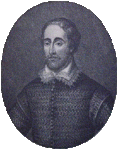
Edmund Shakespeare
(1580-1607)

Today I Learned that Shakespeare’s little brother Edmund (born 1580) followed him to London to become an actor.

Who wants to speculate on connections between little brother, and Shakespeare’s most famous bastard from King Lear?  Edmund had a bastard child of his own, though the child was born four months before Edmund’s death in 1607, making the event too late to have any connection to King Lear, which was written prior to 1606.

How cool would it be if Edmund went to London and actually stayed with his brother during that time, maybe even acting in one of the plays?  No records exist, but does that mean it didn’t happen?
The Sanders Portrait Has A New Home

Which portrait is your favorite?  It seems like Droeshout and Chandos always get the love, but there are quite a few more contenders : Cobbe, Flowers, Sanders?

Well, the Sanders portrait is changing ownership.

The portrait – an oil on two joined oak panels named after its likely creator, John Sanders (1559-1643), Mr. Sullivan’s great grandfather 13 generations removed and a Shakespeare associate in London – was first brought to international attention by The Globe and Mail’s Stephanie Nolen in a front-page story in May, 2001. 

Mr. Sullivan, who inherited the portrait in the early 1970s from his dying mother in Montreal, began to try to confirm its authenticity in the early 1990s and to date has spent more than $1-million in the effort.

Anybody on the “Sanders is the only portrait painted from life” side?  Other than the guy with the direct family connection, who is not shy about talking up how important it is for Canada to have a Shakespeare portrait, what’s the “mounting evidence” they mention in the article?

Hey Remember When We Wrote The Shakespeare in Love Sequel?

You’ve probably heard the news that a Shakespeare in Love sequel that’s coming now that Miramax and the Weinstein Company are doing business together again. “The new venture will get off the ground quickly with sequels to the Best Picture Oscar winner Shakespeare In Love
and Rounders…” the article reads.  What “quickly” means in moviemaking time, I don’t know.

What I’m curious about is whether we could write the plot for this one. What stage of Shakespeare’s life do you think they’ll cover?

I ask, because we covered this exact topic in 2010.  Miramax always planned to do a sequel.  I guess business got in the way.  So this week’s news isn’t so much about a new project, as it is getting an old project back on track.

Some ideas that came up in the original thread…

* Do the Dark Lady / Sonnets storyline.

* Late career, while he’s writing The Tempest

* Do something around Falstaff

* Make the whole story about his daughter Susannah

Seriously, go back and read the original thread, there’s genius ideas in there.  How crazy would it be if one of our ideas takes off?

“Chrome”-Plated Shakespeare

For those of you using the Google Chrome browser, David Fisco just sent me his game “Rote Shakespeare“. It’s a plug-in (why he wrote it as a plug-in I have no idea?) memorization game where you get a passage from the play of your choice, where one of the lines is left out and the words scrambled for you.  Click to put them back in order. There’s no timer, which I prefer, though it does count how many times you tried to get it right and always resets you as soon as you get a word wrong (which makes it easier, because you know exactly which words you got right and can just do process of elimination).

Fun game, and I like how you can zero in on the characters that you want (so you’re not accidentally handed some random spear-carrier’s line to remember).  I don’t think it has anything to do with rote memorization, though.  Unscrambling the words is actually a distraction from remembering what the line is in the context it’s given.

I’m just not sure where the plug-in thing fits.  I think it’s more of a “Chrome App”, which is fine, but I’m confused about how to install and run it if I ever want to find it again.

The Most Important Person Ever

What happens when computer scientists want to figure out what would once have been a hypothetical question? Like, say, “Who was the most important person in the history of the world?” They think like Google:

We rank historical figures just as Google ranks webpages, by integrating a diverse set of measurements about their reputation (including PageRank, article length, and readership) into estimates of their fame, explained by a combination of achievement (gravitas) and celebrity. We correct for the passage of time in a principled way, so we can fairly compare the significance of historical figures of different eras.

 I’ll just tell you — Shakespeare comes in at #3.  #1 probably won’t surprise many people, but I think that #2 might.

There’s a link right to their WhoIsBigger site, which looks like it could be fun to play with.  It looks like it might be broken, though — I’m in “American Writers” and the top category is dominated by Howard Stern, Angelina Jolie, director Ed Wood and professional wrestler Jon “JBL” Leyfield.  I don’t even know what category that’s *supposed* to be.

They also have a book Who’s Bigger?: Where Historical Figures Really Rank
, which could probably be some interesting bathroom reading material for that college student relative you haven’t bought for yet. 🙂