Who’s Up For Nose Painting?

Spotted this question about nose painting on Reddit, but it’s not getting much conversation over there and I think it’s interesting.

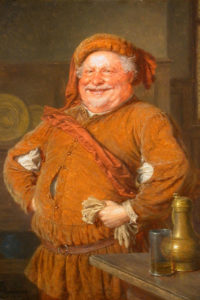
Falstaff, King of Nose-Painting
This is Falstaff. He isn’t in the play but he’s what comes to mind when I think of noses painted from drinking.

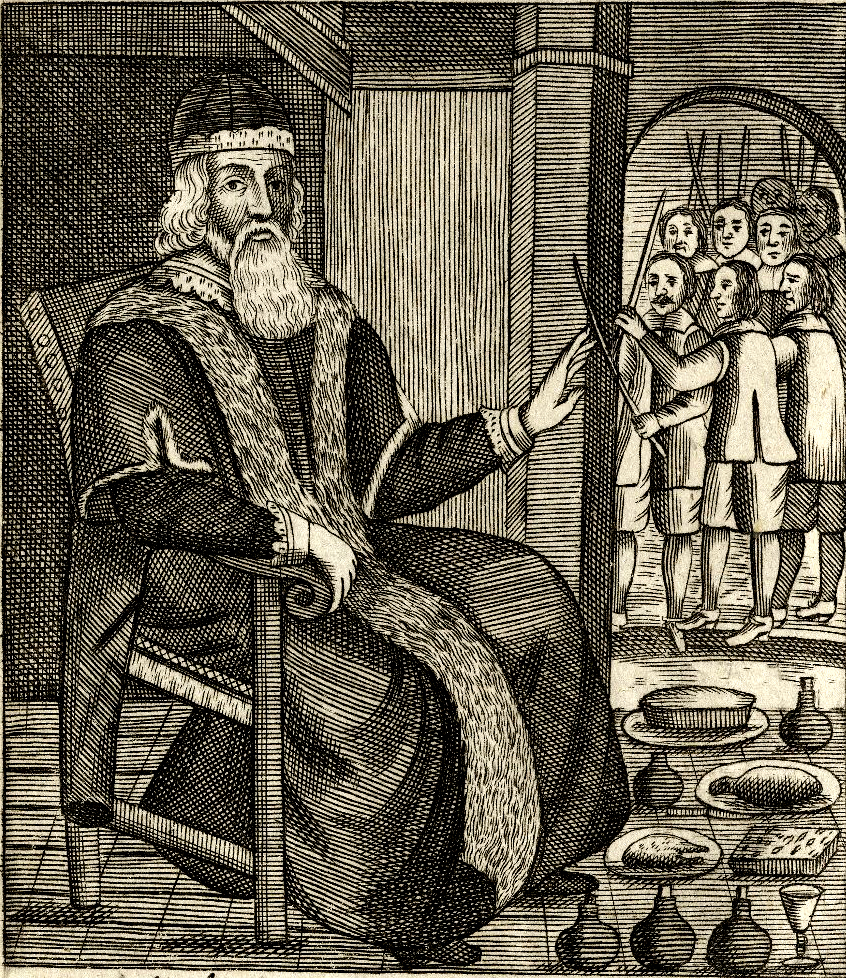
The question is this: When the Porter in Macbeth says that drink provokes “nose-painting, sleep and urine,” what exactly is nose-painting?  The student in question assumed, as do many online resources that it refers to the idea that your nose turns red when you drink too much. His teacher apparently told him that it was more vulgar than that.

Well, off to Filthy Shakespeare and Shakespeare’s Bawdy I went.  Both list it as a euphemism for sex without going into any detail that I can find.

But here’s the thing.  Look at the context:

MACDUFF 

What three things does drink especially provoke? 

Porter 

Marry, sir, nose-painting, sleep, and
urine. Lechery, sir, it provokes, and unprovokes;
it provokes the desire, but it takes
away the performance: therefore, much drink
may be said to be an equivocator with lechery:
it makes him, and it mars him; it sets
him on, and it takes him off; it persuades him,
and disheartens him; makes him stand to, and
not stand to; in conclusion, equivocates him
in a sleep, and, giving him the lie, leaves him.

So his first joke was that drink makes you want to sleep, urinate, and … well, you know.  But then he starts calling it “lechery” and does the rest of the speech about how drink “takes away the performance”, and the more I read that, the more I realize that almost every word is a euphemism for something sexual.  “Stand to and not stand to” is particularly illustrative on dear Mr. Shakespeare’s part.

That doesn’t seem to flow.  “Drink provokes sex, sleep and urine.  Sex, it provokes and unprovokes…”  What?

“Drink makes your nose red, makes you sleepy, and makes you need to pee.  Sex?  Sex is funny when you’re drinking.  You want it, you just cant do it.”  Makes more sense to me.

I believe that Macbeth is the only place Shakespeare used nose-painting, so we can’t compare context elsewhere.  All of the online references I find suggest that it is the “your nose turns red” thing, not the sex thing.

What do you think?  Anybody got some more academic references, like an OED, where we can get something definitive?

Time is Too Slow for those who Wait, Too Swift for those who Fear

Instagram is killing me.  By far, *most* of the quotes that people are circulating as Shakespeare are, in fact, not.   Here’s the latest:

“Time is
Too Slow for those who Wait,
Too Swift for those who Fear,
Too Long for those who Grieve,
Too Short for those who Rejoice;
But for those who Love,
Time is not.”

http://www.goodreads.com/quotes/14286-time-is-too-slow-for-those-who-wait-too-swift

That’s Henry van Dyke, an American author born in 1852.  So to call it Shakespeare is off by almost 300 years and a continent.


6 Facts About Cymbeline That Will Keep You Up At Night

This week we got our first look at the trailer for the upcoming Cymbeline movie, starring Ethan Hawke.  If you haven’t yet taken a look, here’s your chance:

While the most hardcore of Shakespeare geeks debates the merits of another Ethan Hawke version of Shakespeare (and whether the flame throwers were a good idea), I thought it might be a good opportunity to play catch up with the rest of the world who are scratching their heads and asking, “Cymbeline? Wotzat?” Well, brace yourself. This is not your Mama’s Shakespeare. (Your mother was a high school English teacher, right?)

1) Unless you study these things, you’ve almost certainly never heard of Cymbeline. IMDB shows only 5 filmed productions dating back all the way to 1913 (and counting this yet to be released one). In comparison, I stopped counting Hamlet productions at 30+, and that wasn’t even counting all the variations (Hamlet 2, Zombie Hamlet, and so on). Romeo and Juliet has even more. Many Shakespeare plays have become ingrained in our cultural subconscious to the point where we all recognize various Shakespeare references before we ever sit down to watch the show. You’ve almost certainly seen a balcony scene reference, or Hamlet talking to his skull, or Macbeth’s witches around their cauldron. You’ve almost certainly never seen any Cymbeline.

2) The only quote you’re likely to recognize will also probably make you cry. There’s no “To be or not to be” here, no light through yonder window breaking, no witches chanting around a bubbling cauldron. If you recognize anything that comes out of this play, chances are it is this funeral dirge:

Fear no more the heat o’ the sun,
Nor the furious winter’s rages;
Thou thy worldly task hast done,
Home art gone, and ta’en thy wages;
Golden lads and girls all must,
As chimney-sweepers, come to dust. 

Fear no more the frown o’ the great;
Thou art past the tyrant’s stroke:
Care no more to clothe and eat;
To thee the reed is as the oak:
The sceptre, learning, physic, must
All follow this, and come to dust. 

Fear no more the lightning-flash,
Nor the all-dreaded thunder-stone;
Fear not slander, censure rash;
Thou hast finished joy and moan;
All lovers young, all lovers must
Consign to thee, and come to dust. 

No exorciser harm thee!
Nor no witchcraft charm thee!
Ghost unlaid forbear thee!
Nothing ill come near thee!
Quiet consummation have;
And renownéd be thy grave!

3) It’s not a tragedy, or a comedy, or a history. It’s true that Shakespeare plays had a certain formula you could rely on. Comedies end with a wedding (or, well, the promise of one), and the joke is that tragedies always end with everybody dead. Ok, fine it’s more complicated than that, but you get the idea. Cymbeline breaks all the rules. It’s listed in the First Folio as a tragedy, but hardly anybody dies, and rumor has it that the editors of the Folio may have never actually seen a performance of this one. There’s not really a single central “tragic hero” like you might expect to find. It has a happy ending, but everybody was already married. It’s arguably something of a history, because Cymbeline was a real king who ruled at the same time as another of Shakespeare’s favorites, Julius Caesar. And, like watching a production of Julius Caesar, you’re likely to come away from Cymbeline wondering, “Ok, now, wait, how much of that was actual history and how much did Shakespeare just make up?” In short it’s a little bit of everything, which leads us to …

4) Lazy sitcoms did not invent the “clip show” or “greatest hits,” lazy Elizabethan playwrights did. (Credit to Shakespeare geeks MagpieAndWhale and TheRoaringGirl for those expressions.) Shakespeare had his favorite characters and plot devices, and threw them all into the stew for this one. To borrow from theroaringgirl’s useful summary, “It has star-crossed lovers, missing princes, a manipulative wife, an aging king, a trusty servant, a villainous liar (whose name literally means “little Iago”), a “breeches part,” an idealized pastoral setting, war with Rome, getting lost in wales, a visit from the Gods, a soothsayer, songs, mistaken identity, a death-like sleep, and the most convoluted 5th act reveal ever written.” Orson Welles is credited with the quote, “Now we sit through Shakespeare to recognize the quotations.” If point #2 told us that there’s not going to be many quotations to recognize, the good news is that there’s probably going to be a whole lot of plot you’ll recognize from other plays.

5) Most critics over the centuries have hated it. Samuel Johnson did not want to “waste criticism” on its “unresisting imbecility”. George Bernard shaw called it “stagey trash of the lowest melodramatic order.” Henry James offers, “The thing is a florid fairy-tale, of a construction so loose and unpropped that it can scarce be said to stand upright at all.” I bet Ethan Hawke and friends can’t wait for the latest crop of reviews to come out! (Credit to blog Ten Pages or More for these and more similar quotes.) None of this stops them from calling it “Shakespeare’s undiscovered masterpiece” in the trailer however.

6) It’s a pastoral comedy with a happy ending, done in the style of a flamethrower-wielding motorcycle gang. You did watch the trailer, right? I’m not making that up. As someone else noted, it’s like doing Midsummer Night’s Dream or As You Like It with a motorcycle gang. And flamethrowers.

There’s your lesson in Cymbeline for the day. So – if you weren’t already planning to go see it (because hey, Shakespeare movie!), did I convince you?

P.S. – What do you think of the new font?  Too big?  I’m trying it out.

Love to faults is always blind, always is to joy inclined. Lawless, winged, and unconfined, and breaks all chains from every mind.

Something new!  I’d not seen this one before, and had to go look it up.  Sounds a little bit like Shakespeare, but I don’t know, something about the meter (DUH da DUH da DUH da DUH) was too bouncy to be Shakespeare’s style, even in the long poems where sometimes quotes hide that don’t have the same feeling as those that come from the plays.

Anyway, this one is from William Blake if Google Books is any indicator:


[Source]

I think that my favorite source of misinformation comes from the two-fer on this Yahoo! Answers page.

First we have the answer that, “William Blake borrowed it from Shakespeare, who wrote it in one of his sonnets.”  No mention of which sonnet, of course, and it’s not iambic pentameter.  It’s very easy to check and cite references.  But under “source” the person wrote, “I am a Shakespeare teacher.” Just not a good one I guess.

The second bit of genius comes from the well-meaning person who writes, “I searched and couldn’t find it as anything but a quote so maybe it’s something he never wrote down, only said.”  That’s not the first time I’ve heard that, and it conjures up this hysterical image in my brain of the town drunk passing down his story over the centuries.  “So there I am, sitting next to the Bard of Avon himself William Shakespeare, telling him my problems with women. And you know what he does? He turns to me and says, he says, ‘Love to faults is always blind, always is to joy inclined.’ And I says to him I says, ‘Pal, you need to write that down.’  Well I guess he plum forgot because it doesn’t show up in any of his recorded works, but I swear to you, he said it. I was there.”  Imagine Bill Murray telling his Dalai Lama story in Caddyshack. 🙂


Nexus 7 Shakespeare Commercial

Thanks to my wife for pointing this commercial out when I missed it!  Google tells us that the Nexus 7
is as good at reading the classics as it is at reading the best sellers, and uses Romeo and Juliet to prove it:

What’s unusual is that a father appears to be reading Romeo & Juliet to his daughter as a bedtime story.  I’m not sure if I love that or find that bizarre.  Maybe he’s going to skip all the dead people.

Is it wrong that I totally want one now, just because of this commercial? I have no need for it, there’s Kindle Fires all over my house and I develop software for the iPad at work.  But still.  Seems like the kind of advertising I’d want to support :).

UPDATE : Found the whole 30second spot! Apologies, I’d grabbed the first one I saw and didn’t realize that one I posted wasn’t the whole thing.