
Most Popular Shakespeare Tattoos

I’ve been meaning to do this for a while and finally had the time to do it.  In a highly unscientific manner I punched “Shakespeare tattoo” into the Pinterest search engine, and started tracking what came up.  Although there were a variety of Shakespeare images, in this case I was looking purely at the quotes.

Unfortunately if more than one person finds the same image and pins it, all those instances will show up, and it would be near impossible for me to do anything about that. So instead I factored it into the equation.  The prevalence of a given Shakespeare tattoo doesn’t just mean “More people have this one” it also means “More people *like* this one.”

I learned that pictures of freshly done tattoos are pretty gross.  Many of these showed people all red and swollen which I assume means they took the picture immediately upon completion.  I also learned that people will tattoo pretty much anywhere on their body, and saw a fair share of nearly naked people with just a hand covering the bits that weren’t Shakespeare. (Though it’s not on pinterest and was not part of this study I remember seeing a picture of a woman in the bathtub whose Shakespeare tattoo was so high up her leg that I hope she married her tattoo artist afterward.)

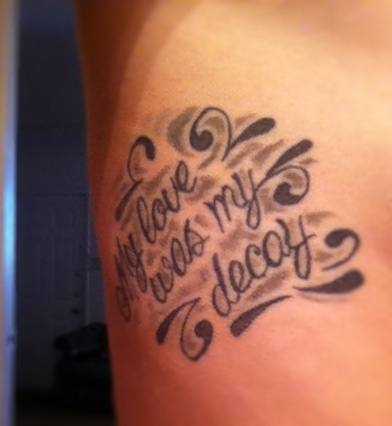
In total I looked at 74 Shakespeare tattoos (or, as noted, re-pins of tattoos). I was surprised at how lopsided the distribution was.  Seventeen of those (almost 1/4th the total) were unique – I found only one tattoo like it. I think my favorite may have been this one:


Shakespeare tattoo: My love was my decay
“My love was my decay”

Because I saw a gazillion Romeo and Juliet, Hamlet, Tempest and Sonnet 116….but who goes to Sonnet 80?  You’ve got to really know and love your material to pull something that almost guarantees no one you ever meet in life will recognize it.  I’ll admit I even passed that one over at first as a not by Shakespeare until I read the note associated with it.

[ All images come from a Pinterest search on “shakespeare tattoo“.  I do not own the rights to any images. ]

Eight tattoos were in the category of “a few people have or like this one”.  Typically I spotted between 2-4 instances of each of these (in no particular order):

  • “What’s past is prologue”
  • “To sleep perchance to dream”
  • “If music be the food of love play on”
  • “Hell is empty and all the devils are here”
  • “Stars, hide your fires”
  • “These violent delights have violent ends.”
  • “All these woes shall serve for sweet discourse in our time to come.”

There were also a few variations on Sonnet 116, including one person with the entire sonnet but most with a portion of “Love is not love that alters…”  Though I like the person who went with “Looks on tempests and is never shaken.”  Two different things to focus on.

But then we get to the big winners.  Two stood out as clearly more popular than the others.  The runner-up, appearing 18 times in my list?

Shakespeare tattoo: To thine own self be true
“To thine own self be true.”

I saw Polonius’ advice on more body parts than I can count (such as the pictured foot).

But the winner (appearing 19 times in the list)?  Want to take a guess?

Shakespeare tattoo: Though she be but little she is fierce
“Though she be but little, she is fierce.”

Everybody loves this quote.  Not only was it the most popular, I saw a number of people who pinned a different tattoo with the comment, “I like this style, only with the quote about she’s little and fierce.”
What do you think quote choice says about the person?  I found it fascinating to consider the different places people have to be in their lives to write of “violent ends” and “all these woes”, compared to those that write of music being the food of love (and bonus points to the creative soul who went with “the earth has music for those who listen” instead).  And how about all these “little but fierce” tattoos? Is that a motivational message to the bearer?  Or a warning to her enemies? Maybe a little of both.


Did I Just Find The Source of the Shakespeare / King James Bible Theory?

When I’m trolling around for blog post ideas I’ll often spot a topic I don’t often see discussed and then google “<that topic> Shakespeare” to see what comes up.  So on Reddit I saw a post about Rudyard Kipling.  Ok.  Google “kipling shakespeare” and one of the interesting things I’ve learned to watch out for is whether Google fills in “shakespeare” before I’m done typing it.  That means that other people are also googling for this.  Sure enough it completes the query.  Even better it completes it with “kipling shakespeare bible.”  Interesting!

And then I found this.  “Proofs of Holy Writ“, by Rudyard Kipling, starring William Shakespeare and Ben Jonson.

Let’s jump to the end:

“Proofs of Holy Writ” was said to have arisen from a dinner table conversation between Kipling and John Buchan about the process by which the splendidly poetic language of the King James’ Authorised Version of the Bible miraculously emerged from a committee of 47 learned men. Might they, Buchan wondered, have consulted the great creative writers of the day, like Will Shakespeare or Ben Jonson ? ‘That’s an idea’, said Kipling, and he went away to turn it into a tale.

As most of us have no doubt heard there’s long been a theory (nay, conspiracy?) that Shakespeare helped to write the King James Bible.  A theory that goes so far as to suggest that Psalm 46 contains a hidden message — the 46th word in from the front is “shake” and the 46th word from the end is “spear”.   (Bardfilm deals with this topic elsewhere, if you are interested.)

So does that mean that we’re looking at the originator of the whole Shakespeare/Bible theory?


Wait, The Puritans Destroyed The Globe?

No matter how many times I see an article like “6 Myths You Still Believe About Shakespeare” I always click and skim to see whether there’s something new under the sun.  This one had all the usual — his birthday’s not necessarily on 4/23, he didn’t get all his money from writing, the plays weren’t “published” in his lifetime, and so on.

But this one was new to me:

The building in Southwark known as Shakespeare’s Globe Theatre is a reconstruction that opened in 1997 – almost 400 years after the original was built. The original was ruined by fire after an accident involving the firing of a cannon during a 1613 production of ‘Henry VIII.’ It was rebuilt the following year only to be demolished in the 1640’s under Puritan pressure.

Emphasis mine.  I knew about the burning of course, but I never realized that the Puritans had it burned less than a generation after Shakespeare was gone?  “A bunch of us are sailing to America.  Last one to leave England, don’t forget to burn the Globe.”

Has somebody out there got more timeline on this? What happened to Middleton and Fletcher and Jonson and all the others that were still alive after Shakespeare was gone?  For that matter what exactly was going on at the Globe after Shakespeare, who kept writing for them?

The Shakespeare Geek blog has been around since 2005, making it the oldest continually active Shakespeare blog today. Shakespeare is Universal represents our biggest fund-raising effort to date. For almost eight years and almost three thousand posts I’ve tried my best to make a place where everyone can talk about everything related to the subject of Shakespeare. If you’ve found my sites and products useful and interesting, I would greatly appreciate your support so that I can continue to do even more. Thank you.

Shakespeare is Universal UPDATE

Shakespeare Is Universal T-Shirt
The Universal Question

UPDATE #2:  We’re drawing to a close, with little less than a week to go.  As of this update we’re at 57 and heading for 100 and truly need your help.  People have begun telling me “Oh maybe everybody’s just waiting until the last minute.”  Well I’m pretty sure the last minute is a Sunday night which is not exactly prime time for everybody to be online so you might discover Monday morning that your opportunity’s missed.

If you haven’t kept up on the news, more languages have been added and all known questionable translations have been fixed.  The shirt is also now available in four colors (grey/black/red/blue) if that helps convince you.

UPDATE #1 : I am going to keep updating this post, keeping it sticky at the top of the page, until the campaign has run its course.  This will help assure that newcomers see it, by keeping it on the homepage. We are at 15 out of 100 reservations, and need more people to see this!

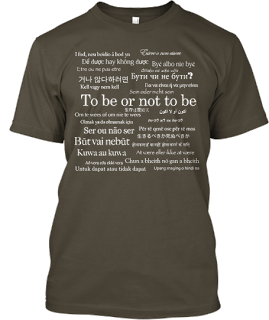
Shakespeare truly is for everyone, and nothing demonstrates that sentiment better than his most famous quote of all, translated here into languages from around the world.

In celebration of Shakespeare’s birthday, show that you believe his works are just as relevant, powerful and important as they’ve ever been!  Available for a limited time only!

Yes! I Believe Shakespeare is Universal! Sign me up!

Proceeds from this campaign go toward funding the mission of ShakespeareGeek.com, which for the last eight years has been dedicated to proving that Shakespeare makes life better.


Teespring is “Kickstarter for t-shirts”. We need a certain number of people, by a certain date, to commit to purchasing a shirt. If we reach that number (or exceed it!), everybody wins. If we don’t, nobody is charged. This method allows the price of each shirt to be greatly reduced, while keeping the quality of the product very high. (The graphics are all cleaned up by designers before printing, so they’re never pixelated or speckled like you sometimes see on traditional “upload and go” print on demand sites.)

If you are at all interested in owning one of these shirts (and possibly seeing other such campaigns) I strongly encourage you to sign up and help us get the word out through all your social media connections. Thanks as always for supporting Shakespeare Geek!

You Don’t Have To Read Shakespeare To Love Him

Someone asked on Reddit, “What’s the best way to start with Shakespeare?”

As expected there’s a bunch of “Don’t try to read him, instead go see a good version of the play” suggestions.  But the particular one upset me in its absolute stance on how bad reading is for you. Quoted briefly, but you should go read the whole thing at the link:

Put down your written copies of the plays. Now. You don’t have to read Shakespeare to love him. Unless you are in a play, or a serious student/scholar, you are not helping yourself or him by attempting to get satisfaction from the words on paper.

I have a big problem with this.  Rather than write it all down again I’ll quote my response.  I’m moving the discussion here because I know my audience better :).

While I appreciate the passion, I agree vehemently with your absolutism on the subject. 

Here’s the problem. Shakespeare’s dead. You will never, not in the next million years, ever see, nor should you want to see, Shakespeare’s plays as he intended them. 400 years have gone by, after all, and you won’t even begin to comprehend the state of mind that his audience was in when they saw them. You will be unable to set your knowledge aside and look at them with the same eyes and listen with the same ears. 

What you get, when you see Shakespeare’s plays today, is the specific interpretation of that director and those actors at that time. Which has nothing at all to do with what Shakespeare intended, other than what they can extract from the text, which is still nothing but interpretation. Again, the man’s dead. We need to stop pretending that we can know for certain what the “right” way to do it is. 

So why then is a certain interpretation of Shakespeare ever better than another? It’s not a question of better it’s a question of different and intriguing. You don’t want to see one, say “Ok, I’ve seen it”, and then check it off your bucket list. You want to see as many Hamlets as you can and then ponder why David Tennant played it a certain way that Kevin Kline did not. Or why Patrick Stewart as Claudius shrugs before drinking the poison. (Why oh why does he shrug?!) 

So, then, what you really want to do is see as many interpretations as you can. What do all those interpretations have in common? THE TEXT. 

How will you ever fully appreciate the Shakespeare that you are watching, unless you know the source material? Or at least the source material as close as we are able to reproduce it? 

Think of it like this. When you go see a play what you’re really saying is “Shakespeare gave this group of people a big block of marble, and what they did is they chipped away everything that, to them, didn’t look like Hamlet.” Wouldn’t you like to see the raw material that Shakespeare started with, and decide for yourself what parts you’d like to chip away? 

I could give a dozen examples. What if you saw 4 productions of Hamlet, all of which cut out Rosencrantz and Guildenstern the way Olivier did? You’d be none the wiser. Then you go and see a fifth version and here come these two guys and you’re all “WTF is the director doing adding these two bozos?!”

See/hear the plays in as wide and frequent a variety as you can find, absolutely. You will learn and understand them by seeing them. I don’t deny that. But to truly internalize them and get rid of all the middle men between you and Shakespeare? Absolutely read them.

Discussion?

The Shakespeare Geek blog has been around since 2005, making it the oldest continually active Shakespeare blog today. Shakespeare is Universal represents our biggest fund-raising effort to date. For almost eight years and almost three thousand posts I’ve tried my best to make a place where everyone can talk about everything related to the subject of Shakespeare. If you’ve found my sites and products useful and interesting, I would greatly appreciate your support so that I can continue to do even more. Thank you.