Poetry By Heart

I love this story about the difference between memorizing things “by rote” versus “by heart”.  Although I don’t see much reference to Shakespeare in the text, it’s not hard to extrapolate.  How often do we use the tired old example of your high school English teacher who forced you to memorize, just for the sake of memorization, the balcony scene?  And the generation of students that can recite it but still hate it, or worse, hate it all the more because of that?

So there’s a thought that if you learn by heart it means you take the poem right into yourself, it becomes part of you. And it remains with you, probably for the rest of your life. I think a lot of us can remember bits of poetry that we learned when we were very young. So it’s something that lives with you forever.

What bits of Shakespeare have you memorized “by heart”?  I can do some rote bits of Dream or Macbeth or even the dreaded balcony scene, but other than as a “go to” bit of text when I need it, there’s no love for those passages.  I know Sonnet 18 by heart because for years I sang it to my children at bedtime.  I know Sonnet 17 by heart because I recited it to my wife during our first wedding dance.  I’ll admit that I don’t know “by heart” many longer passages, just some turns of phrase here and there that truly resonate just right where you need them.

http://www.npr.org/2013/01/19/169731110/u-k-asks-students-to-learn-poetry-by-heart-not-by-rote

Can There Be Too Much Shakespeare?

Honestly I never thought I’d ask this question.  Part of the life of this blog has been spotting every random tv commercial and sitcom that decides to mix in a Shakespeare storyline (hello, Cosby show…) and, in general, we come away with a “Hey, any exposure to Shakespeare is a good thing” feeling.


But lately I wonder.  I’ve been reading the Giver series with my daughter lately. There’s a scene in one of the later books where two children, both poor children in impoverished communities who were never given the chance to read, grow up in different villages.  Both learn to read independently.  When they meet up again after several years, the boy shouts, “I can read Shakespeare!” and the girl shouts back, “Me too!’

Come on, the author’s not even trying there.  I think I’d like to see Shakespeare’s name invoked for a reason beyond just some generic “I’m smart now” measuring stick.

“Hey, see that 6 year old over there, he’s really smart.”
  “Really, how smart?”
“Oh, he reads Shakespeare.”
  “Wow, that is smart!”

It’s not really all that different from an episode of Cosby where Theo and his buddy don’t want to do their homework, so they try to skip out on Julius Caesar by getting the Cliff Notes.  The difference comes in the fact that the episode in question was full of the text, as well as Christopher freakin Plummer doing a guest spot pretty much solely so he could do some Shakespeare.

In The Giver books I see no use of Shakespeare other than the aforementioned “Look how smart I am” checkbox.  Yes there’s a quote about Macbeth, but it’s thrown in so randomly that I can barely tell you which quote (something from Lady M, I believe) or even where it came up.

The Shakespeare Matrix


In a thread today on Reddit someone asked about your “Forever Project.”  That idea you have that on the one hand seems impossible, like the kind of thing that you wish existed but know never will…but, at the same time, it’s the idea that won’t go away, and you’re always (at least, as an engineer/programmer/hacker) thinking, “Hmm….could I build that?”

It was only then that I thought of how to describe mine.  I call it The Shakespeare Matrix.

We’ve all seen the movie The Matrix, right?  All of humanity have been enslaved by aliens, hooked up to a giant virtual reality world so perfect that most of them spend their entire lives never realizing that they’re inside a computer simulation.  That is, except for Keanu Reeves and his band of … pirates?  Rebels?  Who have discovered how to hack the system and program it to do the things they want it to do.  Need to know martial arts?  No need to spend years training – just alter the program so that your character simulation knows kung fu.  I bring up this example as an excuse to link one of the best movie fight scenes ever filmed.   (Everybody knows that this is the best movie fight scene ever filmed.  WHO’S DA MASTER?)  Once Keanu masters his talent he begins to see the world around him *as actual source code*.

Anyway, I get off topic.  What I want is a Shakespeare Matrix.  I want a virtual reality world where you can walk around and watch the plays in any number of ways – maybe as the audience, maybe as a character, maybe you interact directly with the characters.  At any time you can summon Shakespeare himself and have a conversation with him as well.  You can also pull up the  original text, much like pulling up the source code to the matrix.  And when I say original text I mean all of it – easy access to Folio and Quarto versions alike, along with all the glossary and reference materials that you might need.

There’s been a whole bunch of people talking about this over the years.  I notice that “Hamlet on the Holodeck” was published back in the late 90’s.  I’m not a big believer in the holodeck idea, I don’t think that will ever meaningfully happen.  But I do know that the Second Life universe had a Shakespeare group.  And then there was the abandoned massive multiplayer universe “Arden” that I had high hopes for, but gives you an idea about the realities of a project of this scope.

Anyway, not really a question in this one, I just wanted to brain dump a little about the Matrix idea, because I just thought of it and I really like the comparison.  As I think of the different kinds of software that could be used for browsing Shakespeare I always teeter back and forth between “Make something light and easy for the everyday user, like students doing their homework…make a game!” and “Make the ultimate reference guide so that the experts who need access to boatloads of very specific Shakespeare information have a single place where they can get it.”  Technically the latter is easier because manipulating pure information like that is easier than the visual work that needs to be done to make even the most basic game.

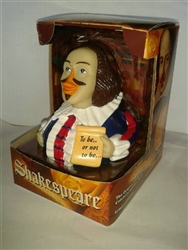
A Duck Walks Into A Bard

What came first, Shakespeare or duck jokes?  Our favorite playwright may have invented the “knock knock” joke as well as the “yo mama” joke, but we’re having trouble coming finding any duck jokes in the First Folio (although we do learn that Trinculo can swim like one).

So, Bardfilm and I decided to help out.  We’ve done chicken crossing the road jokes, light bulb jokes, knock knock jokes … it was only a matter of time, wasn’t it?  It’s time for

Shakespeare Duck Jokes

  • What do you get when you cross a duck with the innkeeper from the Henry plays?  Mistress Quackly
  • Duck walks into an apothecary shoppe and orders a dram of poison.  Apothecary says, “Let me guess, you want me to put that on your bill.”Duck says, “No I need to get to Juliet’s tomb first, I’ll do it there.”OR

    Duck looks aghast and says, “What’re ya trying to do, kill me?!”

  • “Blow, winds, and quack your cheeks!”   – Duckling Lear
  • Why was the duck nervous about seeing Hamlet?  He heard someone threaten to “Murder Most Fowl.”
  • Ophelia is out picking flowers when she sees a branch of particularly nice ones dangling out over the river.  She sees a duck swimming by and calls out, “Hey duck!  How deep is the water?””About waist deep,” the duck answers back.

    Ophelia confidently strides into the water, immediately goes in over her head and is swept away by the current.  Gertrude, who saw this whole thing happen, shouts at the duck, “You told her the water was only waist deep!”

    Duck says, “It is to me!”

  • Falstaff walks into a bar with a duck under one arm.  He sits at the bar, puts the duck down on a stool next to him.  Mistress Quickly comes over and says, “Get that filthy animal away from my bar!”  Falstaff lifts the duck off the stool, places him on the floor.  Mistress Quickly says, “I was talking to the duck, Jack.
  • Gloucester’s at the top of the Cliffs of Dover.  He screams, “How do I get down?”  Edgar screams back, “OFF A DUCK!”
  • Will Shakespeare is walking toward the tavern one day when he sees Ben Jonson coming from the other direction.  Suddenly the Earl of Oxford sneaks up behind Shakespeare an hurls a tremendous piece of ox manure at him.  “Duck!” yells Jonson to Shakespeare.  “Swan!” Shakespeare calls back, “We decided you’d call me” and thats when he got smacked with the manure.
  • Duck says to Hamlet, “I forget all my lines in the next scene!”  Hamlet says, “Can’t you just wing it?”

Thanks as always to Bardfilm, the Hardy to my Laurel, the Curly to my Larry, the Lewis to my Martin, the Kermit to my Fozzie Bear.

It’s The New Shrew Review, Coming Right At You

(* Ok, please tell me somebody gets that reference.)

I just read today that former Disney princess and modern day movie darling Anne Hathaway is signed on to a new Taming of the Shrew movie?  How cool would that be?  The article suggests that she’ll of course play Katharina, which I suppose make sense given her star power — I think the only other role would be Bianca, and that’s very much just a supporting role.

But two questions spring immediately to mind.  First, who should be her Petruchio?  Obviously this movie’s going to skew to a younger audience so I don’t think we’ll see any Russell Crowes or Ralph Fiennes’ stepping up.  How about Chris Hemsworth, the dude that played Thor?  There’s already a bit of ol’ Shakespeare about much of his dialogue anyway.  He’s got the rough sound and look about him that he might be able to play Petruchio.

Second question – do we think that anybody’s ever going to match Liz Taylor and Richard Burton?  That wasn’t just a haphazard hookup of who happened to be hot in Hollywood (see what I did there? Ha!).  They were on a completely different level than that, and it showed.  The fact that it was Shakespeare was really just a bonus — wasn’t that the first (and only?) Shakespeare that she ever did?  Burton was a different story, of course.

When Kenneth Branagh or David Tenant (feel free to borrow some N’s from each other, boys, I can never remember how to spell either of your names) makes with the modern Shakespeare, I think we see it differently.  They are Shakespeareans, and decades from now students will discuss their interpretations alongside Olivier.  But … is Anne Hathaway the next Dame Judi Dench or Helen Mirren? Do young actors today have the Royal Shakespeare Company to fall back on, to produce the next Patrick Stewart or Ian McKellen?