Followup Story – Guess Who I Met?

So, think back a month or two to my stories of almost teaching Shakespeare to my daughter’s 7yr old class.  That is, until the principal got wind of it and shut the project down.

So I’m at karate class this week to pick up my son, and the instructor is introducing a new family to class.  My daughters run up to me and whisper, “It’s our principal!”  Sure enough, the man that shot me down is now standing next to me watching karate class.

So, I introduce myself :).  It was all nice at first, “Hi, I’m so and so, all my kids are at the elementary school with you …” and then I gave him context.  “Do you remember a month or two ago Mrs. B coming to you about a plan to do a unit on Shakespeare?”

He thinks about it, and remembers. “Oh…yes, ok, yes, I do remember that.  Was that you?”

“It was!  How ya doin?”

Long story short I was unable in that brief time to convince him.  He felt that it was not age appropriate (I can’t remember the exact term he used but basically it was “too advanced for them”), and I countered that I have access to all the best resources in the world and will show him as many studies as he wants to see of teaching Shakespeare to 5yr olds.  But it was clear that he wanted to watch his kid at karate, as did I, so it did not go much farther.

Just wanted to give you folks that conclusion to the story.  Saw my opportunity and jumped on it :)!

Win Shakespeare In Love on Blu-ray!

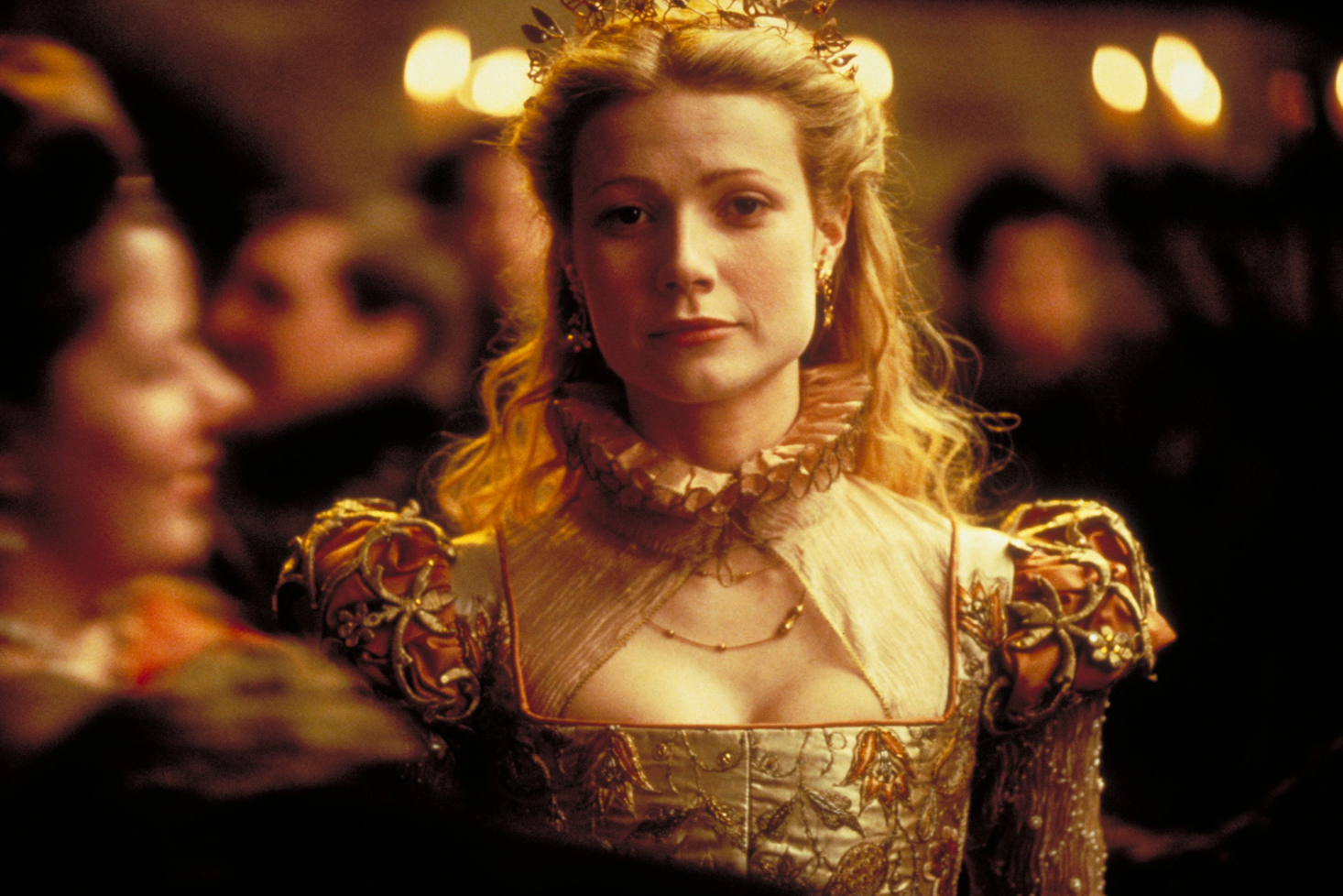
Shakespeare in Love has become infamous in the world of Academy Award trivia for beating out some war movie about saving private somebody or other.  It also guaranteed that Gwynneth Paltrow would forever show up in my Shakespeare news filters every single time she is mentioned because she is now always referred to as “Shakespeare in Love actress Gwynneth Paltrow” (and I’m sure that someday very soon Ralph Fiennes’ brother Joseph is going to get sick of hearing people say, “Weren’t you Shakespeare?”)

Among Shakespeare geeks the movie is a joy, a wonderful example of how you can start with Shakespeare’s material (in this case, Romeo and Juliet) and still make an entirely new and beautiful thing.  It should be no surprise that Tom Stoppard, who brought us Rosencrantz and Guildenstern Are Dead, was behind this masterpiece as well.

On Tuesday, January 31, Shakespeare in Love will be released on Blu-ray high definition DVD. Thanks to the good people at Click Communications I have *three* (3) copies to giveaway.

RULES!

1) Whenever I think of this movie I think of the whole Academy Award thing.  So I want you to add a comment to this post inventing a “Shakespeare Award” category and nominating a play.  Who had the best sword fight? Best Soliloquoy?  Best supporting actor in a non-comedic role?  Hopefully you get the idea. Best Cross-Dressing?

2) Entries must be received by end of day on Wednesday, February 1. This is a quick one!  I like the idea of announcing the winners on Groundhog Day. So you have all day Tuesday and Wednesday to enter (you can make as many entries as you like but your name’s only going in the hat once)!

3) Winners will be chosen randomly from all valid entries received.  So don’t be afraid to get silly with your guesses.

4) Contest open to residents of the continental United States due to shipping constraints.

MORE CHANCES TO WIN!

By a spectacular quirk of fate, and the fact that he found out about the release first and alerted me to it, our buddy KJ over at Bardfilm is running his own giveaway, and he’s taking entries until Friday!  So don’t forget to go put your name in his hat as well to double your chances!

Who will win?  I don’t know. It’s a mystery!

Coriolanus 101

So with the new movie out in theaters (and a certain special review on the way), I’m in a Coriolanus mood. I’ll be honest, I’m just not that familiar with the play. Here’s my nutshell understanding:

Caius Martius is this war hero for Rome.  He’s recently given the title Coriolanus for almost single-handedly winning the battle at Corioles (reminds one of Macbeth getting his Glamis/Cawdor titles).  He’s also got this really uncomfortably close relationship with his mother, and everybody knows it.  Anyway, his advisors tell him to seek a political career, even though he’s a warrior not a politician. It goes bad and he ends up banished from his own city.  So he takes up with his sworn enemy and leads them in an attack on the homeland the betrayed him.  That is, until his mother comes and talks him out of it.

So, I have a couple of questions that I thought maybe people could explain to me?

* How exactly does it go so badly for Coriolanus in his political quest? How does someone go from national hero to banished traitor literally in the span of two scenes?

* How are we supposed to read his mother?  That she loves her son, or that she loves Rome (and herself) more?  The more it seems obvious that she manipulated him to get what she wanted, it just makes him look stupid for not seeing through it.  Or, is that what we’re supposed to see? He’s just this war machine that others manipulate for their own purposes, his own mother included?

I’m sure I’ll think of others.  Feel free to add your own if you’ve always wondered.

When, and How Much?

Discussion time.  When, in your opinion, should Shakespeare be introduced?  I’m looking for a specific age/grade level.  Along with that, what are your *expectations* of understanding Shakespeare at that age?

Last week the topic came up over that whole darned Cliff Notes thing (yet again) and whether you’re assisting students in their introduction to the material (and thus a good thing), or dumbing it down because you acknowledge that they’ll never understand the real thing (which I don’t think anybody is for 🙂 ).

Long time readers know my answer.  My kids have heard *about* Shakespeare and his stories since they were born. And I  mean that almost literally.  My youngest saw his first production of The Tempest while still in his stroller – we were telling that story long before that. The archives for this blog are loaded with stories of me coming home from work and overhearing my daughter playing games with her Barbies which that day were named Ariel, Miranda and Sycorax.  Over the years my older kids have taken to reading the “for kids” versions of the plays on their own, and I’m not shy about showing them quotes and explaining their meaning.

As for my expectation, well, that’s sort of my motivation for the question. I’m ok with my 5yr old knowing plot and character. He asked for King Lear, for pete’s sake.  *Asked* for it.  So when you show me a 17yr old that has to read Romeo and Juliet and goes running for whatever crutches he can find because he’s already convinced it’s too hard and he’s never going to understand it, I get frustrated.  Had we just brought them up on these stories from a very young age, this wouldn’t happen as often as it does.

There are other problems with expectation when it comes to Shakespeare. Last night a Twitter follower asked me for help with her Hamlet homework.  Her essay question?  

“One critic said, ‘Hamlet himself seems stranded between two worlds, unable to emulate the heroic values of his father, unable to engage with the modern world of diplomacy.’ To what extent does this statement explain why Hamlet is a tragic character?”

Are you kidding me??  What high school student, forced to stay awake long enough to even *read* that question let alone *answer* it, will go through life thinking “Wow, I really got into Hamlet, that was an awesome play.”  These are students who have just been introduced to it, and are at the same time trying to get their heads around that same story and character that, had they lived in my house, they would have learned 10+ years ago. And you’re asking questions like that?! Are you crazy?!

I suppose it has value, but there are times when I simply *loathe* literary analysis of the plays.  I try to go back to what Shakespeare was trying to say, versus what 400 years of critical analysis has read into it, and wonder what we should test kids on.  Tell me what you thought of the play. Tell me how you sympathized with the characters, or did not.  Where did you rage?  Where did you laugh out loud? Why? Which passages do you remember because they resonated with you in just the right way?  How do AC Bradley and TS Eliot change what Hamlet means to you?

Ok, rant over.  Been busy at the day job so I haven’t been posting as often as I should, and wanted to see if I could get some conversation going.

The Mute and Pause Method

Long-time readers of the blog know my special love for The Tempest, my excitement over the recent movie version by Julie Taymor, and my eventual crushing disappointment that followed.  I can’t begin to link to all the stories on those subjects over the years.

But that was then and this is now, and I’ve got a copy of the DVD here at home and I’m walking the kids through it in these little 10 minute before-you-go-to-bed bursts.  They don’t understand a word of it, and they tell me.  And I’m ok with that, because I’m standing right there explaining to them, in these 10 minute chunks, precisely what’s going on.

Last night it dawned on me that I’d stumbled across what I’ll call the “mute and pause” teaching method.  Specifically we were watching the scene where Gonzalo and Alonso have suddenly fallen asleep, and Antonio and Sebastian plot to kill them. I mute the scene, since the kids aren’t getting the words at all.

“You see that guy?  He’s the real bad guy.  He’s here thinking, hey, the king’s asleep, his son’s dead, nobody else is around … he’s telling his friend, if we kill the king, then you can be king!  His friend here, he’s more of a medium bad guy, he’s not the kind of guy that thinks of that first.  But when somebody plants the idea in his brain he’s all Yeahhhh…..*I* could be king! Good idea!”

You can’t do this with a book, or a retelling, or even a stage play.  From a child’s perspective, that scene is long.  They talk a lot.  If you’re forced to sit through that, or read that, and you don’t understand it?  Sure, I can see where it’s confusing and boring.  So what we get in my house is we get to *see* it, we get to see the bad guy’s face and how he pulls his friend aside and whispers conspiratorial thoughts in his ear, all while getting the high level summary of what’s going on.  So they get more than just “story and character”, they get a visual to go along with it.  We bridge that gap toward “Shakespeare must be seen, not read!”  Seeing goes a long way toward understanding, I agree completely. But not the whole way.  So why not help the kids along?

Even better than the mute option is the pause option.  *Click* pause. “See that, kids?  See how Ariel has frozen time for a second?  Ariel knows that Gonzalo – the nice man with the gray hair, who won’t stop talking?  He’s Prospero’s friend from a long time ago.  Ariel sees that there’s trouble, and he knows that Prospero would want his friend to be protected, so Ariel’s about to foil the bad guys’ plans.”  *Click* resume.

I could *never* do that for a stage performance.  In the time it took me to lean over my seat and try to whisper that explanation, the scene will have progressed and we’d never catch up.  But when reading it, you don’t get that great tension of exactly how close it is, how they’ve got their swords up and ready to strike right at the moment Ariel wakes them.

One last thing, I’d also like to point out that I’m not just sacrificing the text in my muting and fast forwarding. I’m just picking my spots.  For instance they got to hear the whole introduction of Trinculo and Caliban, and for the most part they understood it (and laughed their behinds off). 

Today’s lesson, though, was about Gonzalo.  “Watch for something, kids.  You know the white haired guy that won’t shut up?  He’s a good and loyal friend, and that’s a big deal. Even though he’s in with the bad guys, he’s a good guy.  When they kicked Prospero and Miranda out of the kingdom and stuck them in the boat? It was Gonzalo who put the food and water and most importantly Prospero’s magic books into the boat with them.  You know how Gonzalo is a good guy?  Because when the king falls asleep, you’ve got these two other guys over here whose first thoughts are let’s kill him and become king!  But good old Gonzalo, who is really pretty old to be doing any fighting, when Ariel wakes him up watch this – his very first words aren’t ‘Holy cow I fell asleep!’ or “What’s going on?” or anything, his very first thought is “Preserve the king!”  So that’s how you know that he’s a good guy.  That’s the guy you want on your team.”

In any other context you might completely miss that line.  But once your attention is called to it, it’s a very important character trait.  At least, in my humble opinion. 🙂