

Every Night Is Now Trivia Night

HQ Trivia. Everybody’s doing it.

I think that, as a general rule, if you know more about Shakespeare than the average person, chances are that’s also true of a broad number of categories.  You’re likely to be good at general knowledge stuff.  Which also, if you’re like me, means that people want you for their trivia team.  I always hope that Shakespeare questions are going to come up, just to watch the other team throw their hands up in the air in exasperation like ‘Seriously?? He gets a Shakespeare question?!’

If I’m right so far, then is everybody out there playing HQ Trivia yet?  It’s the latest mobile app craze (literally, they don’t even have a site for me to link to) that’s gaining in popularity faster than Pokemon Go.  The catch is it’s free to play, and you win real money.  Got your attention yet?

The app/game’s about as simple as it gets.   They play roughly twice a day, at fairly predictable times – 3pm and 9pm in my experience.  This is a live streamed game.  A video host comes out and talks to you. If you’re not logged on within a couple minutes of the start time, you get to watch but not participate.  As one newspaper article commented, “It’s like the next evolution of what used to be called appointment television.”  Now instead of being on your couch at 9pm on Tuesday to watch Seinfeld, you’ve got to be on your phone, surrounded by your smart friends.

12 questions, 3 multiple choice answers for each.  Get just 1 wrong, you’re out (but then you’ll want to watch the rest of the game to convince yourself that you did in fact know all the other answers). But!  There’s a way you can get extra lives to keep playing. More on that in a moment.

Get them all right, you split the prize with other winners.  That’s the other catch.  The prize, typically $2000, sounds great!  But on average over 200 people are going to complete the game and you’re going to get a share somewhere south of $10.  When you have over $20 in winnings, you can get a real payout of real money.  They’ve also had several special event games where the prize is much higher. I think the New Year’s Eve game was something like $18,000 in prize money.

It’s frustrating as heck, and you’ll spend the entire time saying ‘Why am I doing this?’ but you’ll get hooked just like everybody else.  The process is unnecessarily long — did I say the game starts at 3pm? I meant, “You have to fire up the app at 3pm, and then the game starts … and some point in the future, once their algorithm has determined that the number of people joining has leveled off.”  So you might wait 5 minutes, or 15.  But then, the game st….well, no, not yet.  Because here comes the video host to talk to you!  It’s a game show. They’re cheesy, it’s what they do.  And just like for all game shows he’s going to explain the game as if you never played.  But at least it does add some variety to the game, as it is live (so they’ll do things like comment on the chat window) and sometimes surprising – last night, Jimmy Kimmel hosted.

Eventually though you do get to the game, and being as simple as it is, it’s hard to mess up.  Question with three answers comes up, click an answer within 10 seconds, get told if you’re right or if you’re eliminated.  No special preferences, really only one screen.  Basic basic.  But oh so addicting.

I haven’t actually had any Shakespeare questions yet, though I did have a Harold Pinter one.

Ok, so!  About those extra lives.  That’s how they get ya, as the saying goes.  It’s a referral program.  If you sign up because I convinced you, then you can put in my name (which is, of course, ShakespeareGeek) and I’ll get an extra life – which means, basically, another strike.  There’s no collecting them or anything, no choice.  If I get a question wrong, but I had an extra life, then I keep playing – and my extra life count goes down.  So what I’m hoping is that I’ve intrigued a bunch of you out there to try your trivia brains for a shot at some real money, and you’ll hook a brother up by remembering to add ShakespeareGeek as your referral code.  Of course, once you’re up and running, you can share with your own friends and have them use your name.  Pay it forward, yo.

How Do I Get It?!

Ok, here’s the links.  It’s been out on iTunes for awhile, but only recently showed up for Android.  Sometimes it’s a little buggy on both sides, but in general I haven’t had a problem (my kids use iTunes, I use Android, and side by side they’re near identical).

HQ Trivia Android Link

HQ Trivia iTunes Link

That’s it!  Get to downloading, remember to add ShakespeareGeek as your referral code, and I’ll see you in the next game!



How To Get A Complete Stranger Fired With Shakespeare

Names have been changed to protect the innocent.

I’ve often spoken of how, once people meet and get to know me, Shakespeare is in their lives forever.  Months or years later, regardless of how often I might see them, I’ve now got that connection. So I’ll get Facebook messages or texts with links to something Shakespeare and a note, “Saw this and thought of you!”

So there’s this friend of mine who I worked with for five years, who actually went off to pursue his dream project and started a school (you don’t hear that too often).  He texts me yesterday to let me know that one of his humanities professors has a Shakespeare book (well, chapters in a collection) coming out.

Given the guy’s name I went googling.  I saw his bio for the school, but I also saw an Amazon author page.  Click.  Blah blah blah, thirty year veteran of stage and screen, award winning script writer … seems like this could be the guy.

He’s also got a couple dozen ebooks, the first of which is described as “an erotic fantasy, two souls in one body.”

Well that’s different, I think. But hey, it’s not my business.  What people do on their own time doesn’t bother me. I figure they did their due diligence, they know what their employees are up to, they made the same call.

“I think I found his author page on Amazon,” I text my friend.  “Little surprised to see the erotic fantasy pop up, I have to say.”

“HOLY SH*T!” comes the response.

Apparently not 🙂

“Maybe I have the wrong guy,” I reply.  “Australian fellow?”

My friend confirms, with great relief, that I’ve got the wrong guy.   But for a minute there I thought Shakespeare was about to get some dude fired who I never even met!


Shakespeare Storm Quiz

Storm still.

If I scheduled it properly and my software behaved, you should be reading this while I’m sitting up in New England under about a foot of snow.

How often does Shakespeare make a storm of some sort a major plot point?

  • The Tempest, duh.
  • Twelfth Night needs to deposit Viola in Illyria to get started, so a shipwreck seems as good a reason as any. But does the description of how they went down count as a storm, or was it just bad luck at sea?
  • Poor Antonio’s ships in The Merchant of Venice.  Or am I misremembering that? Do we get much of an explanation about how all of his ships go down? I think I’ve always just assumed a storm but not sure my evidence.
  • Macbeth opens with thunder and lightning.  And then there’s Macduff’s description of the night before he arrives at Macbeth’s castle, where it all hits the fan.
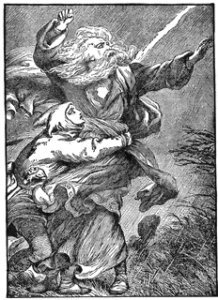
  • King Lear on the heath.  I didn’t realize the power of stage directions until I went back and looked and saw how many scenes say, “Storm still.”  That is a huge storm.

What did I miss?


Unseen Scenes

For reasons too complicated to mention I was fast forwarding through King Lear with the kids last night, jumping to the ending.  I knew it wouldn’t really capture their attention the way I hoped, and I’d have to explain 90% context, but I’m ok with that :).

Which gave me an idea, as I explained how Cordelia died.  Shakespeare gives us lots of action off stage, for whatever reason.  Sometimes modern directors will go ahead and add the scene to make things easier to follow – I’m thinking of Romeo and Juliet‘s wedding scene as an obvious example.  Many people will swear that they’ve seen Romeo and Juliet’s wedding and refuse to believe that Shakespeare never wrote that scene, because it was in the 1996 movie.

What other scenes fit the bill?  I’d love to see Lear’s last desperate act trying to protect his daughter.  I can see the whole thing quite clearly (having just watched Olivier’s version doesn’t hurt).  Cordelia and Lear are sitting happily in a cell.  Enter guard with a rope, who roughly pulls her away despite Lear’s protests. He tries to protect her but is no match for the guard who hurls him back to the ground. The guard struggles with Cordelia and drops his sword so he can use both hands (having been ordered to hang her, not stab her).  Behind his back Lear recovers the sword and does the scoundrel in, just as the messenger from Edmund (et al) arrives screaming for them to stop the execution.

What else?  Petruchio and Kate’s wedding scene writes itself, that’s an easy one.  Then you have Macduff beheading Macbeth, but I don’t think of that one as a really necessary scene, there’s just not much to it.

Which ones am I missing?


Not So Great Shakespearean Deaths (The Game)

When I put the Great Shakespearean Deaths Card Game on my Shakespeare Gift Guide this year, I jokingly put it in the “Stuff I Want” category.  Well god bless my mom who saw that post and thought, “Hurray, my son published his Christmas list!” and immediately bought it for me.

Apparently it’s quite a popular choice this year, as a quick Twitter poll showed at least half a dozen people who could now include it in their stash as well.

The problem is, it’s not a good game.  You have no idea how disappointed I am to say that, but it’s only reasonable, as I’m disappointed in the game.

Each card represents a character death, explaining that death briefly, offering last words where the character had some. It also rates the death on a number of scales – gore, piteousness, fairness, speed of death, and a few others.  So far so good, a chance for people unfamiliar with any deaths other than Romeo, Juliet and Hamlet to learn about the lesser known characters like Enobarbus or “the fly” from Titus Andronicus (seriously? seriously).

If I understood the directions correctly – they’re written in a weird, pidgin-Shakespearean – everybody gets a face-down hand of cards, and can only play their top card at any time. When it’s your turn, you look at your top card, then pick a scale, presumably based on which one is best for that card. Whoever has the high score for that scale (normally you, since you’d pick your best scoring chance), you get the other players cards. If there’s a tie, those stay in the middle and you play again.  It’s basically “War”, the card game.  There’s no real strategy involved. Got a ten? Pick that one.

Has anybody else played it? Did I misunderstand anything?

My kids were bored almost immediately and clearly played only so I wouldn’t be sad that my Christmas gift was boring.  I meanwhile started thinking of ways to make it more interesting.  Here’s a few that we came up with:

  • Pick the category before you look at your top card.  That makes it entirely random, but at least you don’t just keep giving your cards to whoever had a ten for Gore and Brutality.
  • Play two-factor.  Choose two attributes (by dice roll if that’s easier), and you have to maximize your score across both.  So your ten coupled with a two isn’t going to beat somebody else’s six and seven.
  • Everybody gets to look at their cards, but at each turn roll a die to randomly determine which attribute will be played. That way you at least have to decide which card to play.
  • Everybody gets a hand of six cards. Your goal is to maximize your score by playing one card per attribute. For your turn you play it like Go Fish in reverse, offering up a card to see if anybody wants to trade.  For example say you’ve already got Richard III as a 10 in Last Words.  But you’re also carrying Hamlet, and you really need somebody with a better Speed of Death score.  So you’d say, “Does anybody need Hamlet?” without specifying his numbers – people have to learn who the good cards are.  If more than one person wants him, they can make their case – “I’ll trade you a Young Macduff” – and you decide who to trade with.  When everybody’s happy with their hand and either doesn’t want to trade or can’t find someone to trade with, total up your scores.
  • Play by poker rules.  Deal out five cards, try to match up the plays – “I’ve got a full house, three of Hamlet and a pair of Richard III.”

Those are just some ideas, some literally off the top of my head as I write this post.  There aren’t enough cards to play some of the games I thought of.  You’ll quickly be surprised with who is – and isn’t – in the deck, as well as how they’re graded.  This is covered in the rules, and there’s even a blank card to add your own.  A nice idea, but I would have preferred that they just make all the deaths.  It’s been popularized in posters and infographics, it’s not really a hard data point to get.  If there’s too many you could start lumping them together (like “Macduff’s Family”).