Commonwealth Shakespeare on Boston Common: A Midsummer Night’s Dream

In 2007, Commonwealth Shakespeare’s production of A Midsummer Night’s Dream on Boston Common was one of their first shows that I saw. To quote myself:

Here we are almost 20 years later, and it’s time to do it again! Back then I was working in the neighborhood, literally walking over to the site during my lunch break to watch them set up. Now it’s a family event.

How was it? Well, it’s Dream. It’s simultaneously one of Shakespeare’s masterpieces, and yet it’s also one of his funniest, safest, most approachable plays. You can have small children perform this. Sure, there are darker themes if you want to go there, but few productions I’ve seen do that. Most are happy to play to the easy physical comedy.

And so it was here as well. CommShakes is kind of known for that, but then again I’d think that any “free outdoor Shakespeare” group is going to do the same. You want people to wander in and sit down. You don’t want them turned off by the language they don’t understand. You want the laughs to be obvious, and the action to be entertaining.

First, Pictures!

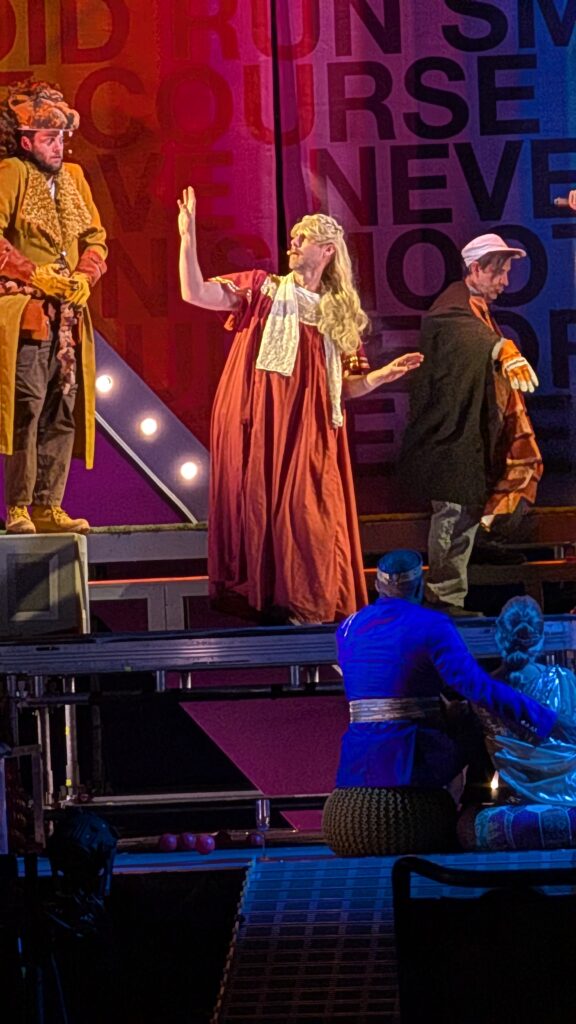
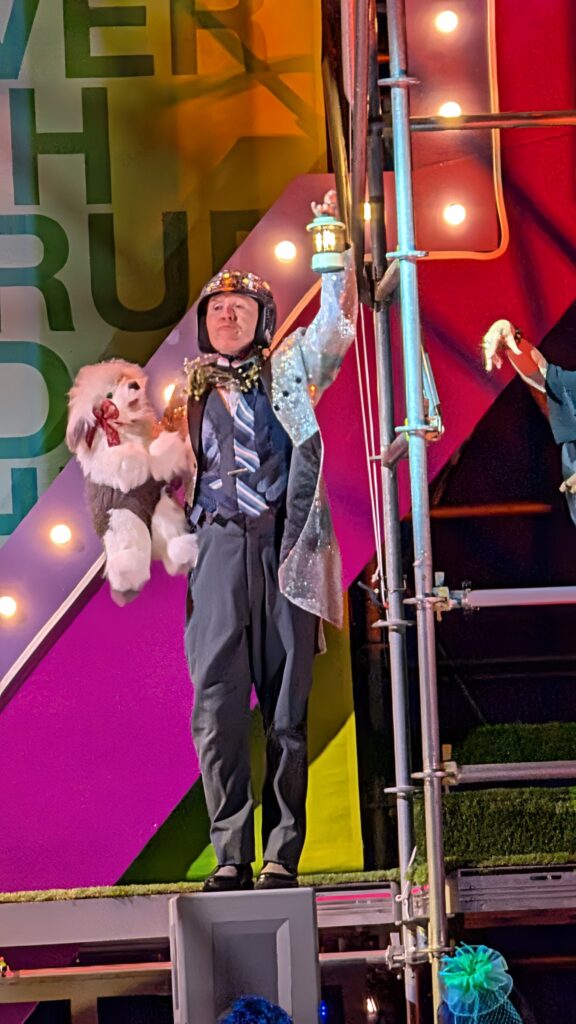
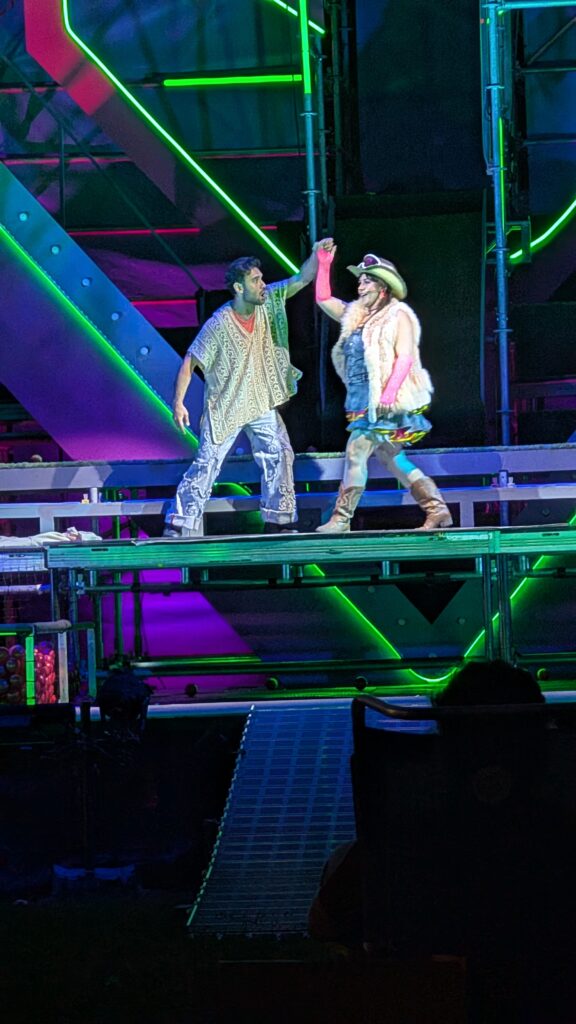
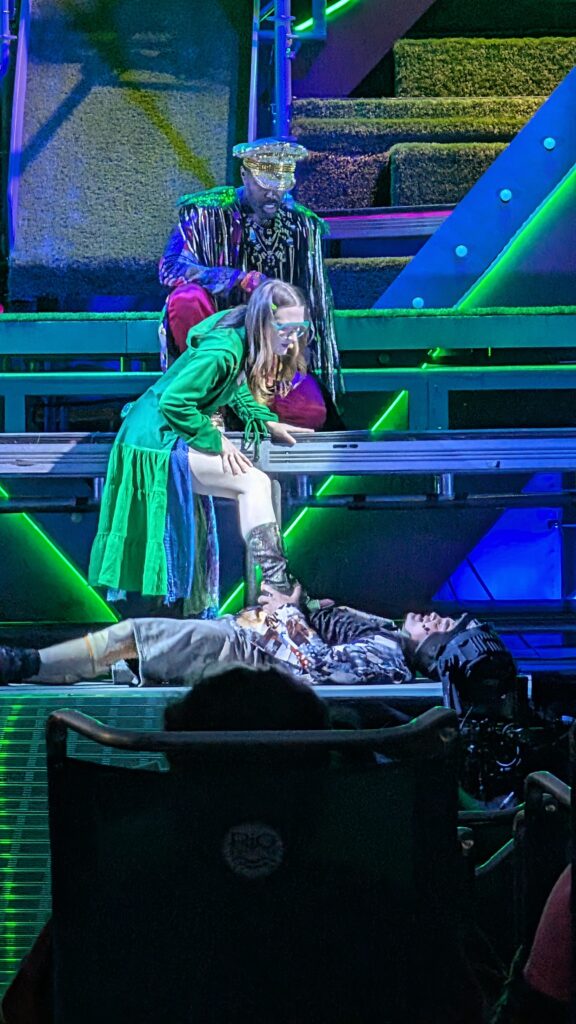
The biggest thing that’s going to differentiate Dreams is the staging and costumes. Are we going woodsy? Neon? Outer space? You tell me. I thought that some of them kind of looked like psychedelic mushrooms.
Hermia and Lysander
First we have Hermia and Lysander in their traveling clothes
Helena and Demetrius
Helena putting her foot down to, and on, Demetrius
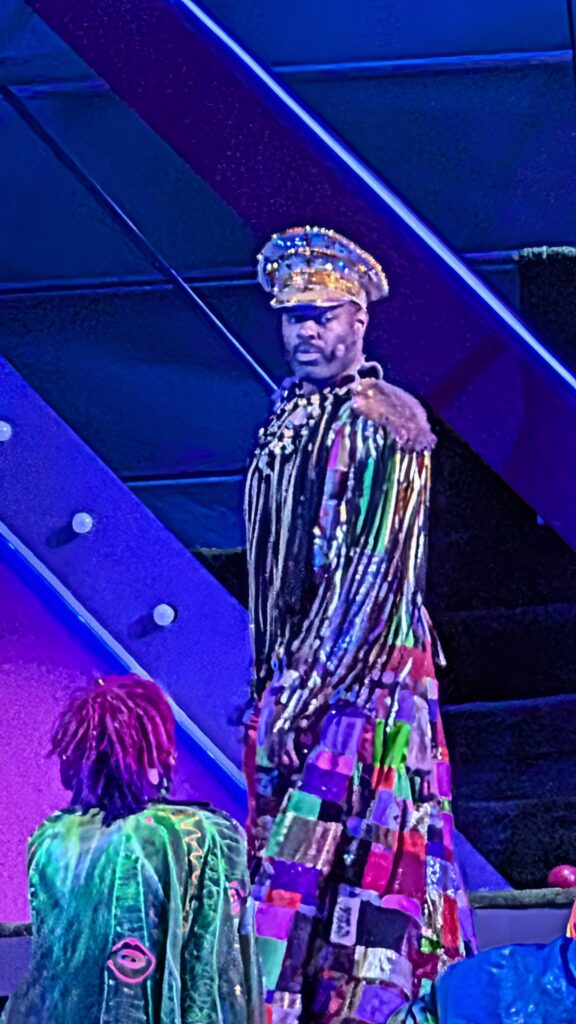
Oberon
Oberon was giving serious Colman Domingo vibes from where we sat, and I intend that as a compliment
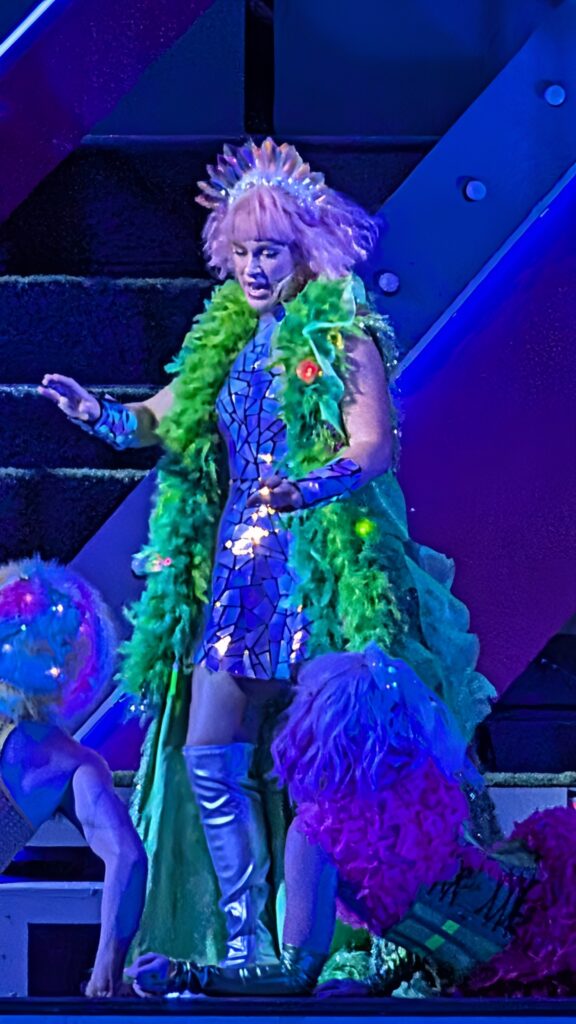
Hippolyta
Hippolyta kind of reminds me of when my daughters would raid the dress-up basket
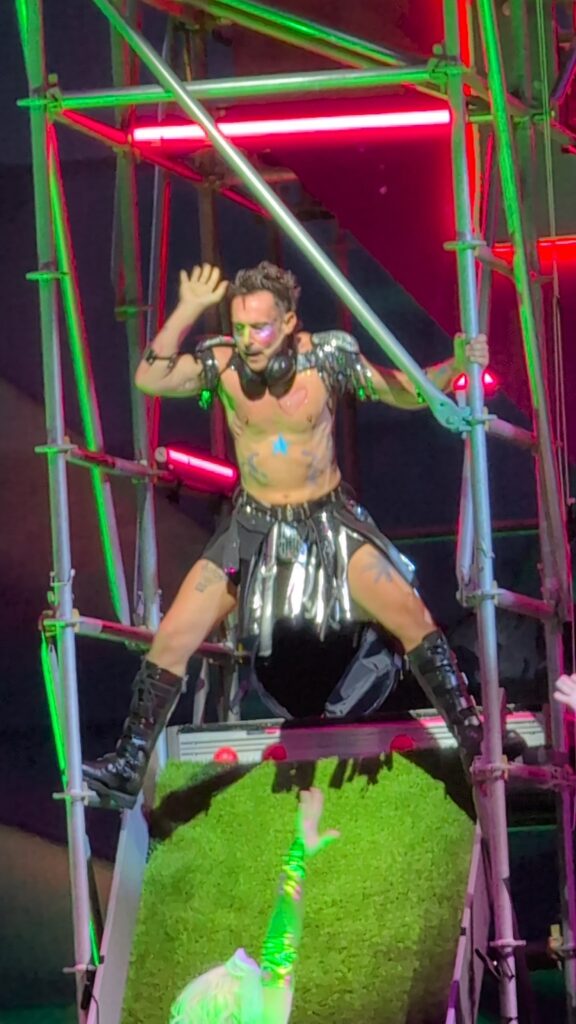
That merry wanderer Robin Goodfellow
You don’t usually think “Roman gladiator” when you imagine Puck, but here we are.
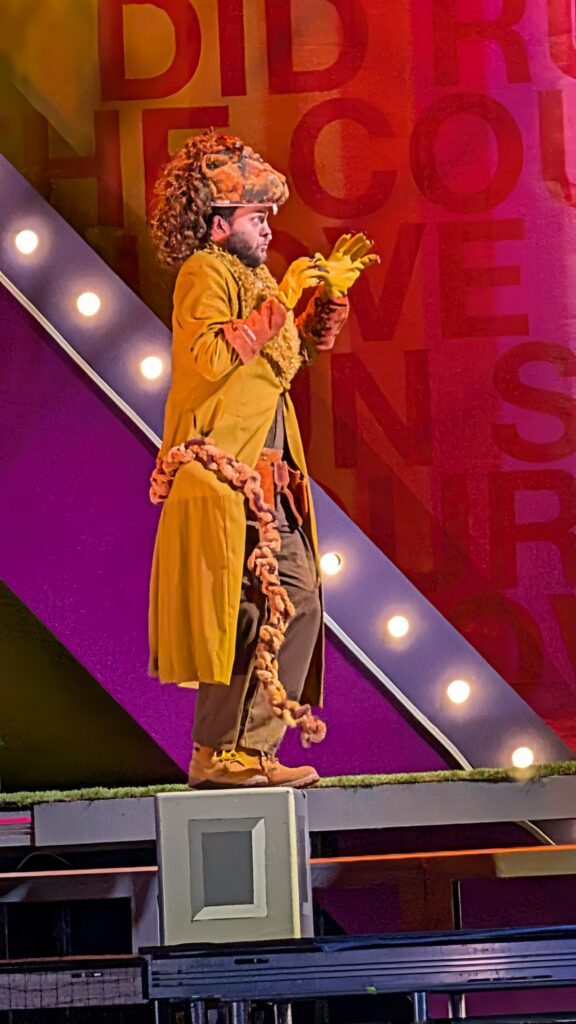
Lion
Well roared, Lion!
Thisbe
Well run, Thisbe!
Moon
Well shone, Moon!

But What About …

I know, we’re missing somebody. We’ve got to see Nick Bottom! Waiting to see how they’ll do Bottom’s transformation is like going to Winter’s Tale and wondering how they’ll do the bear. Ready?
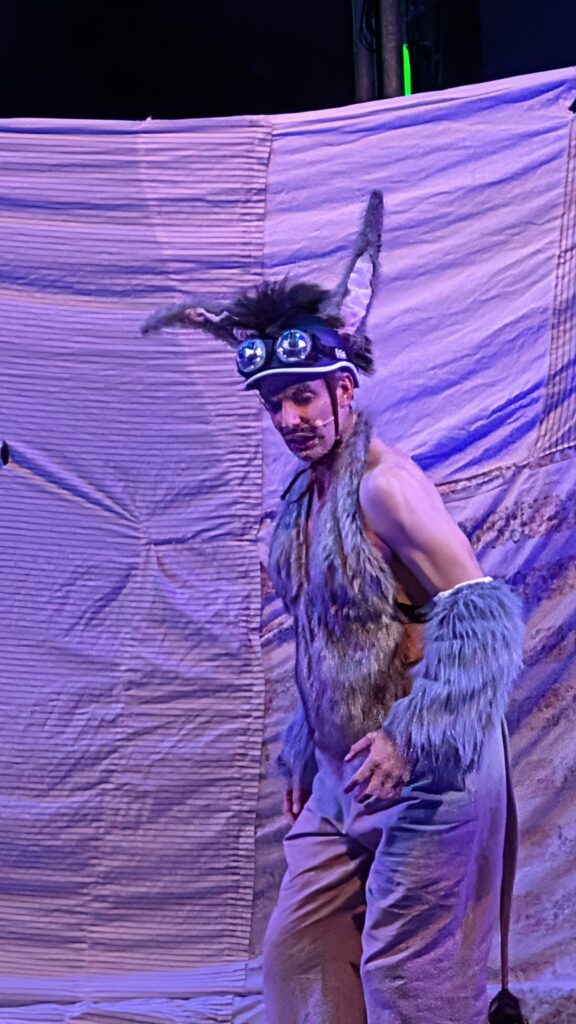
Nick Bottom
Anybody else getting Mad Max: Fury Road vibes?

So How Was It?

As an early review, my wife turned to me after the introduction of the Mechanicals and said, “I like that guy. He’s funny.” That’s an understatement. Our guy was more suave than I would have thought, more Jim Carrey than Chris Farley. I’m still trying to place the character he was doing – not a buffoon, more of an overacting, charismatic Don Juan type of character. It absolutely worked. I told my wife, “There are people who believe that Hamlet and Nick Bottom are Shakespeare’s greatest creations.”

I also want to say a word about Helena. It’s easy to single out her “treat me like your spaniel” speech and think, “Yikes, Helena, not exactly standing up for feminism.” But you know something? When first Lysander and then Demetrius profess their love, this Helena was taking no shit. She did a spectacular job of presenting herself as, “You guys are screwing with me, it’s mean, knock it off right now, I’m not falling for it.” So really the opposite of how she’s sometimes written off. She was probably the most memorable part of the play for me.

What i didn’t like was the singing and dancing. Sorry. It just wasn’t good – it was like every number was being performed by the Mechanicals, and it really bugged me. Particularly when Hippolyta goes to lie down. I always thought of that particular song as a magic spell. I want the audience to feel like every time the music starts, the magic happens (The Tempest is the same way). There was also too much of it. Toward the end, every time they stopped for a song and dance number, I sighed and checked my watch.

Speaking of that, the other problem is that they just go too long. The show started at 8 pm, and at 11 pm we’re still going. Sometimes a show should be quick, hit-and-run, intense. Get in, get the laughs, tell the story, send people home happy and talking about it, not thinking “Oh good it’s finally over; let’s beat the traffic.” Bottom’s death, for instance, just didn’t work. I know that it’s Die, die, die, die, die, but you could do that in 10 seconds or 5 minutes. This one felt more like the latter, which was no doubt on purpose because the entire cast shouts the last “DIE!” at him like they, too, are tired of it. Long way to go for the laugh when it’s 11 pm.

Review: Sing Sing

"Sing Sing"

I’m going to say something up front because I had it said to me (well, I read it), and it helped me enjoy the movie Sing Sing. This is a true prison story. But there are no riots, no escapes, no makeshift shivs sticking anybody in the back. It’s not that kind of story. That’s not a spoiler, that’s permission to breathe, relax, and appreciate what’s really going on in the movie. You don’t have to watch in fear that something bad is going to happen.

I admit that I dismissed Sing Sing at first as just another take on “Shakespeare Behind Bars,” which I first saw twenty years ago. That was a mistake, I’m happy to say.

Sing Sing is the best movie I’ve seen in a long time. Too often I’ll watch a movie in that half-listening, “put it on in the background” way that we sometimes do when we treat an item like a todo-list box to be checked instead of an experience to be savored. Not this time. I was hooked in the first minutes. I put down the computer and sat on the edge of my couch cushions straight through to the end.

This movie tells the story of Sing Sing prison’s Rehabilitation Through the Arts (RTA) program. It focuses on the story of John “Divine G” Whitfield, a playwright himself and original member of the group, played brilliantly by Colman Domingo. We also learn that he’s incarcerated for a crime he didn’t commit, and on a continuing quest to prove his innocence.

We open with the close of the group’s most recent performance, A Midsummer Night’s Dream, and the addition of new members to the group. Here we meet Clarence “Divine Eye” Maclin, playing himself. One of the fascinating aspects of this movie is that it’s based on a true story and played by many of the actual original players. If, like me, you’re wondering how the two main characters ended up as “divine” something? Well, that’s not the writing, that’s the reality. Those were their names.

Despite Divine G’s insistence that Divine Eye be admitted to the group, there’s some immediate animosity at Eye’s strong new personality. G is thrilled when the other members of the group suggest they perform one of G’s original plays next, only for Eye to sway the group that a comedy is the way to go. But then they both audition for the only dramatic role in the script (an original, created by the group’s director).

This sets up the first of many confrontations between the two. G loves the program and knows what it’s done for the other inmates. Eye comes from a world where if someone so much as walks too close behind you, your life might be in danger. The evolving relationship between the two is the our major story arc.

What About The Shakespeare?

This is a Shakespeare blog, so let’s talk about Shakespeare. This isn’t a Shakespeare movie. They don’t perform Hamlet in the big final act. But somehow, that makes it an even better depiction of why Shakespeare is universal.

We find out that Eye became interested in theatre after stumbling across King Lear as one of the few books accessible to him. Unprompted, he quotes, “When we are born, we cry that we are come To this great stage of fools” with no fanfare, no “Look at me I’m quoting Shakespeare,” no flourish or fanfare. His interpretation actually made me laugh, saying that “whoever wrote this, man, had to did a bid before.” The idea that Shakespeare can just pop into your life, at any time and place, and you don’t even know what it is, but it still resonates, no matter who you are? Come on now. What have we been trying to say all these years?

Colman Domingo in "Sing Sing"

There is more Shakespeare than that, not to worry. Despite the play being an original time travel comedy featuring time travel, pirates, and zombies, it also features Hamlet. (If that makes you think of Hamlet 2, you’re not alone.) Eye, of course, is playing the role – which affords G the opportunity to direct him. The actual director of the group is not an inmate, so while he can speak to the theatre, he can’t speak to the experience. That’s where G shines. He helps Eye break through from “I walked on stage and said the lines” to “I am the character.” It’s really quite a thing of beauty to behold.

I’ve often said that a key to understanding Shakespeare is realizing that, underneath the words, “there are people in there.” Well, that’s true here, too. These are prisoners, but they are people. There are multiple scenes where they talk about their children, their lives outside the prison, and how they got there. There’s a scene where they all meditate on their “happy place” and talk about it, and an inmate realizes that his happy place is right there, right now. He is happy where he’s found his people.

I could keep on like this, describing the scenes I loved, but I’ll tell the whole movie. There is a story that we want to see resolved. Eye, knowing he’s innocent, struggles to get out – no matter how much value he’s found in the RTA program. G, who slowly but thankfully becomes part of the RTA program, can’t imagine any world other than the one he’s made for himself. Both these characters are changed individuals by the movie’s end credits.

One more scene, and then I’ll wrap up. During an early confrontation, Eye is still throwing around N-words like they’re part of the normal prison vocabulary. “We don’t say that here,” G tells him. “We say beloved.”

I get it, I think, at least as much as a white person can. Both, in their way, are expressions of a bond that exists, a way of saying, “We are the same, we come from the same world, there are things that we share that not everyone shares.” But they can achieve the same purpose and still be completely different ways of doing it.

And at first, you think, “Yeah, sure.” This is the guy still packing a knife in his waistband, ready to cut one of his fellow actors just because the blocking called for him to get a little too close. But you know what’s going to happen, And when it does, it’s … just so natural. The director doesn’t call your attention to it with over-the-top background music. There’s no meaningful pause for the audience to have their “Ohhhhhh, ok!” moment.

That’s why I love this movie. You don’t spend the whole time thinking, “Somebody created this story, somebody wrote a script, somebody directed it and told the actors what to do and where the camera should look.” This isn’t just a real story, many of the original actors perform the story including Divine Eye. If you love something about it, love it more because it really happened. It’s not someone’s wishful thinking. Score one for Shakespeare.

Image from performance in "Sing Sing"
The actual play performed by the inmates is … something.

Titania’s POV?

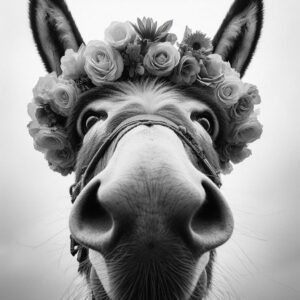
Donkey in a flower crown
Good Morning, Starshine!

While watching the 1935 Midsummer last week, I spotted something interesting. Act IV, Scene 1, we’re starting to wrap up the story. Oberon has drugged his wife Titania and taken what he wanted (the changeling boy), and now he begins to have something resembling guilt about it. (It’s far from a healthy relationship if you ask me, but that’s a different story. )

So, he wakes her up and releases her from the love potion. Here’s where it gets interesting, depending on how we read the text.

Option 1

OBERON
And now I have the boy, I will undo
This hateful imperfection of her eyes:
And, gentle Puck, take this transformed scalp
From off the head of this Athenian swain;

Now, my Titania; wake you, my sweet queen.

TITANIA
My Oberon! what visions have I seen!
Methought I was enamour’d of an ass.

OBERON
There lies your love.

TITANIA
How came these things to pass?
O, how mine eyes do loathe his visage now!

Here, Oberon asks Puck to turn Bottom back to normal. Then he wakes Titania, who presumably sees a human. Sure, she’s still grossed out by it, but she can walk away from the experience, thinking that the whole “donkey” thing was just a weird dream.

Option 2

OBERON
There lies your love.

TITANIA
How came these things to pass?
O, how mine eyes do loathe his visage now!

OBERON
Silence awhile. Robin, take off this head.

Oberon tells Puck again to fix Bottom. It’s perfectly in character for the boss to tell the mischievous sprite twice before he does something, so I’m not looking at this as a mistake of Shakespeare’s. But this second one implies that he hasn’t done it yet. This means that Titania wakes up and sees Bottom in his full donkey-headed glory, which means it wasn’t a dream. Poor Titania will be in therapy over that memory, I’m sure.

Which Do You Prefer?

According to the text, the second line implies that the first wasn’t enough, and therefore, #2 is the “correct” interpretation. But we could snip out “Robin, take off his head” and give Titania a break.

Which have you seen most often in performance? Which do you like better? I think this is a modern addition to how we look at the scene, I don’t think it crosses Oberon’s mind. It’s not like he waits for Puck to fix Bottom’s head before waking her up. If he wanted her to see him that way he could have waited before giving Puck the order. But that’s part of the fun and why we keep doing this, looking for little things we can change that make big points about the character.

Review: 1935 Midsummer

There are many Shakespeare movies that I know about, have written about, have seen screenshots and clips of. But sitting through all of them is a challenge for many reasons. I’m slowly chipping away at a very long list. Happily, I can now move a certified classic to the WATCHED list.

Max Reinhardt’s 1935 production of A Midsummer Night’s Dream deserves its place in Shakespeare Film history. It picked up two Academy Awards (on four nominations) and featured a cast of names still known today – James Cagney, Olivia de Havilland, and Mickey Rooney to name just a few. Watching it now is a weirdly nostalgic experience for a Gen Xer like me. As we get to the big hysterical finish, all I could think of was how much it reminded me of watching the Three Stooges or Little Rascals. I can’t quite put my finger on it, but if you remember those shows (even if you watched them with your parents or grandparents!), maybe you’ll see what I mean.

Let’s talk about dreams for a second. They’re used in metaphors way too often. “Oh, this new job is a dream!” We use dream to mean “the ideal thing I wanted.” Not that. I mean real dreams. Real dreams to me are more like, “Nothing makes sense, and yet I’m oddly ok with all of it. Why am I suddenly back in high school, why are my coworkers here, why is there a freestanding toilet in the middle of the auditorium stage?” While you’re in the dream and not asking any of those questions, it all seems normal. Only after you step out and wake up do you think, “Well, that was weird.”

When I thought of that analogy for this movie, I intended it to be negative, but why not make a Dream movie that feels like a dream?

Let’s Make This More Visual

I’m sure many of us have seen productions of The Winter’s Tale, famous for its “Exit, pursued by a bear” stage direction, featuring no bear.

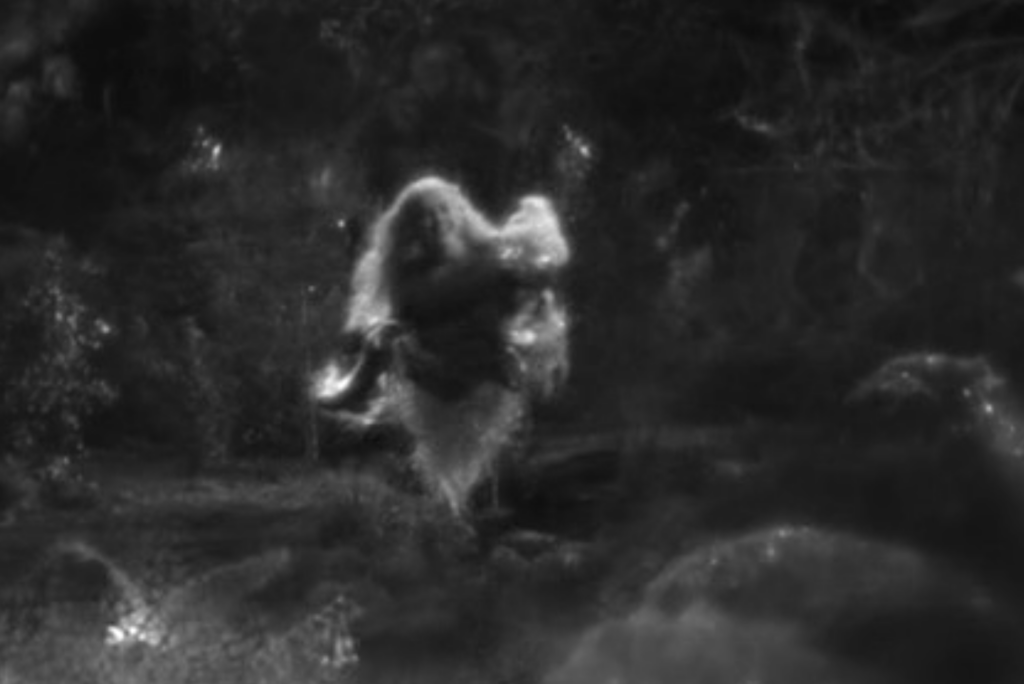
Not so fast! The forest of Athens seems to be home to actual bears now. My best guess is that somebody spotted Helena’s line, “No, no, I am as ugly as a bear; For beasts that meet me run away for fear:” and thought, “Ok, Helena is running away from a bear.”

“Now I will believe that there are unicorns!”

Unfortunately, that’s a line from The Tempest, not Midsummer. I have no idea how this one got here. The word unicorn doesn’t appear in the play that I can find.

How Were The Fairies

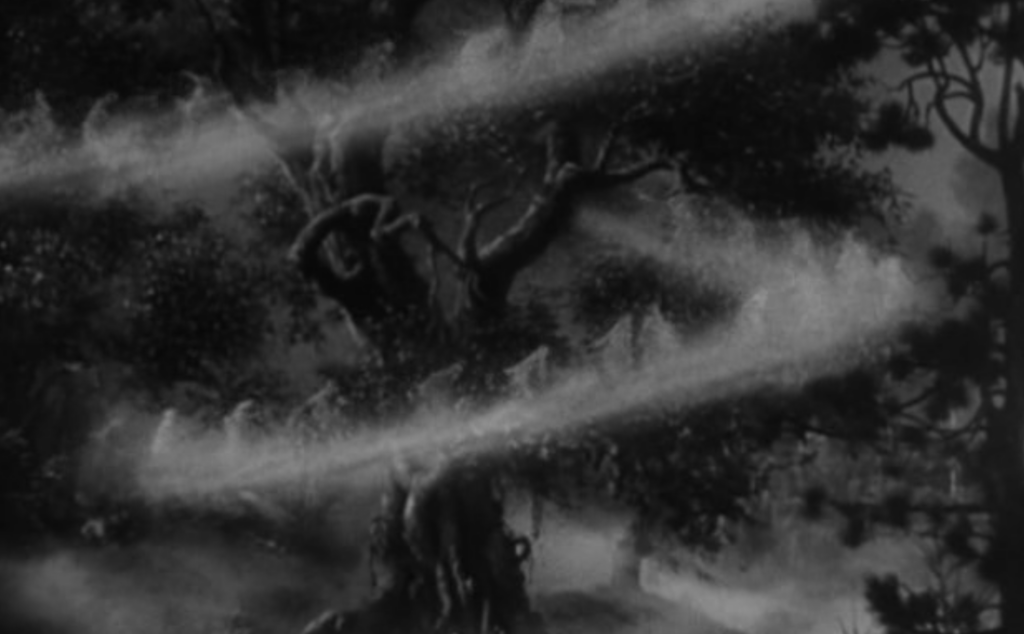
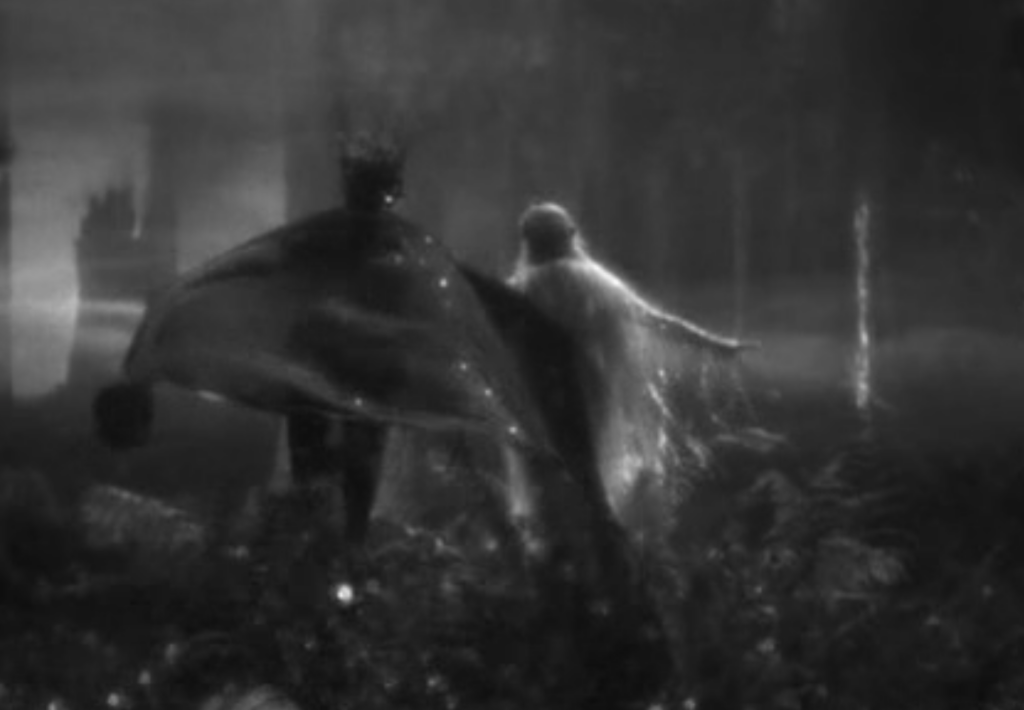
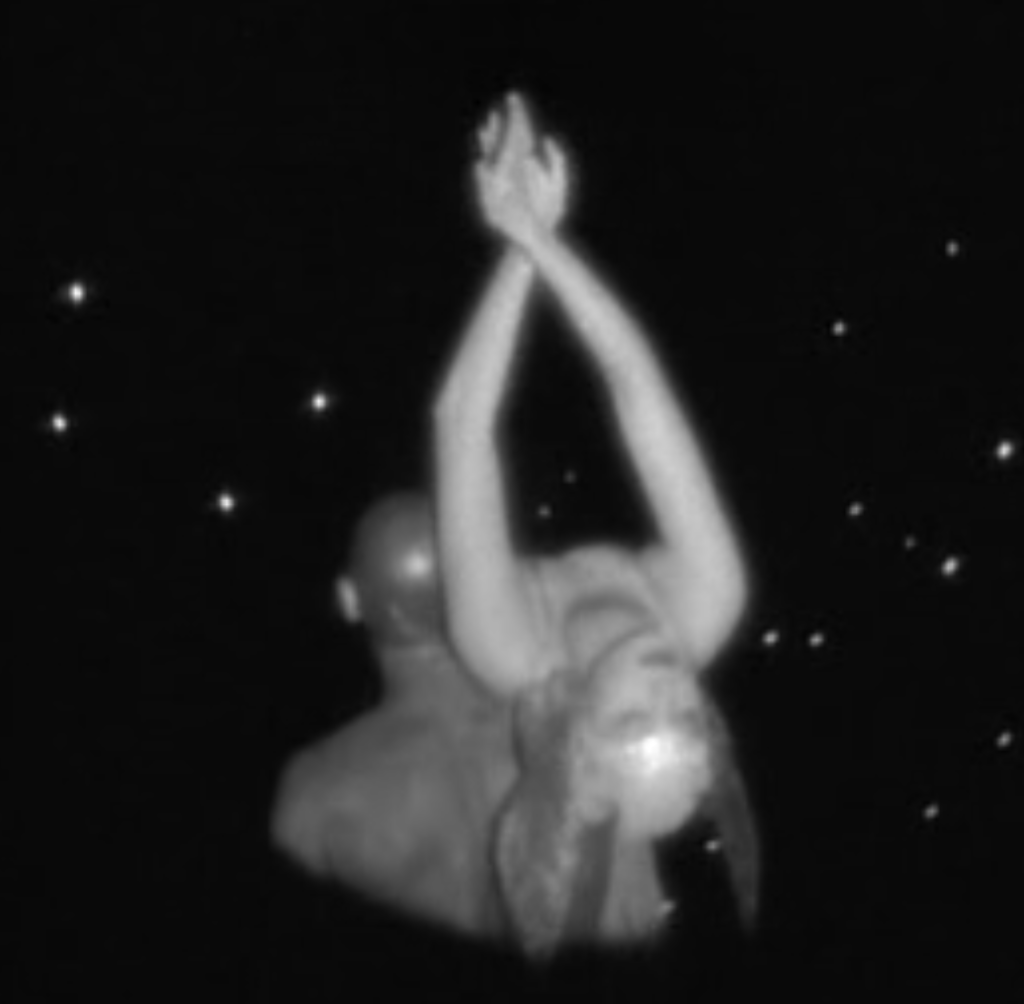
Now, let’s talk about the fairies. Most of the fairy budget was spent on Titania’s retinue. They sparkle, they glow, and they have lengthy dance numbers. At one point, they’re literally floating into the sky by the dozens:

Wow! If this is the entrance for Titania, I wonder what Oberon’s entourage will look like?

Uhhh… yeah. There’s a lot of these guys. They even have a band at one point, and you seriously wonder if the original Star Wars Cantina scene got the idea from this movie.

Later, though, they do get a costume change…

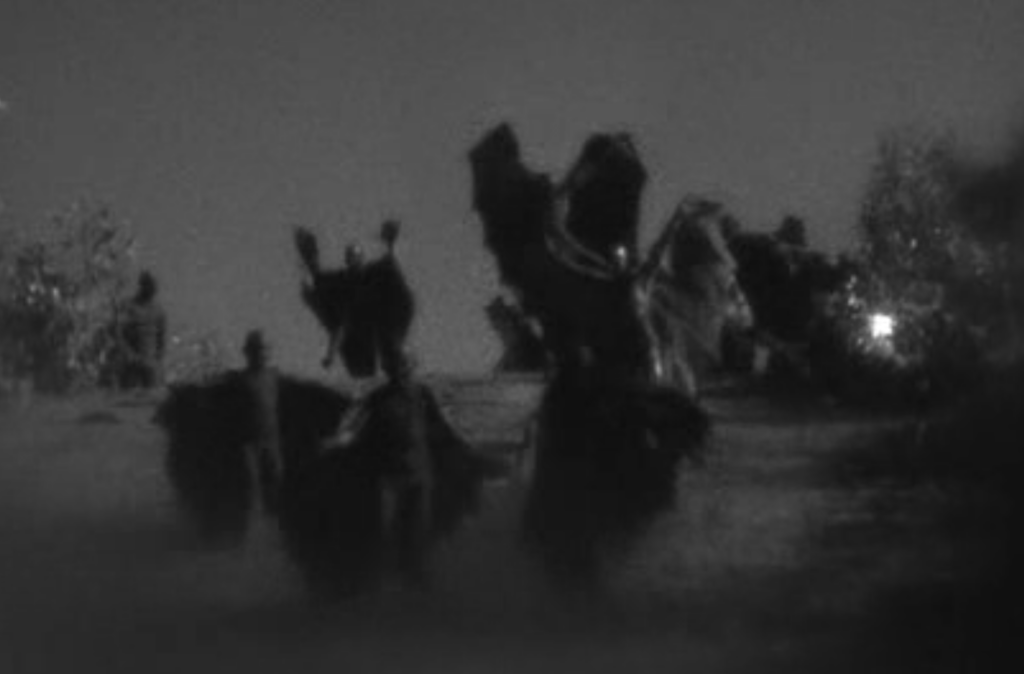
For some reason that I genuinely don’t understand, they suddenly all have wings. Black, scary wings. It’s very much like the part in The Tempest when Ariel suddenly transforms into a Fury, but I don’t recall such a scene in Midsummer. Just all of a sudden, they went from “little people in Halloween masks” to “I don’t know what’s going on but I don’t like it, keep those things away from me.”

What of our stars, Oberon and Titania?

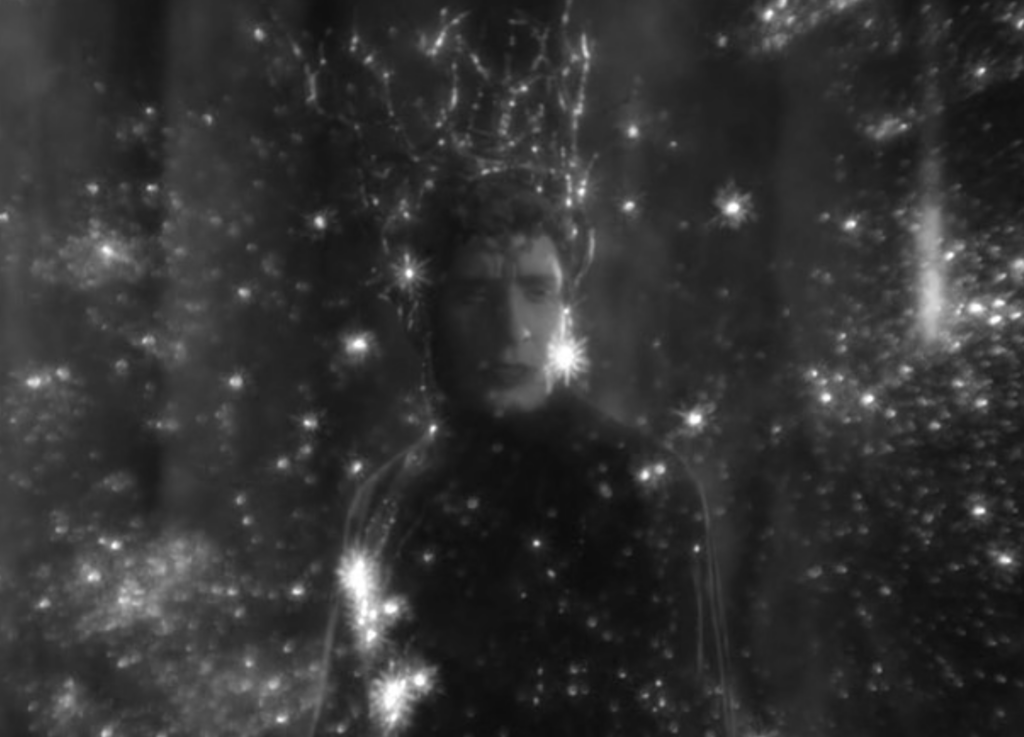
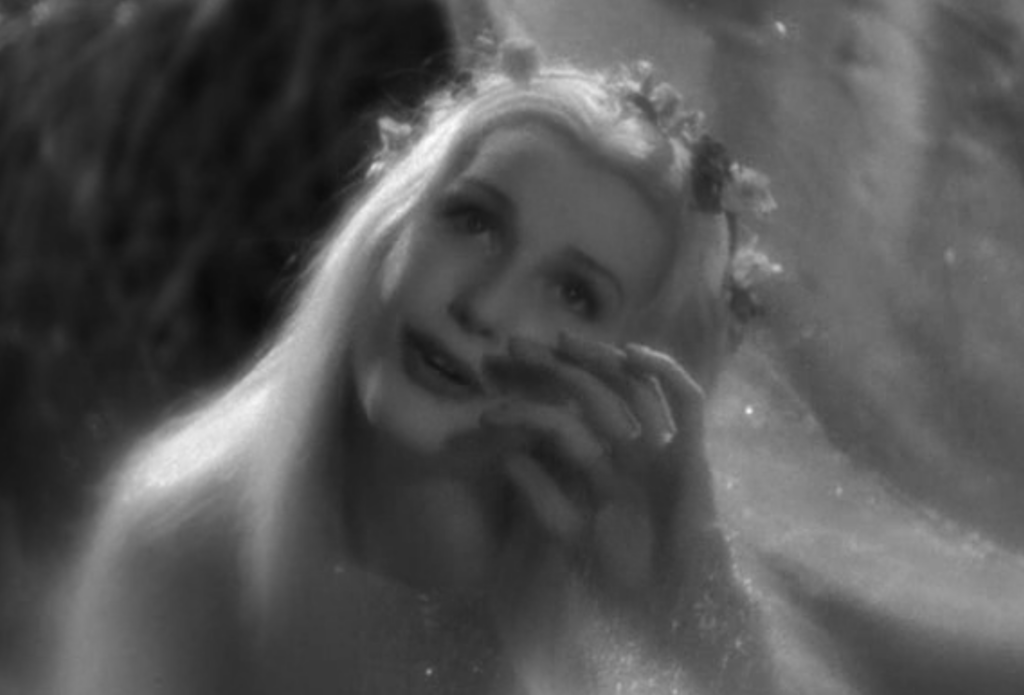
Oberon gets the better deal here. Titania gets to sigh and oooh and ahhh with hand on cheek a lot. She sounds a great deal like Glinda from Wizard of Oz. Oberon, meanwhile, is a walking special effect. Not only does he have this cool crown of branches (that, in fairness, reminds me of Groot from the Marvel movies), but he’s always surrounded by stars. This is another one of those dream-like things. Why are there stars around him? How are they there? Are they actual fireflies? Are they really there or an illusion? If he swatted at them would they move? We don’t get any answers, of course. This is just how he goes about life.

But that’s ok, Titania gets to one-up her Oberon…

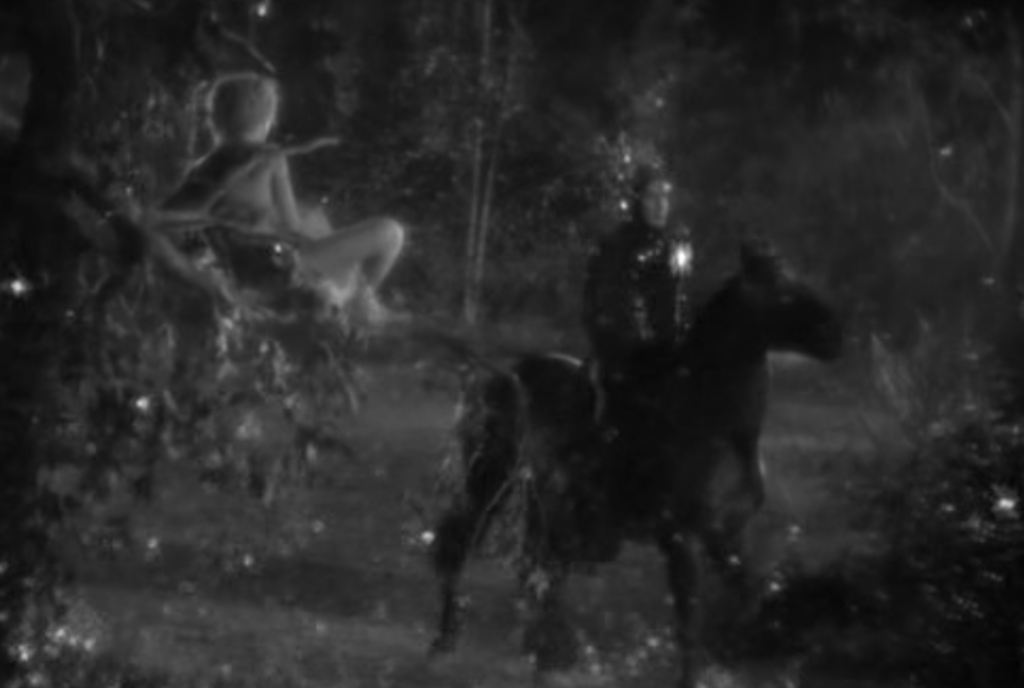
Titania flies wherever she wants. Oberon rides a horse. Again, there’s that dream world logic. Some people fly, some walk, some ride horses. But, are you ready for this?

Oberon can fly, too. SO WHY IS HE RIDING A HORSE?

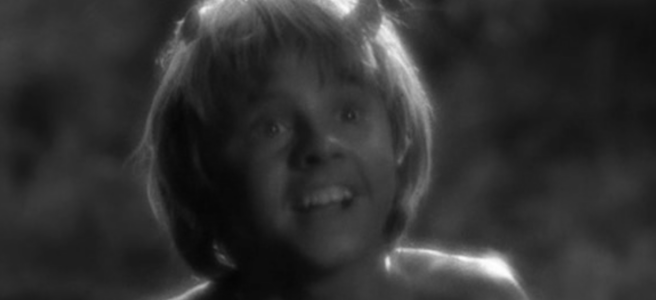
The Mickey Rooney Show

You can tell how old someone is by how they remember Mickey Rooney, a wonderful actor with a record-breaking career that includes credited roles in 10 decades, from the 1920s to the 2010s.

As our Puck, he was just 14 years old and honestly does a spectacular job for someone so young. There’s a lot of creative license in how to play Puck, and Rooney plays to his strengths. He’s a child, running around and causing mischief. When he’s in the mood to act like an animal, he makes animal noises. When he finds things entertaining, he laughs with genuine glee. When an adult tells him what to do, he enthusiastically goes about trying to do it properly, though he doesn’t always succeed. All while delivering a lot of Shakespeare, in makeup and costume. Sometimes he flies. According to the trivia he actually spent much of production with a broken leg and had to be wheeled around the set!

Experience It For Yourself

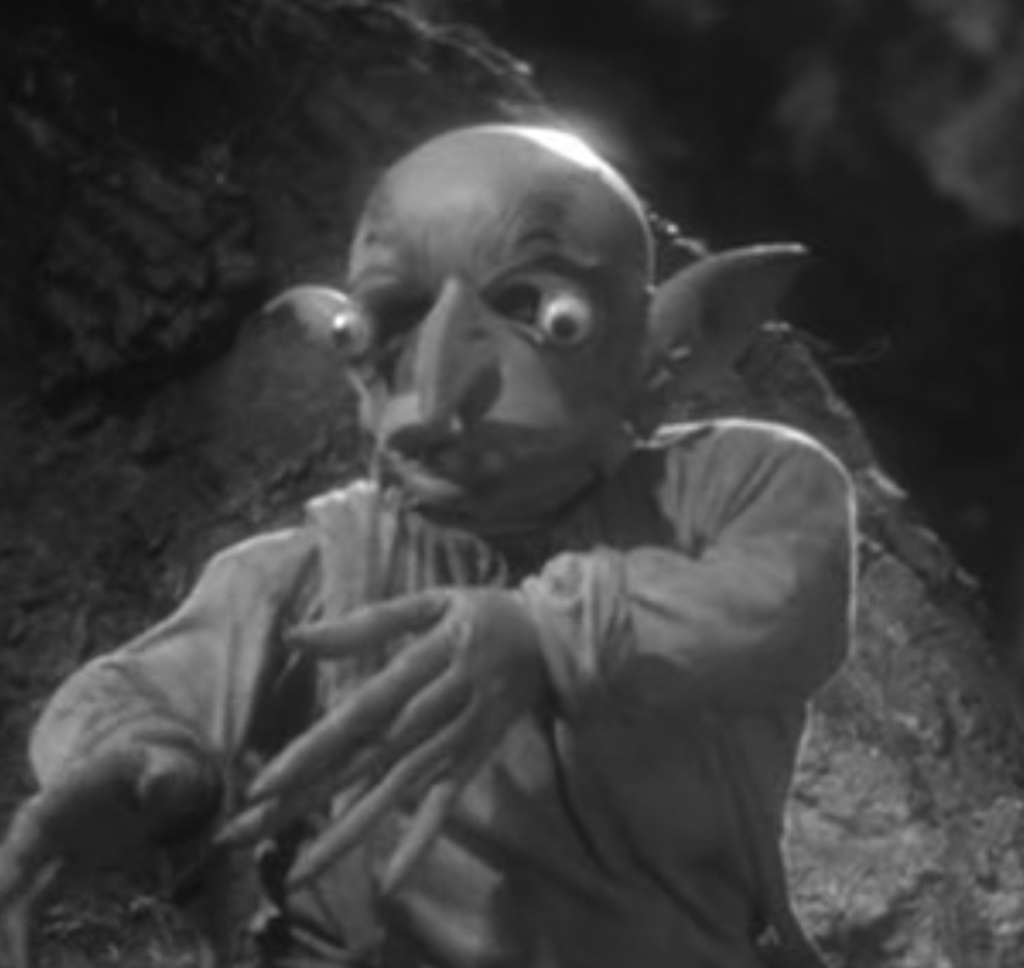
Honestly, just see this one if you can. There are places where you really think you’re watching Mystery Science Theatre 3000 and the entertainment is to be found in mocking how bad it is (seriously, I can’t do justice to the “goblin fairies’). There are random ballet sequences just inserted at will. The special effects deserve their own award for just how broad a spectrum they covered. People fly, people fade in and out of existence, Bottom transforms back and forth before our eyes. Then there are the dimestore masks, and this fairy being carried off into the sunset:

I repeat, it’s like a dream. When it’s done you’re left thinking, “What in the world was that? Did it make sense or not? I can’t really tell.”

Christmas in Shakespeare’s Plays?

I continue playing with ChatGPT in as many varied ways as I can imagine. Last night I asked it to write me a blog post on “Christmas in Shakespeare’s Plays.” Here’s what I got. Let’s dissect!

The celebration of Christmas has a long and varied history, and it has been depicted in literature and art for centuries. In the plays of William Shakespeare, Christmas is often portrayed as a time of joy, celebration, and reflection.

Fine, I guess. Generic.

One of the most well-known references to Christmas in Shakespeare’s plays is in “A Midsummer Night’s Dream.” In this play, the character Bottom describes a dream he had in which he was transformed into an ass and danced at a Christmas feast. This humorous portrayal of Christmas is a lighthearted example of the way in which the holiday was often depicted in Elizabethan England.

…what? After all these years I’ve still got some pretty hefty impostor syndrome when it comes to Shakespeare, so whenever it said Bottom references “dancing at a Christmas feast” my first thought was, “He does? Why don’t I remember that?” So I went looking:

I have had a most rare
vision. I have had a dream, past the wit of man to
say what dream it was: man is but an ass, if he go
about to expound this dream. Methought I was–there
is no man can tell what. Methought I was,–and
methought I had,–but man is but a patched fool, if
he will offer to say what methought I had. The eye
of man hath not heard, the ear of man hath not
seen, man’s hand is not able to taste, his tongue
to conceive, nor his heart to report, what my dream
was. I will get Peter Quince to write a ballad of
this dream: it shall be called Bottom’s Dream,
because it hath no bottom; and I will sing it in the
latter end of a play, before the duke:
peradventure, to make it the more gracious, I shall
sing it at her death.

I even went into the Quarto versions. I’m aware that just searching “Christmas” isn’t going to yield a hit, but so far I see nothing even close. I asked on Twitter, and others didn’t seem to know, either. Hmm. Ok, moving on.

In “Henry V,” Shakespeare references the Christmas season in a more serious manner. The play takes place during the Hundred Years’ War between England and France, and it tells the story of King Henry V’s victory at the Battle of Agincourt. In one scene, the king speaks to his troops on the eve of the battle, reminding them that it is Christmas time and encouraging them to fight for their country.

It’s Christmas Time? <asks Google to remind me when St. Crispin’s Day is> October. Again, I’ll plead ignorance and ask, is there a connection here? Would you call Agincourt “Christmas time”? Ok, one more.

“Twelfth Night” is another play that features Christmas as a prominent theme. The play is set in Illyria during the Christmas season and follows the misadventures of the character Viola, who disguises herself as a man after being shipwrecked on the coast of Illyria. In one memorable scene, the character Sir Toby Belch gets drunk and sings a song about Christmas, declaring it to be “a time for joy, a time for love, a time for peace on earth.”

This is just a no. Twelfth Night is named for when the play was performed, not for the plot. It doesn’t mention anything related to Christmas or the Christmas season at all. And, much like Bottom’s Dream, I have no clue what song of Sir Toby’s it’s talking about. The word “peace” pretty much only appears in the play when people are saying “Hold thy peace.” Joy doesn’t appear at all. No version of “a time for” anything appears at all.

Overall, Shakespeare’s plays depict Christmas as a time of joy, celebration, and reflection. Whether it is through humorous references or more serious themes, the holiday is an important part of the fabric of Elizabethan England and continues to be a beloved tradition today.

And we wrap up with the generic, basically repeating the intro paragraph. This is what I used to teach my kids as the “middle school format”. Make a statement, say what your essay will show. Three paragraphs demonstrating your point. Conclude by restating your original argument.

At first glance I only picked up on Bottom’s Dream and thought, “Oh, interesting, I wonder what bug caused that.” But upon further reading and realization that it’s entirely wrong and just flat out making stuff up, my whole attitude toward the program has changed. A student tasked with looking for Christmas references in Shakespeare’s works could be given this response and assume every word of it is true. I sent me feedback to the creators (which you’re supposed to do, that’s one of the reasons it’s free for people), but I don’t expect it’s something they can address. Where do you even look for the source of something like that?

On that note, Happy Holidays, everyone! I hope everybody gets lots of Shakespeare Geek Merchandise!