William Shakespeare is widely regarded as one of the most influential playwrights in history, and his plays have been performed and studied for centuries. From the timeless tragedy of Romeo and Juliet to the hilarious antics of A Midsummer Night’s Dream, Shakespeare’s plays continue to captivate audiences around the world. Whether you’re a fan of tragedy, comedy, or romance, there’s a Shakespeare play for everyone. So why not revisit these timeless classics and discover the magic of Shakespeare for yourself?
Normally I wouldn’t give a second thought to a Mark Wahlberg movie like The Gambler. It’s just not the kind of thing that interests me. But then I learned that he plays a Shakespeare professor with a gambling problem. Ok, that’s more interesting. Still, though, if that’s just character development then we’ve all seen it before – cut to a scene of him dismissing a classroom full of students and telling them there’s a quiz on Romeo and Juliet tomorrow. Bam, you’ve just established him as a Shakespeare professor.
Only…not this time. The clip I found actually opens with him talking about Greene’s Groats-Worth of Wit, if you can believe it! There’s a reference that the typical “took Shakespeare in high school” audience is not going to get.
Even better! A student makes a joke that Greene’s “beautified with our feathers” line is actually because he knew that Shakespeare was really Edward de Vere.
First of all, what? I’m not even sure where the connection lies between those two thoughts.
But it gets better, because Wahlberg doesn’t have any patience with the anti-Stratfordian argument. “The Earl of Oxford wrote poetry,” he responds. “Badly.”
I have not finished the movie yet, so perhaps someone can tell me — is that it? Does Shakespeare, either his words or his themes, play a larger role in the movie? Having just completed The Humbling I’m left a bit disappointed. If somebody tells me that’s it for interesting Shakespeare content, I probably won’t finish this one.
I would never have heard of “The Humbling” if Google news alerts didn’t pop it up for a Shakespeare reference. It stars Al Pacino and is based on the Philip Roth novel, which I have not read.
The play opens with Pacino, dressed in a trenchcoat and looking like something out of Death of a Salesman, practicing the ages of man speech from As You Like It. It looks at first like he’s trying to remember his lines, but we soon see that he is trying to decide how he’s supposed to deliver them. The line between his acting and his reality is becoming a blur, and he’s having trouble differentiating between what he feels and what he’s only pretending to feel. After an event at the performance sends him to the hospital there’s a funny scene where he’s moaning in pain and asks the nurse, “Do you believe that? That I’m in pain?” When she says she does he says, “I could do that better. Let me try it again,” and tries a different delivery. It’s not that he’s faking. He just can’t escape analyzing his own performance, even when it is reality.
Now we get to what I like to call the “not Shakespeare” part of the movie. He goes to rehab and meets a crazy stalker lady who wants him to kill her husband because as an actor he’s got experience. Then he comes home and starts a relationship with the daughter of some old friends of his, who happens to be a lesbian. He’s then quickly introduced to the past loves of her life, including the department head who she slept with to get her job, and a post-op transgender man who still wants her.
Or maybe not. Scenes often play out, only to reset as if they’d never happened. It becomes obvious that Pacino’s character is losing his mind, and some if not all of the above may not have ever happened. Throughout the film he engages in regular videoconference updates with his therapist, who also has trouble distinguishing what’s actually happening from what Pacino thinks is happening.
Now, back to the Shakespeare. After vowing never to get on stage again, Pacino is ultimately pulled back for a performance of King Lear. I mean sure, why not, a guy has a nervous breakdown during As You Like It, goes to rehab, swears off acting, of course you want to just throw him right into Shakespeare’s Mount Everest. I’m ok with that, though, because it means we get to watch Al Pacino perform some of King Lear.
It’s an interesting movie, but it’s not a Shakespeare movie. It’s mostly Pacino, but in a way that I would have liked even more Pacino, if that makes sense? He’s surrounded by this crazy cast of characters that are all trying to take the focus away from his character and I found them more of an annoyance than anything else. It might be interesting if you’ve read the book, I suppose. Or if you’re a “see everything” Al Pacino fan. But other than that it didn’t do much for me.
Back in November 2011 I reviewed a graphic novel called Romeo and Juliet: The War. I remember that I quite liked it. It’s overly violent, and there’s a weirdly gratuitous nude scene that may have been inserted to appease the teenage boy demographic but completely ruled out the chance of me showing it to my kids, but overall I was happy with the effort. It looked very nice and stayed consistent with the world they’d built.
I even said:
You know what? I said that it looks like a movie. I think that if somebody tried to tell this version of the story as a movie, it could be pretty awesome.
Well, look what I found. Romeo and Juliet: The War is coming in 2017. It’s one of those “only accessible with IMDB Pro” deals so I can’t get all the scoop. Maybe one of the readers out there can see it? We definitely know it’s the same source material, though, because in the “People who liked this also liked…” section, I can see a Stan Lee movie :).
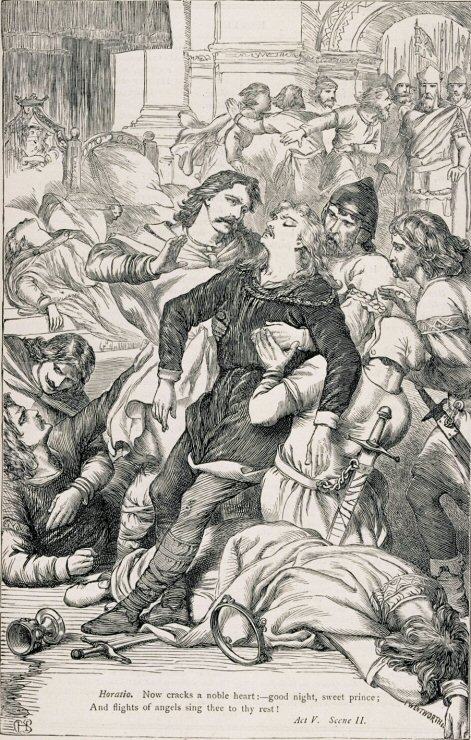
Horatio at Hamlet’s death. Image via Wikipedia commons
He doesn’t. He’s what you sometimes hear referred to as the “exception that proves the rule.” Like how at the end of Hamlet, everybody dies. Except Horatio.
The official body count in the final scene (Act 5 Scene 2) of Hamlet is four: Gertrude, Laertes, Claudius, Hamlet. Enter Fortinbras, who says “What happened here?” and Horatio is left to tell the tale.
Kenneth Branagh’s 1996 film version may have also killed off Osric (the referee, for lack of a more description term), it’s difficult to tell. In Branagh’s version, Fortinbras is actively invading the castle while the final duel takes place between Hamlet and Laertes. Osric is seen being taken by surprise and stabbed. However, he then returns to the scene to deliver his line about Fortinbras’ “warlike volley.”
In some interpretations, such as Ingmar Bergman’s 1986 production, Horatio is killed at the end of the play. When Fortinbras orders, “Bid the soldiers shoot,” some directors have taken that as license to execute Horatio, presumably as the last remaining witness to all that had taken place. It’s important to note that there is nothing in the text to indicate this (just like Osric’s death above). However, there’s two ways to die in a play. Either the script says you die, or else you eventually just run out of lines. Once you’re no longer part of the action (such as Osric), you might fall victim to artistic license and find yourself dead at the end of Act 5 whether Shakespeare wanted it that way or not.
There’s a short and easy answer to the question of why Hamlet killed Polonius. It was an accident. A case of mistaken identify, if you will. What he did next, however, certainly was no accident.
The story so far: Hamlet has sprung his mouse trap, playing out Claudius’ crime in front of him with the help of the actors. Claudius reaction has, as Hamlet anticipated, “caught the conscience of the king.” Gertrude, upset with her son for angering her husband, has requested Hamlet come to her bedchamber so she might speak with him. Polonius offers to spy on Hamlet by reaching the queen first and hiding in the arras (curtains).
Hamlet, in exultation at having proven Claudius’ guilt, comes to his mother’s bedchamber and intends to tell her off:
Hamlet. Now, mother, what’s the matter?
Gertrude. Hamlet, thou hast thy father much offended.
Hamlet. Mother, you have my father much offended.
Gertrude. Come, come, you answer with an idle tongue.
Hamlet. Go, go, you question with a wicked tongue.
Gertrude. Why, how now, Hamlet?
Hamlet. What’s the matter now?
Gertrude. Have you forgot me?
Hamlet. No, by the rood, not so!
You are the Queen, your husband’s brother’s wife,
And (would it were not so!) you are my mother.
Hamlet’s mood at this point is pretty obvious. He’s been unhappy with his mother and is letting it all out. You have my father much offended. You question with a wicked tongue. You are your husband’s brother’s wife.
If Hamlet had stormed off at this moment, having made his point, the play would have gone differently. Instead, Gertrude stands up and says, “I don’t have to take this!” and Hamlet shoves his mother back down, because he’s not done with her yet:
Gertrude. Nay, then I’ll set those to you that can speak.
Hamlet. Come, come, and sit you down. You shall not budge;
You go not till I set you up a glass
Where you may see the inmost part of you.
Gertrude is not prepared for Hamlet to put his hands on her. Remember that the whole castle believes Hamlet to have lost his mind. So it’s hardly unexpected when she yells to Polonius for help:
Gertrude. What wilt thou do? Thou wilt not murther me?
Help, help, ho!
Polonius. [behind] What, ho! help, help, help!
Hamlet didn’t know someone else was in the room. He stabs blindly through the arras:
Hamlet. [draws] How now? a rat? Dead for a ducat, dead!
[Makes a pass through the arras and] kills Polonius.
Polonius. [behind] O, I am slain!
Gertrude. O me, what hast thou done?
Right now the audience is thinking the same thing that Gertrude is. What just happened? Hamlet’s a thinker and a talker, not a doer. Up to this point in the play he hasn’t really done anything. Until now. Heard a noise? Kill it!
Hamlet. Nay, I know not. Is it the King?
Gertrude. O, what a rash and bloody deed is this!
Hamlet. A bloody deed- almost as bad, good mother,
As kill a king, and marry with his brother.
Gertrude. As kill a king?
Hamlet thought Claudius was hiding behind the arras! During this exchange, in fact, he still believes he has killed Claudius, which perhaps explains why he so blatantly accuses his mother of the crime, thinking that he has now avenged his father.
Hamlet discovers Polonius. Image via Wikipedia commons
The timing here is subject to some debate. In the previous scene, on his way to his mother’s bedchamber, Hamlet had already passed Claudius at prayer. He has an opportunity there to kill him, but chooses not to take it. So, then, does Hamlet think that Claudius somehow beat him to the same destination? It’s possible that Hamlet took his time getting to his mother’s room eventually. Or that castles do tend to have secret passages and if there was a shortcut to Gertrude’s room, Claudius knew it. It’s also likely that in the heat of the moment Hamlet simply never thought of this.
So, Polonius’ death was an accident. What happens next is not. Hamlet hides Polonius body, refusing to let him have a proper burial. Act 4 scenes 2 and 3 are actually devoted entirely to the search for Polonius’ body:
Rosencrantz. What have you done, my lord, with the dead body?
Hamlet. Compounded it with dust, whereto ’tis kin.
Rosencrantz. Tell us where ’tis, that we may take it thence
And bear it to the chapel.
And then, when Rosencrantz and Guildenstern can get no answers out on him, Hamlet is taken before Claudius:
Claudius. Where is Polonius?
Hamlet. In heaven. Send thither to see. If your messenger find him not
there, seek him i’ th’ other place yourself. But indeed, if you
find him not within this month, you shall nose him as you go up
the stair, into the lobby.
So Hamlet uses the dead body of his girlfriend’s father as a prop so he can tell Claudius to go to hell. Is this part of his crazy act? Or at this point does he truly care so little about such things that he doesn’t think twice about defiling a corpse?