
Could It Be, Hmmm, I Don’t Know … SEYTON!?!?!

(Does a “Church Lady” impression date me pretty badly?)

Bardfilm wanted some academic discussion on Twitter today, and knowing that it’s very hard to learn anything permanent on Twitter (try Googling for it later!) I’m summarizing in a blog post, but you can check to see if the #SeytonSatan hashtag is still active.

Question: In Macbeth, would “Seyton” be pronounced like “Satan”?  And, if so, would that have suggested some sort of desired audience reaction?  When Macbeth calls, “Seyton!” would the audience have been all, “He’s calling SATAN?! Dude’s evil!”   (My paraphrase.  Bardfilm’s original question had more “you betcha”).

There’s much that’s been said on the topic but little of academic note.
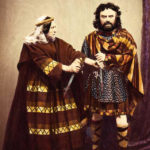
On the subject of sounding it out, I linked in @BenCrystal, an expert in original pronunciation (OP), who responded, “I’d say them the same in OP, something like [‘sei-tun] with a really soft /t/.” This then led to a discussion about when exactly the Scots burr came into the language (after the arrival of King James) and whether Macbeth would have been played that way.

But what of the whole Satan thing?  Do we think that Shakespeare intended to put Satan in the mind of his audience?

My personal position on this is perhaps too grounded – what happens next?  The audience hears Macbeth call, “Satan!” and then this regular old soldier shows up and starts taking orders.  So either you just get this brief scare where the audience is left thinking, “Oh, phew, for a minute there I thought Macbeth was actually calling you know who!” and then we go about our business.  Or we get something more like, “Who’s this guy?  Is that Satan in the form of one of Macbeth’s soldiers?  Oooo, I bet he’s going to do something just off-the-charts evil.”

I just don’t know enough about the time period to know if this was a thing that Shakespeare would even attempt.  Did you get to mention Satan on stage like that?  Would Shakespeare have suggested that Macbeth was so evil as to invoke the big man himself?  And, worse, order him around like a lackey?

Lots of discussion material here.  Show of hands, who’s done the Scottish play and has an opinion from experience?

What Comics Can Take From Shakespeare

I tagged this article by John Ostrander without knowing who he is.  I gathered from a quick skim that he is an author of comic books, who cites Shakespeare as one of his influences.  I like that.  I’m reminded of last week’s Ben Kingsley story where he said that he “Brings a little Shakespeare into everything he does.”  Which in turn reminds me of the great Martin Luther King’s quote about, and I will paraphrase this because I’ve got to get back to the topic at hand, “If you are called to sweep streets, then sweep streets like Shakespeare wrote poetry.” Amen, Dr. King.

Anyway, where was I?  Oh, yeah, John Ostrander on what the comics can take from Shakespeare. The fact that he uses Measure for Measure as his primary example shows that there’s going to be some depth to his argument, he’s not just pulling high school memories of Hamlet or Romeo and Juliet and doing little but name dropping our dear bard.  Mr. Ostrander’s apparently thought a lot about this.

A brief excerpt:

Explore all sides of the question. What did Shakespeare think on any given question? It’s hard to tell because he would give convincing arguments to both (or more) sides of a question.

He then uses the example of Claudio preparing for his possible death, first speaking with the Duke and accepting it, but then turning around and telling his sister Isabella how much he fears it.

Which attitude speaks Shakespeare’s true mind? 

Both. Both are true, to the moment, to the character, to the author, and for the reader or audience. It comes down to which is truer for us and that was Shakespeare’s intent or what I learned from it. Shakespeare had a many faceted mind and he used it in his work.

That’s just one of several points he makes (although, to be temper my original praise, his point about Hamlet seems a little thin.)

Oh, and before I wrote this I had to google Mr. Ostrander so that I didn’t get schooled by the comic geeks in the audience for not knowing him.  Turns out he’s not only done time with Marvel and DC, he’s contributed to the Star Wars universe as well.  Looks like his Shakespeare lessons have been serving him well!

Happy Shakespeare Mother’s Day!

In honor of our moms, this week we imagine what Mother’s Day cards might have been like from Shakespeare’s characters.  Shakespeare is a bit like Disney in not giving us very many mothers to work with, but we do our best.

Happy Mother’s Day!

“Dearest Mother, I can not begin to tell you how thankful I am that you did not pluck your nipple from my toothless gums and dash my brains out.” 

“Mom, I know you don’t always like to express just how much you care about me, but I know you do because you died of grief at the end of our play.  Offstage of course.  Love, Romeo.” 

“To The Woman Who Raised Me As If I Were Her Own Daughter,   I’m totally crushing on your son Bertram, could help me hook that up?” 

“What would I do for you, Mother?  I would spare Rome, even if you did embarrass me in front of Aufidius and his friends.” 

“For A Wonderful Mother-In-Law on Mother’s Day.  Sorry about the Tybalt thing Mrs. Capulet, I totally understand why you tried to have me executed.” 

“You Are The Queen, Your Husband’s Brother’s Wife, and Would It Were Not So You Are My Mother.  Happy Mother’s Day. “

Kinderbard

I think that Daeshin Kim would be fun to hang out with.  We have a lot in common.  We both think that it’s never too young to expose our children to Shakespeare. We both think that music is a key component in doing that.  I sing lullabies, never met a pun I didn’t like, and post stories of my geeklets wisdom here on the blog.

And then Daeshin goes off and produces Kinderbard, and we’re in different leagues.  Clearly a labor of love for him and his family, Daeshin and his 5yr old daughter Sherman wrote and produced a collection of nursery rhymes – including Sherman singing them! – that they call “A Horse With Wings” (Imogen, from Cymbeline).  Each rhyme is sung from the perspective of a Shakespeare character, and attempts the dual task of teaching a lesson (or dealing with an issue) while providing some context about the character doing the singing.

Example?  Juliet’s song, “It’s just a name.”  If you know the story of Romeo and Juliet you’ll immediately recognize the idea behind Juliet’s “What’s in a name?” speech.  Here, sung by Sherman, it’s a song about dealing with teasing when your perhaps your own name is on the more unusual side.

Or maybe Cordelia’s “I don’t know what to say” song, encouraging shy children to speak up for themselves.

Of course there are the silly ones, too.  Two Gentlemen of Verona‘s contribution is the “Smelly Dog” song, and let me just tell you now, the dog doesn’t smell because it needs a bath, it smells because of what somebody’s been feeding it.  If you get what I mean.

And then there’s Falstaff’s dirty laundry song, where he comes face to face with something so disgusting I’m not going to blog about it (but it will no doubt have younger children in stitches).

Honestly there’s not a great deal of Shakespeare in this.  The coverage is impressive, with contributions from 16 different plays (not just “the big ones”).  Where possible they sneak in direct references (Yorick sings about giving piggyback rides, and As You Like It’s Jaques pretty much sings a simplified version of his entire ages of man speech), and there is some artwork with original quotes.  But I don’t think that a child is going to come away from any of the songs with any long term understanding of Shakespeare.  Although I’ve often said that at the youngest age, the most important thing is recognition of character and maybe plot.  So if the kids who work through Kinderbard learn about Ariel and Yorick and Cordelia and remember those names?  It’s a good start!

Disclaimer – Daeshin and I have discussed this, and he’s clear that his goal is “a songbook that happens to have Shakespeare as its source”, and that he is not primarily attempting to teach Shakespeare.  So I don’t feel as if I’m throwing him under the bus by going here.  This is, after all, a Shakespeare blog so I have to take the logical angle.  If I saw this on a shelf I’d want to know how much Shakespeare my kids are going to get out of it.

My kids are too old for the collection now, but I’d like to think that if it had existed when mine were still young enough that I was popping nursery rhyme CDs into the car stereo when we drove around town?  That I would have picked it up.  If nothing else Kinderbard shows what can happen when you’ve got the kid of passion for a project that Daeshin has demonstrated.

This year’s Shakespeare Day Celebration is sponsored in part by Shakespeare Is Universal: Shakespeare truly is for everyone, and nothing demonstrates that sentiment better than his most famous quote of all, translated here into languages from around the world.   In celebration of Shakespeare’s birthday, show that you believe his works are just as relevant, powerful and important as they’ve ever been!

Another #ShakespeareDay Is Done

*phew!*

So, how was your day?

This year I succeeded in publishing a new record *28* stories.  And you know what?  I’m pretty sure that a silly picture I tweeted in the middle of the day got more traffic than all of those stories combined.  But that’s ok.  Tweets are temporary, posts are forever.

Here’s a quick recap of the day’s action, since so many posts will have scrolled into the archives before most people get to see them:

  1. My Shakespeare, Rise!
  2. Cover Songs and Sampling
  3. Playing Against Type
  4. Deconstructing Shakespeare
  5. Theme Song Shakespeare : And The Rest!
  6. The Master
  7. A Game! Novel Perspective
  8. Sonnets to Sundry Notes of Music
  9. A New Sonnets to Music Collection
  10. WIN One of the Beautiful Shakespeare Signature Series, Free!
  11. Review : Undiscovered Country by Lin Enger
  12. Synetic Shakespeare
  13. “Shakespeare” by Jaden Smith
  14. Romeo & Juliet Trailer
  15. Drive-by Earl of Oxford Jokes
  16. Review : Shakespeare Shaken
  17. Review : So Long, Shakespeare
  18. Willie “Shakespeare” Joel’s Greatest Hits
  19. Kinderbard
  20. Dreaming in Shakespeare (A Continuing Series)
  21. Tales from Shakespeare : Illustrated
  22. Why Are Some Plays Better Recognized Than Others?
  23. Pen Us A Play You’re The Stratford Man
  24. Review : The Wednesday Wars
  25. Rocky Shakespeare III
  26. What Shakespeare Means To Me
  27. Is Shakespeare Universal? Show Your Support!
  28. Why Should I?
This year I’m trying something a little different. I’m running a fundraiser that I’m calling “Shakespeare is Universal.”  In the style of Kickstarter, this company Teespring produces a much higher quality product at a lower price than any other outlet I’ve yet found.  The trick is that you need to get a minimum number of people to sign up for the campaign (i.e. reserve a shirt) by a certain time.  By working in bulk quantities the prices stay low, without sacrificing the quality. 
I am hoping that loyal readers who have enjoyed the blog and everything I’ve done for the cause of Shakespeare over the years will do me the honor of joining the campaign.  There’s three good reasons I’d really like to see this latest effort of mine succeed. First, there’s the obvious practical reason that if I have money I can spend it on more cool Shakespeare things. I don’t believe in lying about that or trying to hide it.
Second, I think it’s a nice shirt.  I made this image awhile ago by taking “To be or not to be” and translating it into as many languages as I could find, and had a graphic designer friend help me with the layout.  When you look at the patterns and realize how you can tell what it says even when you can’t speak the language you begin to see Shakespeare as this Rosetta Stone that enables communication between people all around the world. I think that’s a very cool idea.  When we talk about “Shakespeare for everyone” that doesn’t just mean English speakers.
Lastly there’s a reason of personal importance to me.  If the campaign succeeds, that will mean that there’s at least a hundred people out there who’ll be wearing shirts that identify them as fellow Shakespeare geeks.  One day I will bump into somebody in the wild who is wearing one of them, and that will be an amazing milestone for me, because my bond with that person will be deep and it will be instant, yet again confirming that power that Shakespeare brings out in all of us.