You Do Realize Romeo And Juliet Is A Tragedy, Not A Romance, Right?

A question from the audience!

What is the cause of the tragedy in Romeo and Juliet?

Is this an open and debatable question, or is it one that has a specific answer that popular opinion gets wrong?  The tragedy of Romeo and Juliet is not in the romantic notion “Oh no, it’s so sad they couldn’t be together!”  It’s in the stupidity of the adults who don’t see the error of their ways until Fate kills their children for them and says “Now do you get it???” Or is it?  Discuss.  Or perhaps I’ve misinterpreted the question about the “cause” of the tragedy? Bonus question – what do you think happens after the conclusion of the play?  Do you think that Capulet and Montague really do learn their lesson, and the feud is over?  Or are they merely going through the paces (for some reason the images of Heat Miser and Snow Miser from Year Without A Santa Claus just came to mind…), and will be at each other’s throats again 5 minutes after the Prince dismisses them?  Oh dear god somebody gouge out my brain for thinking of this, but I blame Disney…..could you imagine Romeo & Juliet : The Sequel? !

Tempest On The Cape

Caliban

http://www.shakespeareonthecape.org So!  I packed up the family, took the day off work Friday and headed down Cape Cod for a “Kiddie Shakes” production of The Tempest.  All my regular readers will know how exciting this was for me – The Tempest being the way I introduced my kids to Shakespeare, telling it to them as a bedtime story for as long as they can remember.  So the idea of that being their first performance (even better, a special kids’ version of the show), was too good to pass up.

Took us a little while to find it.  With only the location “Mashpee Commons” in mind, I’m heading into this thinking “Boston Common” – some sort of big grassy lawn where we can spread a blanket, maybe set up some chairs.  When I turned into the area called Mashpee Commons and found what could best be termed an outdoor shopping mall, I was just a little confused.  Eventually security told us “It’s between the movie theatre and the Banana Republic”, and darn it all, that’s exactly where it was.  No grassy area, just a brick courtyard sort of a thingie where they’d set up, god, maybe 30 or so plastic lawn chairs.  There were no signs at all saying what was going on, just a handful of props strewn about the ground.

You know what? I LOVED IT.  Out came the cast from behind a hastily hung screen in the corner, not even 10 of them.  They were all young – I’d be surprised if any of them had hit their mid 30’s.  The cast was mostly female, so Prospero and Antonio were both played by women (as well as Trinculo, who also played the narrator, but it seems to me that Trinculo is often cast as a woman).  The story then became everything that I love about trying to explain Shakespeare to people.  First, Trinculo (whose real name was Tessa) would narrate, in a sort of Dr. Seuss rhyming style.  But then, this is the best part, they switched back over to legitimate performance of the actual text!  Sure they cut bits here and there (more on that later), but the important thing is that they didn’t paraphrase.  They didn’t give new lines to anybody to make it easier.  That’s what the narrator was there for.   So you’ve got one person talking to the audience saying, “Here’s what’s about to happen (e.g. Stefano and Trinculo, with Caliban, plot to take over the island), and then you get that scene.  My wife came away saying “Now that one I really liked, I understood every word.”

Since the whole thing ran 45 minutes they certainly cut a bunch, and particularly toward the end it seemed to wrap up very quickly.  For my taste I could have watched them do the whole play this way – it’s not like it’s that long of a play to begin with.    Gonzalo was completely eliminated, which I was a little sad about, I like him.  They left in his first speech (about an acre of dry land), giving it to a random sailor who never appeared again.  But that was it – nobody tried to kill him as he slept next to the king, and he was not around to be reunited with his friend Prospero.  I happened to be around for the later show (while my kids got ice cream and watched a juggler), and Gonzalo was even edited out of the grown up version.

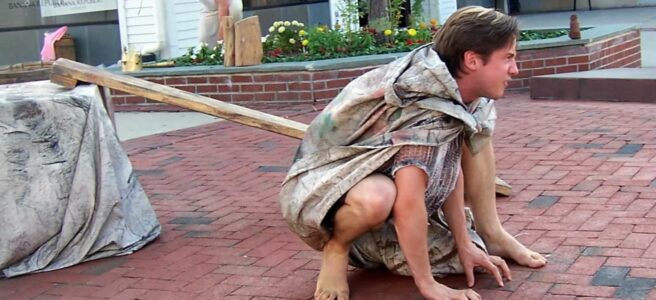
The show had clearly been organized to showcase Ariel and Caliban, since they ended up with the most stage time.  All the other humans (including Prospero) seemed more at the whim of the narrator who could cut them off and say “…and then this happens” and that was the end of that.  Caliban, on the other hand, really threw himself into the role, cackling like a fiend and leaping through his scenes all hunched over like some frog-like henchman from a monster movie.

Ariel, in contrast was…hmmm, what’s a good adjective for Ariel?  Ariel (played by Ben, whom I’d spoken to online to tell I was coming to the show) was really the center of attention, and I mean that in a variety of ways.  He seemed to tower over the rest of the cast.  And whenever he was on stage he came with special effects, whether noise makers (a drum and a thunder machine, in particular), a chorus of fairies to sing with him (they were quite good), or just a bunch of sheets that served as everything from ocean to stage-within-the-stage (for Prospero’s wedding gift to the children) to Ariel’s Fury costume.

They did a lot with what they had.  (By the way, is it always that hard to fit “suffer a sea-change” into the rhythm of the song?  Never seems to fit right, both when I’ve heard it and when I’ve tried to sing it myself.)

How was the performance?  Given the setting it was darned near “Shakespeare in the wild”.  Clearly an act of love for what they were doing.  Shoppers were walking all around, and at least once somebody walked through the set.  But they persevered.   I was in awe, the entire time.  Maybe I’m a special case – here’s a bunch of people acting out my children’s bedtime stories, something I could never hope to do.  None of them seemed like “seasoned professionals” (although perhaps they all hope to be some day :)), and nobody passed the hat.  I was surprised at that last, I was all set to contribute.  Perhaps it came out later, during the adult performance?

Only one time did I flinch at a directorial choice, and that’s when the narrator introduced the monster “Cackle-a-ban”, and I was like, “ummm…what?”  Then the actors came out and referred to him as Caliban, and I thought “Perhaps that was a mistake.”  No – in narration, they named him Cackleaban, but in the play he remained Caliban.  I don’t understand that.

The cast hung out after the show, letting the kids play with the props and asking questions about the story.  As always my kids froze under pressure of being asked a direct question, but hey, I’m working on them :).  We hung out waiting for Ben, which must have come across like we were some sort of fan club – “Hey Ben, there’s a guy and his wife and kids out here asking for you!”  I felt awkward not just jumping in and hanging out with the whole cast, but I haven’t quite gotten used to just walking up to people and saying “Hi, I’m Duane from ShakespeareGeek.com” unless I’ve had some sort of connection with them.  Makes me feel like a newspaper reporter looking for a story or something.  Perhaps I’ll have to get used to that however, as Ben came out of the dressing area (out of costume) and said, “You must be Duane from Shakespeare Geek?” and the rest of the cast said, “Oh!  You’re the one he’s been telling us about!”  So, Ben, my apologies to the rest of the gang if I seemed at all rude.

In all, it was the time of my life.  I’d spend my entire summer going to shows like that if I could.  It fired on all cylinders for me – a show that my family knew and could understand, performed in a small enough venue that we could comfortably watch and enjoy it, keeping “original” text (yes yes, I know), by a cast small and friendly enough to hang out and talk to us after.  So glad I went!  Highly recommended.  Even if you can’t get to this particular show, go find your local group that does something similar and go put some butts in the seats for them.

Rebel Shakespeare (Salem, Mass) : Romeo and Juliet

http://www.rebelshakespeare.org Christine and Keri, my new friends in the neighborhood,  have put up the schedule for their Romeo and Juliet.  Rebel Shakespeare is acted by kids – perhaps Christine or Keri can chime in and tell us what age group will be performing this show? Friday August 22 5pm: The Athanaeum. Salem MA, outdoors in the garden… Friday nights they do a “speakers series” and Keri will be the speaker, and the kids will do the production. Very high class.
Saturday August 23 1pm: Mary Jane Lee Park, Salem MA. Saturday August 23 5pm: Open – Possibly Beverly or Marblehead.
Sunday August 24 1pm: Open – Possibly Beverly or Marblehead
Sunday August 24 5pm: Derby Square, Old Town Hall steps, Salem MA. Monday — Day off, or as they say in theatre “dark” day.
Tuesday August 26 1pm: The Senior Center, Salem MA Tuesday August 26 6pm: Palmer Cove Ballfield. Salem MA. Around the corner from Mary Jane Lee Park, the outfield will be Verona, and the lights will be turned on so everyone can be seen.  
Wednesday August 27 1pm: Tentative — Moesley Woods Park, Newburyport MA. A natural wooded amphitheater with a giant rock sculpture/climbing thing that will be good for the balcony scene.
Wednesday August 27, 5pm: Winnekenni Castle, Haverhill MA.   I love the idea of Romeo and Juliet performed by kids on a playground.  Seems like such a natural setting, which I suppose could turn really dark once the killing begins.

Romeo and Juliet : Homework Help

(The conversation’s been a bit on the deep end lately so I thought I’d throw one in for the occasional student who comes by looking for homework help.)   If you need help remembering the plot of Romeo and Juliet, study Friar Laurence’s confession in the final scene.  He pretty much tells you the entire play:

Romeo and Juliet got married in secret, but then Romeo ends up getting banished when Tybalt is murdered.  Juliet’s parents think she’s upset about Tybalt when really she’s upset about Romeo, and they arrange this hasty marriage to Paris.  She comes to me saying that she’ll kill herself if I don’t do something, so I come up with a plan.  I’ll give her a sleeping potion that makes everyone think she’s dead.  Then I’ll write to Romeo, informing him that she’s not dead, and that he should come to the family tomb when she wakes up and take her away.  But I discover that Romeo never received the letter!  So I raced over to the tomb to rescue her myself, figuring that I’ll come up with a new plan once I can straighten everything out.  But then I see Romeo and Paris both dead.  I try to get Juliet to leave with me but she won’t go.  I heard a noise that I went to explore, and when I came back, she’d killed herself.  If you don’t believe me ask her nurse, she knew all about their wedding.  It’s all my fault, I accept that, and throw myself on the mercy of the the law.

Between that speech and the opening prologue (“Two households…Verona….ancient grudge…..young lovers take their life….”) you’ve got the idea.  Now, I’m not a big fan of saying “There you go, just study that and you’re all set.”  If you do, you will have missed all the poetry (not to mention the sex and violence) in the middle.  Think of this speech more as a set of pegs on which to hang the rest of the details of the play more easily for yourself.  Who did Romeo kill?  Tybalt.  Who gave Juliet the sleeping potion?  Friar Laurence.  Why did Romeo think Juliet was dead?  He never got Friar Laurence’s letter.  And so on… Hope it helps!

Oh,When I Shall *Die*! Now I Get It!

Rosenbaum’s Shakespeare Wars continues to be the most serendipitous book I’ve ever read.  By that I mean that I’m never quite sure when I’ll turn the page into a new chapter and he’ll be talking about something I was just talking about two days ago. In this case it’s the “When I shall die” line (as opposed to “When he shall die”) that we talked about last month.  Certainly it’s supposed to be “Give me my Romeo, and when he shall die, cut him out in little stars….” rather than the version Luhrman gives us, “When I shall die, cut him out in little stars….” After all, if he’s not dead, why are you cutting him up?  Oddly, though, my googling showed that most Shakespeare versions do in fact have it as I, not he. Rosenbaum gets to this near the end of his book, speaking of a trip to Bermuda. He even points out that most editors do indeed go with the “he” version (which is apparently Fourth Quarto) because the “I” version makes no sense. And what Rosenbaum offers (not his own hypothesis, but rather one he heard, though I do not have the book handy to quote the original author) immediately makes sense to me, I’m just not sure if I love or hate it.  He goes back to the more bawdy version of “die”, namely “orgasm”.  He says that Juliet, a mere 13 yrs old and not married, is to put it bluntly thinking about wedding sex, and how good it’s going to be.  You have to admit, if you make that little word translation, it still fits.  Now you’ve got an anxious young girl, in love but also certainly in lust, waiting for that big moment when … ummm….hmm, how can we say this and keep it clean?  Shall we say, when she gets to consummate her marriage?  It’s going to be so good, she tells herself, that all she’ll see are stars, and her Romeo.  (I’m not sure when all the rest of the world comes into it, though?) I love it because it works, pretty much.  It’s somewhat crude, it’s the sort of thing you don’t talk about when you talk about the story like it’s the greatest love story ever told, but sex is certainly a part of that type of love, and it’s certainly believable that a virginal bride-to-be is contemplating what it will be like.  (Now that I’ve seen that interpretation, other parts begin to fall into place –  “I have bought the mansion of a love, but not possessed it, and though I am sold, not yet enjoyed”???) I hate it because it destroys what I consider to be one of the most romantic lines in the entire play.  It’s an opportunity for Juliet to explain how much Romeo means to her.  Normally it’s the guy spouting all the poetry and the “You’re my world” stuff.  Sometimes it’s nice to hear it back the other way.  What would Juliet do without Romeo?  She would repaint the heavens in his image, and the rest of world would say, “Wow, yeah, we like that better.  Who is that guy?”  🙂   Thoughts?  Nobody mentioned the sex interpretation the first time we discussed that line, so I’m curious if it is a popular interpretation.