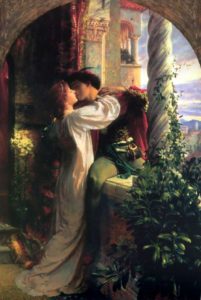
Why Some Scholars Hate Romeo and Juliet

or, What Play Can You Just Not Even?

Our pal Bardfilm is mad as hell, and he’s not gonna take it anymore!

He is so over Romeo and Juliet, that he’s decided no more productions for him. It has been plumbed to its depths, we have wrung all possible angles and meaning from it, it has been set in every possible time and space in the continuum. He’s seen enough, he can’t see any more.  In fact, he wants to eradicate it completely. Sort of.

Here’s his proposal. We keep the text, and we can read it whenever (if ever) we want. But if we elected some crazy dictator who’d been horribly bullied in high school for being a theatre geek and takes out his emotional issues by banning Romeo and Juliet from ever being produced again … Bardfilm’s totally ok with that.

Which of the works brings out similar resentment for you?  You’re in charge, you get to declare a complete moratorium on one Shakespeare play never to be performed again.

What’s it going to be? Shall it be Merchant of Venice, so people can stop arguing with you whether Shakespeare was anti-Semitic? Comedy of Errors, so directors can stop worrying where they’re supposed to find two sets of identical twins?  Maybe A Midsummer Night’s Dream so we can stop having kindergarten productions with five-year-old butterfly-looking fairies?

I’m totally going to take the easy road and pick Merry Wives of Windsor. I’ve literally never seen it, nor even read it (except during my brief “read them all” period in college).  But I also don’t know how much it “makes life better,” otherwise it probably would have hit my radar by now.  So, having never missed it, I figure I won’t miss it going forward.


Not By Shakespeare : An Empty Barrel Makes The Most Noise


Last week there was a bit of nonsense in the news when some politician called another politician and “empty barrel” making the most noise.  I do know the names of all parties involved, but we’re not here for the politics so why get into it?  The comment probably would have gone unnoticed, like so many idioms might, if it were not for the fact that woman on the receiving end of the comment immediately said, “That’s racist.”

Many people, myself among them, would be quick to point out that it’s not racist, it’s Shakespeare.  Henry V, Act IV Scene 4:

I did never know so full a voice issue from so
empty a heart: but the saying is true ‘The empty
vessel makes the greatest sound.’

I even repeated on Twitter that Shakespeare is the source of this quote.  But, for the record, he’s not.  It even says so right there in context if I’d been paying attention — “the saying is true”. It was already a saying when Shakespeare wrote it down.

The saying seems to date all the way back to Plato, although I can’t find any specific references as of yet.  Anybody got one, so we can make it official?

What I’m finding interesting is that the more I look into it the more I’m not sure I know what it was originally supposed to mean.  These days it’s used to imply that the people without anything intelligent to say (the empty barrels) are precisely the ones that won’t shut up.  But I’m not sure that’s what Plato would have meant?  I could just as easily imagine it as more complimentary — “The person who is always open to learning new things is the one who will make the biggest impact in the world.”  That’s pretty much the opposite.

There’s supposedly a second half to the quote, “So they that have the least wit are the greatest blabbers,” which would clearly suggest the first meaning is the intended one.  But I learned a long time ago not to simply believe something is true because it shows up in a quotes database on the internet.

Thoughts?

Oh, Sir Ian, No.

Ian McKellen has said his King Lear, which is currently on at Chichester Festival Theatre, is probably his last big Shakespeare part.

http://www.bbc.com/news/entertainment-arts-41531398

Sometimes we realize this when we wake up to discover that an entertainment idol has died – Robin Williams, David Bowie, Tom Petty.  You don’t appreciate what you had until life tells you, “No more.”
But sometimes you know what’s coming, and I’m not sure if that’s worse.  Sir Ian McKellen (and Sir Patrick Stewart and Dame Judi Dench and too many others to name) will not be around forever to bring the Shakespeare.  In the linked interview above Sir Ian gets realistic on us that he’s “probably not really” got any more Shakespeare in him.  Sad day, but one that had to come eventually.

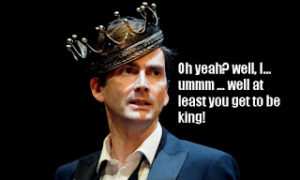
What’s your favorite Sir Ian role?  Richard III, Macbeth, Lear?  In the image above a very young McKellen takes on Hamlet. I wish we had video of that!


This Is Gonna Get Ugly

For my day job we have a very large email marketing business.  It’s normal conversation to talk about what others are doing, so when I got the following subject line in an email I laughed and showed it to my coworkers:

Make someone ugly cry. Adobe can help.

What I wrong as a comment was, “I know what they meant, but that’s the worst subject line I’ve ever seen.”  It sounds like Adobe’s offering to help you chase ugly kids around the playground and make them cry.

A couple days after that post, a coworker calls me over and says, “You posted something the other day and I’ve been meaning to ask you about it…I don’t get it?  You wrote, I know what they mean … but I don’t.  I don’t know what they mean? Is it like the optical illusion with the old woman and the young woman and I can only see the old woman?”

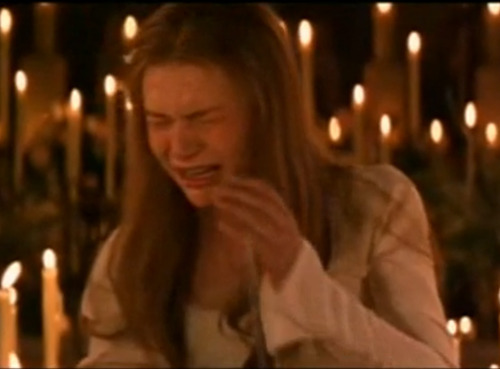
So I told him, “Claire Danes in the Leonardo DiCaprio Romeo+Juliet.”Clare Danes cry faceTurns out there’s actually several blogs and tumblrs dedicated to her cry face in particular, and she’s even been asked about it in interviews 🙂

Give Shrew Its Due

In the kitchen at work the other day, a coworker tells me that he’s just returned from London, where of course he had to stop by The Globe.  I ask if he saw a show, and his response is, “I wasn’t really on a schedule that allowed time for a show, and besides, it was Taming of the Shrew. Maybe if it was Hamlet or something, but Taming of the Shrew?”

Taming of the ShrewWe generally agree that Taming of the Shrew is, at best, “nothing special” Shakespeare.  I refer to it as a Shakespearean sitcom, and compare it to a Seinfeld re-run that you see on the hotel room tv when you’re channel surfing.  Maybe you’re all “Oh yeah, this is a good one” or maybe you’re more, “Eh, seen this one a thousand times.”

But! A coworker hears our conversation and comes to Shrew’s defense. He calls it a vicious takedown of masculine roles in Shakespeare’s time, and that it is only the fault of modern directors who want to “move it along” and tend to skip or de-emphasize key scenes that cause the play to appear like the “battle of the sexes” romantic comedy it’s known as.  He says that when played properly, you completely empathize with Katherina because you see the kind of men that she’s expected to put up with.  When I push him for specific examples of key scenes he refers to the line of suitors that are introduced early in the play, by which I assume he’s referring to Act II, Scene i for anyone that needs a refresher.

Where do you stand on Taming of the Shrew?  Is it completely misogynistic?  A silly romantic comedy with a happy ending?  Or should it be taken more seriously?  How deep does it go?