
Shakespeare and Long-term Illness

Hermione livesWe recently discovered that a family friend has cancer. Luckily (happily? thankfully? not sure what the word is to use there) it is a reasonably treatable one with a life expectancy measured in decades.  But, you know.  Still.

That got me thinking. If her husband asked me over a beer, “So, what’s Shakespeare got to say about this?” I don’t know how I’d answer. For years I have spoken about finding the answers in the works of Shakespeare, how the entirety of human experience and emotion can be found within the pages.  “If you’ve ever felt it,” I bet you could find me saying, “Shakespeare wrote about it.”

Pretty sure Shakespeare never mentioned cancer.

So let’s talk about it.  I’m trying to think of places where a character is ill and not going to get better. Or perhaps a more reasonable comparison might be, “Knows that he is going to die before his time and there’s nothing left to do about it but contemplate what that means.” What about the characters around them?  The woman I’m thinking of is a wife and mother.  The journey they’ve been put on isn’t just for her and her husband, her kids are part of it as well.

Technically there’s the king in All’s Well That Ends Well, but that doesn’t really count – he gets better.

Hamlet is really one long contemplation on what life is all about, but it’s not really what this post is about.  Hamlet’s father’s murder is not the same thing – being taken suddenly is not the same as having a long time to prepare for it coming.  I suppose if we had Polonius or Ophelia say a single word about what happened to Ophelia’s mother, there could have been something there.

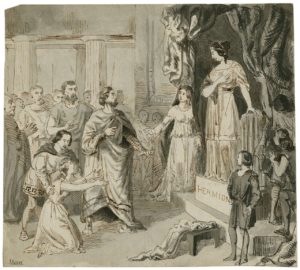
The Winter’s Tale?  I don’t have time to go through the text right now but if Leontes believes his wife to be dead, taken from him before her time, doesn’t he have some thoughts on the subject? True she ends up coming back to him, but at the time he thinks she’s gone forever.

Are there no examples of a sick character? Surely the idea of, “You are sick, and you are only going to get worse until you finally die” was a thing in Shakespeare’s time, regardless of the name they attached to it.  Did Shakespeare give us any characters in that situation? I suppose in a time of plague that was a pretty depressing topic, but he mentions it in places like Romeo and Juliet so it’s not like the subject was totally off limits.

Getting back to the original premise, I’m open to discussion on the idea.  If a friend of yours was suddenly confronted with their own impending mortality (or that of a loved one), what comfort can Shakespeare offer?


Looking for Pink Unicorns? Click Here!

Sorry, I couldn’t resist.  My daughters (the middle one in particular) are girly girls and whenever the evil Starbuckian Empire came out with a hipster drink that was a pink sparkly unicorn, they had their mother and I running around town trying to find one.  Nobody drinks the thing, of course – I hear it’s gross – they just need to take pictures with it for Snapchat.

We struck out, it was sold out everywhere we went.

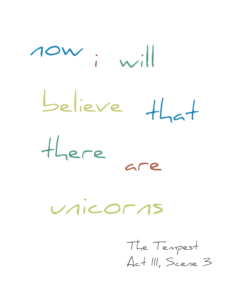
Now I Will Believe That There Are UnicornsSince I was looking for new t-shirt designs anyway, we designed our own “pink unicorn” (although it is available in different colors). Everybody here knows The Tempest is a special play in my house, not to mention a special bond between my daughters and I.  I’ve often used “Now I will believe that there are unicorns” as an example of my favorite Shakespeare quote, dating to long ago when I was in college and we (well, the drama group) did The Tempest. For three days, I was enchanted. While I translate it to people as more of a Shakespearean, “Well! Now I’ve seen everything,” I personally think of it more as an acknowledgment that you never know what wonders the universe will drop at your doorstep, so always keep your mind open to the possibility that a unicorn could walk around the corner.

I hope everybody likes it.  I was getting so tired of dark on light and light on dark, I wanted to try something bright and colorful that my girls would like.

Netflix Some Shakespeare (and Chill)

I love when people make lists for me of what Shakespeare stuff is available for streaming.  IBTimes has 8 options to enjoy, with or without some company. Although in fairness, 5 of them are actually on Amazon Prime and only 3 on Netflix.  Come on Netflix, step yo game up!

Shakespeare in Love is probably the most obvious choice (if you haven’t already seen it a dozen times).  There’s that newish Romeo and Juliet with Hailee Steinfeld from a few years back. Shakespeare in Love I tried that one once, but couldn’t get past the joust at the beginning. You remember that part in the original text, right?

If you like the older stuff, Amazon’s got the Helen Mirren / Judi Dench A Midsummer Night’s Dream from 1968, and a WWII Hamlet that I’d never even heard of.

There’s also some documentary stuff, including Shakespeare High that I remember for years ago but have never sat down to watch. Might have to check that out.  Something for everybody!

Attention Playwrights! The Search for the Next Shakespeare Begins!

American Shakespeare CenterA couple years ago the Oregon Shakespeare Festival made a bold move by commissioning 36 playwrights to translate the works of Shakespeare into modern English.  I honestly can’t tell you how it went, as I didn’t follow the project.  I’m not interested in your project if your premise is that Shakespeare has to be rewritten.

American Shakespeare Center is putting their own more interesting spin on this game, announcing this week that they will be commissioning a modern canon of 38 “companion pieces” to each of Shakespeare’s works. What constitutes a companion piece?  Straight from the Artistic Director Jim Warren:

We’re not looking for a retelling of Shakespeare plays. We’re looking for partner plays that are inspired by Shakespeare, plays that might be sequels or prequels to Shakespeare’s stories, plays that might tell the stories of minor characters in Shakespeare’s stories, plays that might dramatize Shakespeare’s company creating the first production of a title, plays that might include modern characters interacting with Shakespeare’s characters, plays that will be even more remarkable when staged in rotating repertory with their Shakespeare counterpart and actors playing the same characters who might appear in both plays, plays that not only will appeal to other Shakespeare theatres, but also to all types of theatres and audiences around the world.

The ambitious project stretches for the next twenty years and will pay out a million dollars in prize money.

I remember back in college, probably after being inspired by Rosencrantz and Guildenstern Are Dead, I tried my hand at a similar piece I called Ophelia’s Song. The premise was that Ophelia was in on Hamlet’s feigned madness, only it wasn’t feigned, so as he went insane in his own peculiar way, so did she.  They would speak in modern English during the original scenes, and then switch back to original Shakespeare dialogue for the “real” scenes.  It was never produced, but it was fun to write.

So, who’s going to enter?

Be sure to check out the new Shakespeare Geek Merchandise page, new for 2017 on Amazon! All new designs!

What Are We?

Bardfilm and I were having an interesting conversation yesterday about the great divide (from where I sit) in the Shakespeare Universe.  If you are not a professional Shakespearean (mostly thinking of academics and researchers, though I would have to say that full-time directors, actors, etc… would also count themselves among this group) … what do you call yourself?  How do you explain your relationship to Shakespeare and his works?

From what I have seen, academia prefers to refer to us as “fans”. If you are not a professional, you are a fan.

Fans
“Woo! Play Hey Nonny Nonny!”


I hate that.  I am a fan of Pink Floyd.  I have not spent the last twelve years of my life writing thousands of posts about how Pink Floyd makes life better. I did not tell my kids The Wall as a bedtime story growing up. I do not have an ever-growing shrine to Roger Waters on my desk at work, and I don’t celebrate David Gilmour’s birthday like it’s a near-religious holiday.

I have invested a great deal of my life, and the lives of my friends and family, in Shakespeare. People that know me know more about Shakespeare because of me.  But for all of that, the way I am to describe myself (and those who feel the same way I do) as …. fans?

For fun I grabbed a random thesaurus entry for “fan” and here’s what it gave me to work with:

adherent, beau, believer, booster, boyfriend, buff, bug, cat, devotee, disciple, enthusiast, fan, fancier, fiend, follower, freak, girlfriend, groupie, hound, junkie, lover, nut, partisan, patron, rooter, suitor, supporter, swain, sweetheart, wooer, worshiper

You know what dawns on me is missing from that list?

Geek.

I didn’t originally pick that word because of my computer background.  It’s not supposed to be “The geek who is also into Shakespeare.”  It was more about a healthy obsession with learning everything I could about the subject. What Wikipedia has to say about the word isn’t bad, actually:

The word geek is a slang term originally used to describe eccentric or non-mainstream people; in current use, the word typically connotes an expert or enthusiast or a person obsessed with a hobby or intellectual pursuit, with a general pejorative meaning of a “peculiar person, especially one who is perceived to be overly intellectual, unfashionable, or socially awkward”.[1]

I think I agree with almost all of that.  “Expert” is clearly tricky in this context because by definition we’re not trained professionals. Am I an expert? Are you? Who’s to say?  But we can all probably agree on enthusiast. Obsessed?  Check.  I think Shakespeare qualifies as an intellectual pursuit. And I’m even ok with the pejorative stuff – peculiar and socially awkward?  Well, yeah, I was that before I got into Shakespeare!

How about you? What do you call yourself when it comes up?

Be sure to check out the new Shakespeare Geek Merchandise page, new for 2017 on Amazon! All new designs!