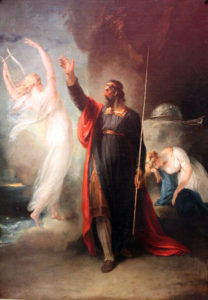
On The Complexity of Rosalind

“Rosalind and Hamlet are surely the most complex in the vast parade of Shakespeare’s characters.”

So begins this Signature article, “What’s So Complex About Shakespeare’s Immortal Rosalind?

I’m already stumped, and that’s nothing personal against Rosalind.  I’ll give you Hamlet. But a funny thing happened as I sat here thinking, “No, wait, surely there’s a lengthy cast of characters that could vie for that title.”  Complex female characters in Shakespeare’s work. Ummm….hmmm. Maybe they have a point? I keep rattling off names – Desdemona, Juliet, Cordelia – but the word “complex” does not come to mind for each of them, even though they each have their own strengths.  I guess Viola is the obvious competition.

Maybe I’ve not yet seen a good As You Like It, because my impression of Rosalind is inevitably “boy crazy teenager.”  I saw this one interpretation where Rosalind and  Celia, talking about boys, at one point grab each other by the forearms, jumping up and down in a circle while laughing and squealing loudly. You’ve no doubt seen similar played out in many a television sitcom. It didn’t take much creative energy, I’m sure. I didn’t like it, as it left me thinking, “Is this all there is to this one?”

Maybe I’m wrong, though, and I’m open to debate.  I think I’m biased toward Viola in Twelfth Night , however, thanks to Wayne Myers’ book “The Book of Twelfth Night, or What You Will: Musings on Shakespeare’s Most Wonderful Play,” which explores many of the darker themes of that one.  Viola doesn’t have time to finish mourning for her dead brother before she assumes his identity. Let’s see Rosalind try that!

Rosalind.  Complex?

P.S. – Can I get a word in about the editor’s note?  The article’s title says “the immortal Rosalind,” to which the editor adds, “a character who has never lived and therefore can never die.”  So…literally, in the literal sense of the word, every fictional character.


Let Slip The Sled Dogs of War

Shackleton's Shakespeare
Who’s a good boy?

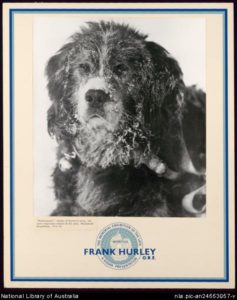
Learn something new every day.  Perhaps you’ve heard of Ernest Shackleton, the Antarctic explorer?  Fine.  But did you know that one of his lead sled dogs was named Shakespeare? I don’t know why I would have known that, but I’m happy that I learned it.  Like a moon of Uranus, just something to bust out during games of trivia.

They had 69 dogs apparently, but for some reason the linked page only lists names for 66 of them.  I’m not exactly sure who was in charge of naming them. Shakespeare’s the only name from literature, except perhaps Hercules and maybe Mercury. Everything else is stuff like “Surly” or “Rufus” or “Fluff.”

Unfortunately the story does not end well for Shakespeare and the King’s Dogs.  They were running out of food and it was taking more to feed the dogs than to feed the men, so the necessary decision was made to put many of the dogs – including Shakespeare’s team – down, that the explorers wouldn’t starve.


And The Winners Are …

I know this post is about a week late, but the idea just came to me over the weekend and I didn’t want to just throw it away 🙂

The 2017 Shakespearean Academy Awards

Animated Feature Film:   I’ll Hold My Mind, Were She A Zootopian

Cinematography, Directing: ‘Ban, ‘Ban, Ca-CaliLaLaLand

Costume DesignFantastic Beasts With Two Backs And Where To Find Them

Documentary (Short Subject):  Bruised White Helmets and Bended Swords

Film Editing, Sound Mixing: A Hawk From A Hacksaw Ridge

Makeup and Hair StylingSelf-Slaughter Squad

Music (Original Score), Production Design‘Ban, ‘Ban, Ca-CaliLaLaLand

Sound Editing: Arrivals of My Watch

Visual EffectsYou Kiss by The Jungle Book

Writing (Original Screenplay): Manchester By The Sea Of Troubles

Best Picture: Well Shone, Moonlight!


(And I’d like to award the special Shakespeare Geek Award to Hidden Behind An Arras Figures because I thought that was a good joke and I wouldn’t get to use it otherwise!)


Give Sorrow Words

Today I learned that a friend’s dad passed away.  I can’t say I knew much about his dad, or that he was sick, it never really came up in our somewhat frequent conversations.  We know each other long distance, one of those “professional colleagues who only really know each other online” sort of thing.  So while I can say, “I am so very sorry for your loss,” that doesn’t really feel like enough.  “If there’s anything I can do” doesn’t really seem to mean much from a thousand miles away.  My wife and I can’t even bring over some hot dish so they don’t have to cook dinner.

What’s left, then, is Shakespeare. This wouldn’t be the first time I said that Shakespeare contains within it the entirety of human emotion.  Whatever you feel, Shakespeare gave us the words to express it, that we may … what’s the word I’m looking for here, empathize? Commiserate? Share. To remind us that others have been there too, that we are not alone.

Not being the religious sort, I’m not a big “my thoughts and prayers are with you” kind of guy. But it’s cool, my friend knows that.  I think he also knows what I’m going to say next, because I certainly know that he’s reading this.  I have my own personal thing that I say when someone important leaves us. Maybe it’s a bit cliche, but I don’t care, because it means something to me.

Rest in peace, and flights of angels sing thee to thy rest.

Thinking about you, my friend.


Which of Shakespeare’s words get you through grief, or offer comfort?  Share them in the comments.


Shakespeare via Portal

Ok, this is pretty cool.  You want to perform Shakespeare.  So does your buddy, only he’s 1600 miles away.  Not a problem! Coventry University and University of Tampere in Finland have created a giant window where the actors can see each other.

In a world of Facetime and Google Hangouts I suppose the underlying technology is not that exciting, but the application is very cool.  CoulProspero, Miranda and Ariel from The Tempest by William Shakespeared I do the same thing with my iPad?  No, not really. We’re talking about full body images, right there on the stage.  Imagine if Sirius Black fell through the curtain in whatever Harry Potter book that was, only now he’s standing there looking out at you from the other side, and you can have a conversation. Neat!  I suppose I could have come up with a more apt Shakespeare reference, but J.K.Rowling’s the one that gave us that easy example :).

What are the practical limits?

The article made it sound like one side was doing the performing and the other was doing some critiquing, but the video shows them interacting in the dialogue.  But that of course begs the question of physical interaction.  Does the whole thing go out the window when you’re supposed to run the virtual player through with an unbated and envenomed blade?

Maybe we could use it for ghosts, or other ayrie spirits? How about Caesar’s ghost, or Hamlet’s father?  I guess I’d have to see it. What’s coming to mind is that if it’s just a flat plane, can you only see the actor straight on?  How do you meaningfully project that to the audience?  I suppose we could get to the point where we put it on a little remote control scooter and drive it around the stage (there are iPad robots that do exactly that), but would that be ridiculously corny?  Maybe if we just embed it into the back wall and then treat it like part of the scenery?  I’ve never directed a Shakespeare production, I’m just brainstorming randomly.

How would you use this?

What do you think?  If you had this technology, Shakespeare directors, how might you use it?  (Obviously it’s a new thing and we don’t know the limits of it – so assume there aren’t any!)