Surely you’ve heard the story of how the starling was introduced to America? Legend has it that a certain Mr. Eugene Schieffelin of New York was both an avid ornithologist and lover of Shakespeare. So much so, in fact, that he got it into his head to introduce into America all the birds mentioned in the works of Shakespeare. In 1890 he started with the starling, which is now considered an invasive species and quite a problem. (He’d actually been introducing a number of other birds since 1860, but most of them did not survive the new environment and are rarely mentioned when telling the story).

The problem is that the story is completely false. Never happened. I have been looking for proof for years, and failed in my mission. I can readily put my hands on the man’s obituary, for Heaven’s sake, and it does not mention Shakespeare. Starlings yes, Shakespeare no. He did release the starlings. There’s just no reason to believe Shakespeare had anything to do with his decision.
I’m well aware, however, that my failure to find proof doesn’t prove anything. I’m not a professional academic, or a researcher. So I turned to those who are.
Reddit has a group called “Ask Historians” which holds for itself a very high degree of proof. Not only do you need to cite sources for everything you state, sometimes people will call into question the validity of your sources. It’s great. I’ve always considered it a “read only” group, because I never thought I could offer anything that would stand up to the rigors of their cross examination.
So I asked them about Shakespeare and the starlings. In that thread you’ll find plenty of reading material on the subject of Mr. Schieffelin, starlings, and Shakespeare. If you think to question their research, feel free to jump in. They’ll defend it. It’s what they do. Nobody there is offering unsubstantiated opinions.
Guess what? They couldn’t find any proof either. The one commenter who offered the most research even said, “I never thought to question the story” but quickly discovered that the story must surely be a post-mortem fabrication because the only time Shakespeare’s name is ever mentioned with Schieffelin is long after his death, even when starlings play a prominent role in the story.
I’m convinced. The burden of proof has shifted. I have numerous documents from the man’s lifetime that never mention him having any obsession with Shakespeare, or that this was his purpose in releasing the starlings. Is it still possible? Technically yes. You’ll notice in the comments of that thread (at the time of this writing), that there was a tenuous connection between an 1889 essay on the “Extinction of Shakespeare” that in theory could have been read by Mr. Schieffelin and given him the idea. But why then did no one, including Mr. Schieffelin, ever write it down?
Until someone finds a document from Mr. Schieffelin’s lifetime, preferably with some direct connection to him, it is our belief that the starling story is false and people should stop telling it.
EDIT : We all know that “authority” to Google means people link to you. If you’ve got a permanent Shakespeare site of any sort (i.e. not just Twitter) and would like to see this story debunked once and for all, please consider linking this post. This will help drive it up in Google’s rankings so people googling for “Shakespeare starlings” will find the truth. Thanks!


 I did not see the television special that my brother in law was referring to, and I wouldn’t really be surprised to discover that contaminated water was generally a problem for everybody in a world of black plague. But would it have sickened and killed him almost immediately? I would assume that if it was that common to drop dead that easily from contaminated water, surely the historians of the last 400 years might have thought of that as well. And like I said, I’ve never heard that theory. It’s far more common to hear people suggest that he had syphilis.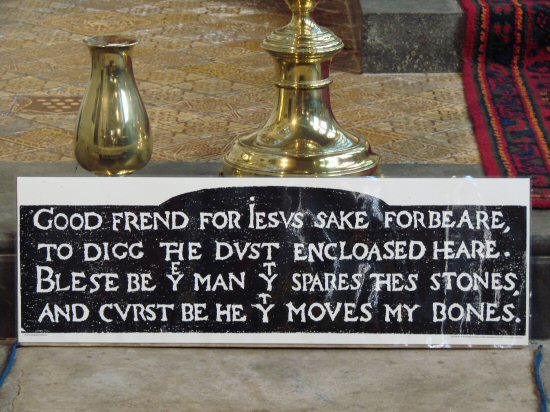
 There’s been talk for years about excavating Shakespeare’s grave, and of course that’s never going to happen, but plan B has always been to scan the ground and see what’s under there because we just can’t leave well enough alone.