
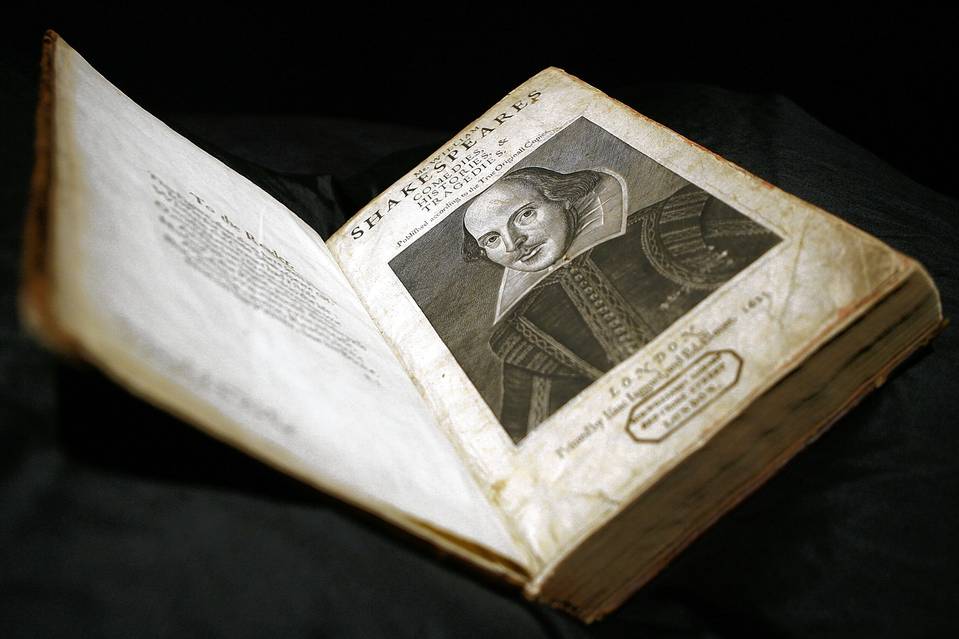
I’ve often said “The mission is working” when random friends and coworkers bring me Shakespeare references. I smile and think, “I’ve had an impact on this person’s life. If they didn’t know me, they would never have recognized and paid special attention to that Shakespeare.”
So it was when my coworker Bryce tapped on the aquarium-like glass wall of my cubicle this morning, holding up a copy of the Wall Street Journal emblazoned with a huge First Folio image. I immediately waved him over.

Conspicuous Consumption for Shakespeare Junkies
I don’t know how to describe the tone of the article, but I don’t like it. “It’s called one of the rarest books in the world,” it begins, “but it’s not – not by a longshot.” After all, 233 copies exist and “more are always turning up.”
If you cringe at the term “bardolatry” you’re going to have a conniption over “bibliographic fetishization” that “can’t be explained in rational terms.” Because, you see, most modern editions of Shakespeare don’t even follow the First Folio, because it’s so full of printing errors. The theory that all the punctuation and spelling choices are Shakespearean directorial choices is a “dubious” one at best, you see, because Shakespeare died before the FF was published and no original manuscripts exist.
It goes on like that, questioning whether there’s any scholarly purpose for the Folger collection to even exist, and making it a point to let the reader know that Charlton Hinman’s implausible theory of five compositors is “nothing of cosmic importance” and can only lead to the conclusion, “So what?”
I feel like the entire article is trolling us, and I’m not going to respond. I’m going to forget the author’s name (which I have not bothered to include here), and will promptly forget it myself in the morning. If Shakespeare makes life better, as we believe, I hope the author is happy with his average life. He doesn’t understand what he’s missing.
No, you know what? I’m not going to end there. I’m going to remind my readers of the time I got to see the Most Beautiful Book in the World, and something a different co-worker said to me:
“You look so happy!” she said. “Look how happy you look! It must be amazing to be that passionate about something that it can make you that happy.”
The author of this article will never understand that.

 I did not see the television special that my brother in law was referring to, and I wouldn’t really be surprised to discover that contaminated water was generally a problem for everybody in a world of black plague. But would it have sickened and killed him almost immediately? I would assume that if it was that common to drop dead that easily from contaminated water, surely the historians of the last 400 years might have thought of that as well. And like I said, I’ve never heard that theory. It’s far more common to hear people suggest that he had syphilis.