
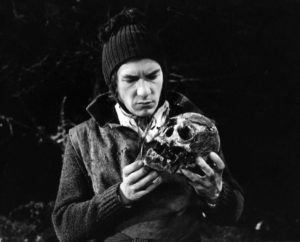
 When I first started reading The Story of Edgar Sawtelle by David Wroblewski, I immediately sat down to write A Hamlet Story. What does it mean when you know that something is supposed to be a Hamlet story? How close will it echo the plot? Will all the characters be there, will the ending be the same?
I think that I’ve been so long immersed in kid-friendly versions of kid-friendly stories that I’d forgotten that it’s possible to do what Wroblewski’s done. This entirely new story doesn’t just help itself to the “son avenges father’s murder” idea and call it a day – it tracks nearly everything, and then some. It answers questions that Hamlet never answered. I loved it.
I know that Bardfilm reviewed this book as well, briefly, and chose not to divulge any of the plot at all. So stop here if you prefer that style of review, because I’m going to give you at least a little bit.
This is the story of the Sawtelle family, and more specifically the “Sawtelle dogs”. For generations the family has bred dogs that are unlike any other in the world. Nobody can explain why, exactly – not even the Sawtelles. But you know it when you see it.
The story starts out pretty far removed from anything resembling Hamlet, which confused me. A grandfather here, a soldier over there, a miscarriage scattered in for good measure. With every character I found myself asking, “Now, is that Hamlet? Hamlet’s father? Laertes?” It was like reading one of those books that retells Romeo and Juliet, only several generations prior. *Eventually* you find a character you recognize, and then everything else falls into place. So it is with this one. One character walks in, one unmistakably named character, and the lightbulb goes on. Oh, I see, now the entire family tree is laid out for me. I love it.
Wroblewski’s creativity doesn’t stop there. I find myself surprised by what I’m about to say, given his source material, but it’s like he adds another dimension to Hamlet.
Examples?
The Sawtelle family raises dogs, as I mentioned. Special dogs. In fact, not only does Edgar speak to the dogs, it is made quite clear that the dogs understand what he’s talking about. So the dogs are characters in the story, and you may easily discover that Laertes is actually canine. (* He’s not. I’m not giving anything away.)
Second, The story is told from multiple points of view. Edgar tells some. But then turn the page and it’s his mother’s turn to tell the same portion of the story. Think about that, oh ye Hamlet fans. For how many years have we yearned to know what exactly Gertrude was thinking? Why she went with Claudius? Or, for that matter, what exactly Claudius was thinking? What was his relationship with his brother? This is where the parallel universe comes in. We don’t get to know what Shakespeare’s Gertrude was thinking, but at least we’ll get a glimpse into the mind of Wroblewski’s doppleganger for her.
Combine all these things and you get something whose sum is greater than its parts. It is Hamlet, plus parts of Hamlet we always wanted. Plus completely original things. When you feel something, you have no idea if you should give credit to Shakespeare for starting it, or Wroblewski for the way he tells it.
There is a part, in any good production of Romeo and Juliet (bear with me), where you know beyond a shadow of a doubt what is going to happen, and yet you’re still on the edge of your chair muttering Oh god, oh god, hurry, get there faster…. That’s why it is genius. Shakespeare started out the story by saying “See those two? They’re going to die.” And before two-hours’ stage traffic is complete you manage to feel so much for them that, once you remember again that they’re doomed, you desperately want that not to be true.
Such was the case with this book. I started it wondering whether there was even an Ophelia character in the story. Once I discovered the answer to my question, all I can say is I know what the phrase “hit me like a ton of bricks” means now. Who knows, you may spot it immediately. You may have your own moments. The book is full of them, and that’s the great part.
How does it end? Does it have the same body count? How pray tell does the story of murder among Danish nobles play out in a modern story? You don’t just run around killing each other during duels, after all. And I’m not saying. 🙂
Highly, highly recommended. Nobody sent me a copy of this one, I sought it out as one of the first books to put on my Kindle.