
http://www.shicho.net/38/ Just got an email from Ingrid, a fellow “tech geek with a love of literature” who wants to beef up her Shakespeare by doing a maddening one-play-a-day read through starting on March 1. She’s looking for folks who might be interested in reading along, in what I can only describe as something of a “speed book club”. I can’t pull it off, I don’t have nearly the time or attention span to tackle such a thing, but I promised that I’d post her request. Anybody up for a month of Shakespeare? She’s calling her project “38 Plays in 38 Days” and has a site up (linked) to track progress. Good luck!
Category: Uncategorized
Most of the posts in this category are simply leftovers from a previous era before the site had categories. Over time I plan to reduce that number to zero and remove this category. Until then, here they are. I had to put something in the box.
Why No Love For Shakespeare In Love?
http://www.screenjunkies.com/movienews/10-worst-oscar-best-pictures-all-time It’s widely understood that Shakespeare In Love winning the Best Picture Oscar (over Saving Private Ryan and Life is Beautiful) is considered one of the top WTF? moments of Academy Award history (though in the above list it only makes #9). So, I have two questions. First, do you think that’s valid? I mean, we’re all Shakespeare geeks here, I’m sure we all have some amount of love for Tom Stoppard and the source material if nothing else. Did you love the movie? Do you think it deserved Best Picture? Second question, assuming I can count the above three as variations on a single question : If you agree that it did not deserve the award, why do you think it won? Some sort of political wrangling going on that we’re not privy to?
What Did Shakespeare’s Father Do For A Living?
Saw this question go by in my referrer logs, thought it was an interesting topic we don’t usually cover. Here’s my understanding of Shakespeare’s dad.
Shakespeare’s dad was a relatively well regarded business man (a glove maker), and member of the community, holding several political positions. He got into some trouble for illegal dealing in wool, and his debt got to the point where he would no longer attend church for fear of being arrested. Eventually he dropped out of public life completely. He did at one point apply for a family coat-of-arms, which was eventually granted in 1596 when son William applied for one on behalf of his father.
John Shakespeare actually held numerous public offices including burgess, chamberlain, alderman and ultimately bailiff, which was the rough equivalent of mayor. So he was well connected, well liked and respected in his community to keep moving up the political ladder. There’s evidence that he was involved in usury – lending money with interest – something on which his son would have something to say later in Merchant of Venice. He was apparently good at it, as records have him associated with a loan of money that would today be worth more than $50k. This, however, was highly illegal at the time, subject to fines equal to all of the loaned money, plus interest, fines, and still imprisonment on top of that. Risky business. If he was so successful in his political career, why did he turn to the shady dealings? My guess is that he was a man of entrepreneurial spirit who had his hands in many things, and as he got closer and closer to “the line”, sometimes maybe he stepped over it – knowingly or not. But once you step over it, reap your profit and don’t get caught, then guess what? You’re going to want to hang out on the wrong side of the line again. It’s like a gambling addiction. You tried it, you won, you liked it. You tried it again, oh hey look, you lost. Now you’re screwed, but now you keep playing because you feel the need to get even and win it back. I suspect John Shakespeare had much the same issue. [Credit to both Wikipedia and also the tremendous EnglishHistory.info that has a dozen or more pages on the topic.]
All Common Elements In Shakespeare’s Plays
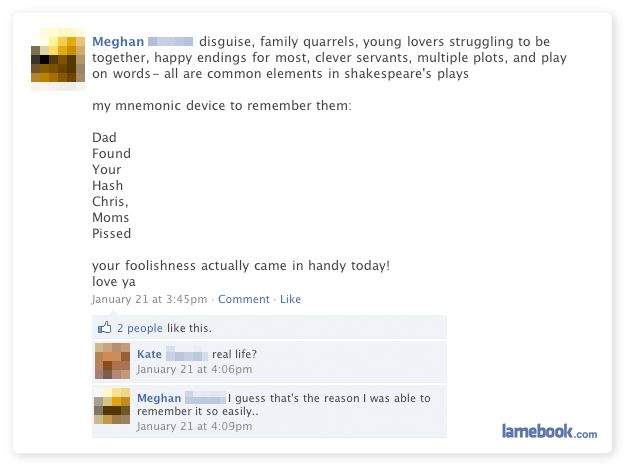
 I don’t often see Shakespeare mentioned so I couldn’t resist. 🙂 [ Found via Lamebook.com ]
Best Of : Shakespeare for Valentine’s Day
Think of Valentine’s Day and we think of love, and poetry. And who did it better? Over the years we’ve hit on this Hallmarkiest of holidays a few times, so I thought I’d go back and grab some favorites:
[Originally posted January, 2007]
Once, a coworker asked me if I knew any good love quotes from Shakespeare. Apparently it was his anniversary and he was working on something for his wife. I asked him to be more specific. While there’s plenty of love to be found in the works, there aren’t too many happy marriages :). (I think we ended up with something from Romeo and Juliet).
Anyway, as Valentine’s Day approaches I thought I’d go combing for some of the more obvious Cupid references. At first Sonnet 153 leapt right out at me, but then I saw Sonnet 154. I’m not a big student of the sonnets, so maybe somebody can explain this to me?
| SONNET 153 Cupid laid by his brand, and fell asleep: A maid of Dian’s this advantage found, And his love-kindling fire did quickly steep In a cold valley-fountain of that ground; Which borrow’d from this holy fire of Love A dateless lively heat, still to endure, And grew a seething bath, which yet men prove Against strange maladies a sovereign cure. But at my mistress’ eye Love’s brand new-fired, The boy for trial needs would touch my breast; I, sick withal, the help of bath desired, And thither hied, a sad distemper’d guest, But found no cure: the bath for my help lies Where Cupid got new fire–my mistress’ eyes. |
SONNET 154 The little Love-god lying once asleep Laid by his side his heart-inflaming brand, Whilst many nymphs that vow’d chaste life to keep Came tripping by; but in her maiden hand The fairest votary took up that fire Which many legions of true hearts had warm’d; And so the general of hot desire Was sleeping by a virgin hand disarm’d. This brand she quenched in a cool well by, Which from Love’s fire took heat perpetual, Growing a bath and healthful remedy For men diseased; but I, my mistress’ thrall, Came there for cure, and this by that I prove, Love’s fire heats water, water cools not love. |
Are those not almost the exact same sonnet? I don’t really have the attention span here at work to dissect the whole thing, so I’m going to assume that the ending is fundamentally different for each, but the setup’s certainly the same, isn’t it? Cupid falls asleep, the nymphs come and steal his little bow and arrow and shove it in the water to cool it off. Only instead of cooling it off, it produces a hot spring that men come to soak in. 153’s ending makes clear sense – Cupid see’s my mistress’ eyes and that is enough to light his torch again, and the cure for the poet’s ills is not the hot bath, but his mistress’ eyes as well. But what’s 154 mean? He went to the bath to try to stop thinking about his mistress, and it didn’t work for him?
[ Originally posted Feb, 2009 ]
I’m a pretty big believer in that whole “eyes are the windows to the soul” thing. Ask me if there’s beauty in a person, and I’ll look at the eyes first. Does that make me an eye man? Ain’t nothing in the world like a big-eye’d girl, as the song goes…;)
But let’s talk Shakespeare. When I picked Sonnet 17 to be “our” sonnet (that being my wife and I, not you my dear reader), it was this one line that stood out:
If I could write the beauty in your eyes, and in fresh numbers number all your graces, the age to come would say “This poet lies, such heavenly touches never touched earthly faces.”
(Yes I was lazy with the syntax of the original there.)
For Valentine’s this year, on the card for my wife’s roses, I wrote this:
The bath for my help lies where Cupid got new fire – my mistress’ eyes.
That’s from Sonnet 154.
Then of course there’s the famous sonnet 130, “My mistress’ eyes are nothing like the sun…”
I’m at work and don’t really have time to write a small novel on the subject, so I thought I’d throw it out there for discussion – were eyes a particular theme of Shakespeare’s more so than other things? Am I just seeing what I want to see? I went combing through the sonnets last night and actually found him referring to his own eyes (most often in the context of “I get to see how beautiful you are”), but very often he does speak of “thine eyes” or “mistress’ eyes” and so on.