I don’t know whether Calvin and Hobbes (who coined my chosen subject line) were in the brain of Erin McKean when she penned this masterful yet subtle slam on a certain recent Shakespeare-wanna-be in the news about how the English language evolves the right way. (In truth, the timing may purely be coincidental, as Mrs. Palin is not mentioned at all in the article. But I like to think it was deliberate…) The subject? Verbing. That is, the use of nouns as verbs. English allows for it, whether you like it or not. I have a blog, I blog things. I also have a table, and I can table things. I look around my office and spy a wall, and technically I could say that I was going to wall my calendar, although what that means might be ambiguous – am I going to hang it up? If I walled my buddha statue that might mean I threw it at the wall. Or I suppose I could lure my enemy down into my wine cellar with the promise of Amontillado and then wall him up down there, too. Grammatically, all valid sentences. Verbing is also at the center of an old grammatical puzzler: “Buffalo buffalo buffalo Buffalo buffalo buffalo Buffalo buffalo”. I think I got the right number of Buffalo in there. Because the word happens to work as a noun (the animal), an adjective (the place from which they come), and a verb, you get such a valid sentence. It’s often hated, no doubt. We all google things and xerox them without too much thought, but sit in a meeting with too many MBA project managers talking about statusing each other or incentivizing their customer base and you may want to beat them with a dictionary. Oh, and one more thing, and I think that this is how and when you correctly drop Shakespeare’s name:
Philip Davis, a professor at the School of English at the University of Liverpool, devised a study in 2006 that tested just what happens when people read sentences with verbed nouns in them–and not just any verbed nouns, nouns verbed by Shakespeare. (Shakespeare was an inveterate noun-verber; he verbed ghost, in ”Julius Caesar, I Who at Phillipi the good Brutus ghosted”; dog, in ”Destruction straight shall dog them at the heels”; and even uncle, in ”Grace me no grace, nor uncle me no uncle.”)

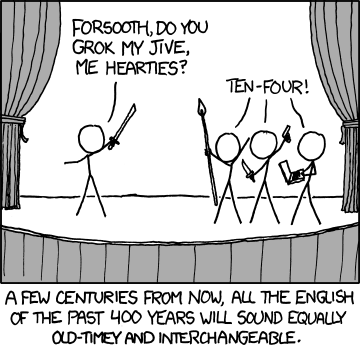
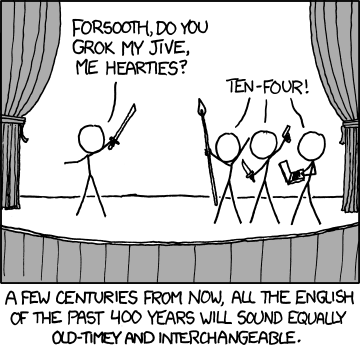 Geeks of the more technical persuasion will recognize, and probably already saw, this XKCD comic. But I couldn’t resist, for obvious reasons. In case you’ve never been to XKCD, there’s always an extra joke hidden in the rollover text of the image. I’ve not included it here, so click through to the original if you want an extra chuckle.