Allow Me To Reintroduce Myself

Happy Shakespeare Day, one and all!

This year, I won’t be online much, as I’ve been invited to speak at the assisted living facility where my wife works. In other words, a room full of people whose average age is 95! I’ve already been once, and they liked it enough to ask for more. I’ll report back!

In the meanwhile I also wanted to say hi to all our new newsletter subscribers! I don’t know exactly what happened, but I’ve seen a surge of new readers over the past few weeks, and I’m happy you’re all here. There are 20 years of posts to explore, so I hope you find something of interest!

Making A Name For Myself

Shakespeare Geek Logo

For a very long time, I’ve been Shakespeare Geek online. Google it, they’re all me. Twitter, Facebook, Amazon, etc, me me me. But after twenty years of doing that, I discovered a problem — Shakespeare isn’t my job. It’s my hobby. I’m actually a career software engineer. When I got laid off, it was a hurdle to take this huge social media audience I’d grown and realize that they couldn’t really help me. I needed to market myself differently.

https://www.duanemorin.com

Introducing my new Project Portfolio site. Here you’ll find everything I’ve worked on (complete or in progress), both Shakespeare and not. No matter how often you visit, chances are you’ve missed a few (or possibly forgotten them), We’ve got merchandise, a couple of books, a few games. And that’s just the Shakespeare stuff.

I’ve also got a few mobile and web apps. I’m very happy with my free Daily Gratitude app. I’m always trying to get more people to use that one.

This is also the site where you can find all my contact information in one place, both social (Threads preferred) and professional (LinkedIn).

What’s New?

Lately, I’ve been working on something a little different.

I realized there are a lot of dads out there—myself included—who are working hard at the day job, supporting a family, and then trying to build something of their own in the in-between time. Nights, weekends, early mornings. Hoping that maybe one day the “want to do” work can replace the “have to do” work.

And then it hit me: I’ve been doing that for over twenty years.

Being an empty nester doesn’t mean I’m done thinking about dad stress. If anything, it means I’ve got some perspective on how to survive it—and maybe do something meaningful along the way.

So I started putting those ideas together into a short ebook called Always Building. It’s about figuring out how to make progress when time is limited, interruptions are constant, and you don’t always know where to start.

There’s a free chapter available now while I work toward the full release.

If that sounds like you—or someone you know—I’d love for you to take a look. Early interest and feedback are what will help bring it the rest of the way.

Happy Shakespeare Day!

I don’t know how many posts I’ll make today. I queue them up as I find them, and often bang them out in real time during the day if inspiration finds me. In my younger days I’d do marathons, often posting two dozen stories, but I don’t think that’s going to happen this year. Like I said, I’ll be off learning from the near-centenarians! I made cookies!

(*) At least, I think I made cookies. That’s the plan. I tell you, this queuing up posts for the future is for the time-travelling birds.

I Knew Him Well, Horatio

I love it when I learn something new, even after doing this for twenty years

Ever since Twitter/X died, Threads has been my social media channel of choice (just in case you want to follow me 😁. Admittedly, I’ve drifted away from the pure Shakespeare thing ever since my last layoff, when I had to start leaning more heavily on the developer-dad thing. But I’m still on the lookout for the good stuff, and it does not disappoint when it does come.

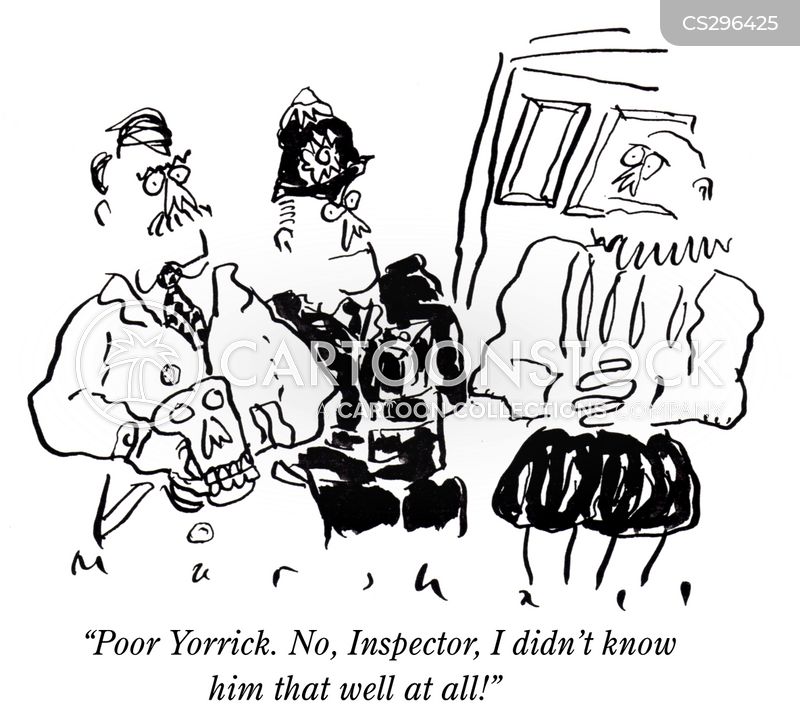
So I spotted this thread about a Shakespeare meet-cute gone awry. The first party opens with “Oh, Horatio!” instead of “Alas, poor Yorick.” Only for the second party to correct(?) him with, “Alas, poor Yorick, I knew him well.” The embarrassment came from realizing that this, too, was incorrect. The Folio says, as I’m sure most readers know, “Alas poore Yorick, I knew him Horatio, a fellow of infinite Iest; of most excellent fancy, he hath borne me on his backe a thousand times…” (I looked that up and copied it, lest we continue the misquoting trend 🧐 )

But wait! That wouldn’t be worthy of a blog post. What caught my eye was the follow-up saying:

“I knew him well” is perfectly fine. LOADS of versions since the 18th century have included the word “well”.

Excuse me? Since when? I was all set to call up my scans of both Quarto and Folio to assure people that it was not, in fact, perfectly fine…. and then I kept reading.

OP brought receipts!

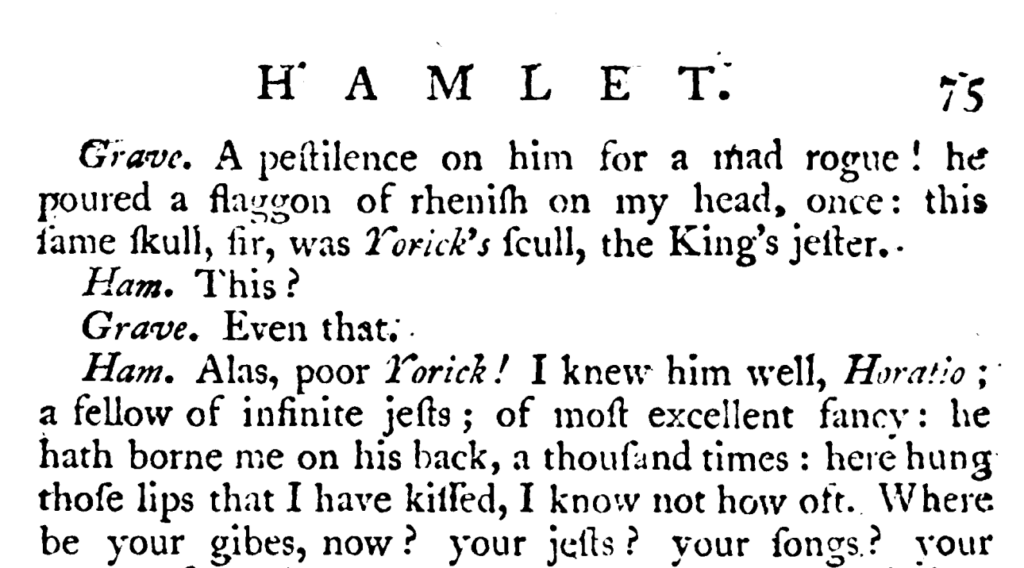
In Bell’s Edition of “Shakespeare’s Plays as They are Now Performed at the Theatres Royal in London” By William Shakespeare, John Bell, Francis Gentleman · 1773

Page 75:

Including a screenshot. Well, color me intrigued! Time to do my own research and see if I can come to the same conclusion. After all, this is the internet in the age of AI. Just because somebody cites a reference and purports to have a screenshot doesn’t guarantee that either is accurate.

I Knew Him Well, Horatio

And would you look at that!

I knew him well, Horatio.

Thank you, Google Books! (Want to hear a funny story? When Google first put the works of Shakespeare online? They quoted me. I’m so happy that link still exists.)

But anyway. I’m not sure how much I’m willing to allow the original poster’s “it’s totally fine” and that LOADS of versions print it that way — this is literally the first time I’m seeing “I knew him well, Horatio,” and I’ve seen my fair share of Shakespeare editions. But it’s not wrong, it’s right there for us to see, going all the way back to 1774.

It is acknowledged that Bell’s edition is not an academic resource:

The editions of Shakespeare’s plays produced by the printer/publisher John Bell were rather different form the scholarly editions being produced at the same period by Samuel Johnson, George Steevens and others. They were acting editions, based on the text actually used in the playhouses, and came complete with current cast lists and illustrations (which could also be bought separately).

My first thought was that this presents us with a bit of a time machine problem. We quote it that way today, assuming that it’s correct. Well, there’s at least one version going back as early as 1774, proving that people were saying it that way. But! That edition is just a written version of how the plays were being acted at the time, so the actors were already saying, “I knew him well, Horatio” before this edition existed! So we’re still left with the question: how did it start?

The reason for doing it is pretty straightforward: the line’s meter feels off. If you’ve got iambic everything on the brain, then i KNEW him …<beat>…Ho-RA-ti-O feels like it’s missing something. It’s only 7 syllables. Text purists will say, “Well, yes – everything in Shakespeare’s work, right down to the pauses and punctuation, are there for a reason.”

But it’s also true that actors and directors have been running with the words in their own way ever since. So there is a certain logic to adding in that well. i KNEW him WELL, ho-RA-ti-O. Bam, 8 syllables, balanced. Sure, it’s not 10-syllable pentameter, but guess what? Neither is that whole passage. That’s not the point. Some actor at some point felt that the line was out of joint (arguably, misunderstood the line), made that adjustment, and it stuck.

So there you go. Did we answer the mystery of where “I knew him well” came from and why? Nope. But we confirmed, it has definitely been a “valid” interpretation of the line for a few hundred years. People saying it that way aren’t misquoting it; they’re just quoting a much lesser-known version that has worked its way into the public’s subconscious. (Much like the debate over whether a tiny candle shines its beams in a naughty world, or a weary one. But, that’s another post.)

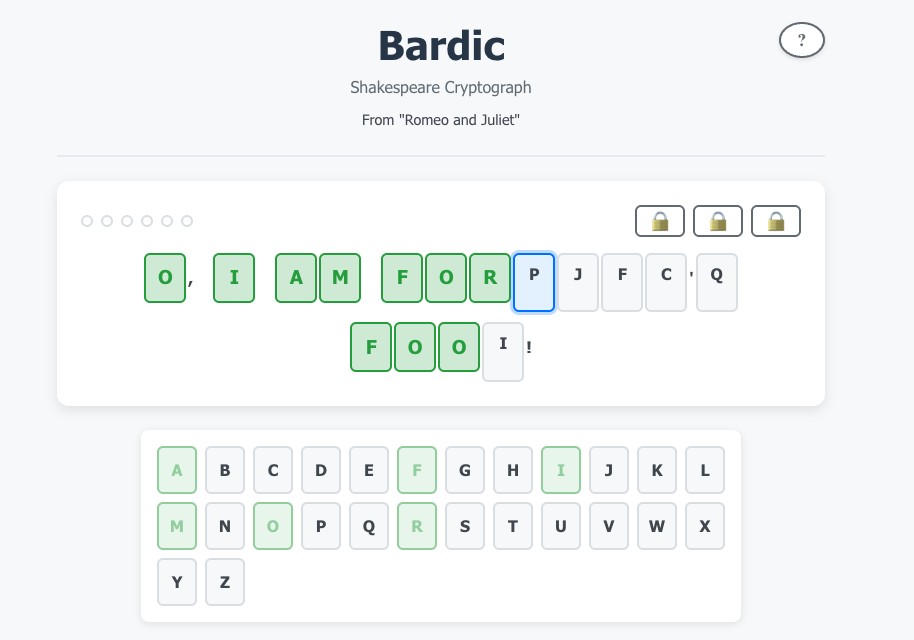
Bardic – Your Daily Shakespeare Cryptogram game!

Would you like to play a game?

Just in time for the holidays, it’s Bardic – Daily Shakespeare Cryptograms!

The underlying game is simple enough – every letter represents another letter. Flip all the tiles to reveal a Shakespeare quote! I’d say “famous” Shakespeare quote but by the time I’m done there’ll be 500+ quotes represented and some of them are going to be really advanced!

You’ve got up to 6 mistakes before the answer will be revealed, and you have to try again tomorrow.

Three hints available!

Don’t forget to share your wins and streaks on social media, so everybody can play!

Seriously, I’ve tried to take into consideration all the feedback I’ve gotten about my other games. This one does allow you to play different individual versions of the game, so you can always poke around if you’re bored rather than waiting for the next day. But only the daily puzzle counts toward your streak!

Board with Bardle?

Having Pairicles pains?

See if you can beat Bardic today!

Review: Hamnet (Movie)

It’s the end of the calendar year, the time when all the most artsy award contender movies all flood the theatres to get it under the deadline. This year, we have to pay more attention than usual, though, because Shakespeare is in the mix. The movie version of Hamnet, by Maggie O’Farrell, is in theatres now. I made sure to read the book before I saw it – review here.

Starring Academy Award Nominees Jesse Buckley and Paul Mescal, and directed by Academy Award Winner Chloé Zhao, this one is absolutely showing up on every list.

But Did I Like It?

Somebody called it Shakespeare In Love 2: Shakespeare Is Sad and I wish I’d thought of that.

This might be the first time I’ve ever said this, but I’m annoyed by how much Shakespeare content is in this. The more you know about Shakespeare, the less you’re going to like this movie.

Let’s back up. This is going to contain spoilers if you don’t already know Shakespeare’s biography, but I’m assuming that most readers of this blog already know the story.

The book did something fascinating that at first annoyed me, but I came to love. Shakespeare’s name isn’t ever mentioned in the book (I think maybe once). He’s barely in it. The book is told from Agnes/Anne’s perspective – a woman forced into a marriage by pregnancy, left in Stratford while her husband runs off to London to build a better life for himself (and, in theory at least, them). All while the plague is all around them, Life is not easy for Agnes, especially once tragedy strikes the family. The book does a spectacular job of telling the story of this wife and mother who just happens to be “Mrs Shakespeare.” The famous guy is secondary to the story.

Well, somebody in Hollywood missed the memo, because all the marketing material says is Shakespeare Shakespeare Shakespeare. Look how pretty Paul Mescal is! Make sure to point the camera directly at his face as many times as you can, and just leave it there. Let them get lost in his eyes.

I’m not even being facetious. You know how some writer / directors are famous for the “walk and talk” style? We’ll call what Zhao does something more like “stare a lot and sometimes talk.” There are many scenes of Buckley and Mescal just staring at each other. There’s also no music to speak of in these scenes, just dragging awkwardness.

The movie also has no faith in telling Agnes’ story, so they inject lots of extra scenes of Shakespeare in London. It was important in the book not to have that, because Agnes didn’t get that luxury. Her husband’s absence was a mystery, and a real point of tension in their relationship. The audience should sympathize with her, especially after their child dies and her husband says, “Well, back to London I go.” Showing Shakespeare’s own grief and pain is completely unnecessary, in my opinion, and weakens the movie.

Let me pause for a second and say nice things before getting to the parts I really hate. This is a beautiful movie. The effort that went into the scenery and costumes is outstanding. If this movie’s getting any awards, it should be in those areas.

Jesse Buckley is, to put it simply, her generation’s Meryl Streep. She’s brilliant in every scene, and the movie would be better by having more of her in it. She’s called upon to act out both her child’s birth and death in a single movie. If that’s not range, I don’t know what is. We’ve often referred to Constance’ famous speech from King John about grief (“Grief fills the room up of my absent child, Lies in his bed, walks up and down with me, Puts on his pretty looks, repeats his words..”) and Buckley is the embodiment of that speech. Her fury at her husband stealing their child’s name to use in his little play, storming to London to confront him, literally screaming at the actors mid-performance that it is not theirs, they can’t have it? Amazing. I won’t spoil everything but I will say that even after that moment it gets even better. (Before unfortunately getting worse.)

Let’s talk about the direction. My wife came out of the theatre asking, “I don’t understand why it kept showing the table.” It took me a second to realize what she meant, but she’s right. The camera spends much of our two hour runtime on the scenery, even when the main characters are having a conversation. Agnes and Will are talking, but are they on screen? Nope, let’s look at the table. Or a leaf on a tree outside the window. Or various big black holes, like the gap in the tree roots, or the exit from the stage. I’m sure there’s some deep reason for this choice, but I much prefer a more grounded approach. When people are talking I want to see their faces.

What About The Shakespeare?

As I mentioned, there’s almost no Shakespeare content in the book, except right at the end. I wish they’d kept it that way, the ending would have been more powerful. Instead, some producer somewhere no doubt read the script and said, “Where’s the balcony scene? People love the balcony scene, add the balcony scene.” So yes, spoiler alert, we get a shot of Shakespeare – back when Susannah was just a baby – working upstairs on “But soft what light through yonder window breaks,” tapping out the iambic pentameter as he recites it. Bleh. I think that scene might have already been in Shakespeare In Love but that is not why that one got its Oscar. Never mind that this was probably 10 years before the play was written. The man was just that good, I guess? A regular Earl of Oxford.

But wait, there’s more! Of course, Shakespeare shared his work with the family, being the good, present, and attentive father that he was (at least, in this story). He choreographs stage combat with Hamnet. The children put on a play for their mother. What do they recite? When shall we three meet again, in thunder, lightning, or in rain? Sure, why not? Who cares that Hamnet died in 1596 and Macbeth wasn’t written for another 10 years?

Can it get worse? Oh, gentle reader, brace yourself. You do know for certain that “To be or not to be” is Hamlet contemplating suicide, right? We know, because in this movie, in his grief, we literally get a shot of Shakespeare debating whether to throw himself into the river while reciting that soliloquy. That’s got to be the worst decision they made. The movie’s already being called “grief porn.” They already injected a bunch of scenes of how Shakespeare dealt with the death of his son, because they didn’t have enough faith in the child’s. mother’s grief. Instead they have to take a scene like that and say, “You know what would be great here? What if he recites To be or not to be?” And all the other writers in the room say “Brilliant!” when in reality it ruins the movie.

See It or Not?

People always ask me, “Would you recommend it?” about movies and I never know what to say. My opinion is my opinion, and yours may vary. As noted, it’s a visually stunning movie, and Jesse Buckley alone deserves to be seen. I’d like to say the same about Paul Mescal but really, I so resent the extra footage of him that they jammed in there, I can only really see him as a pretty face they kept shoving in there because they didn’t have enough faith in Buckley’s, which is a true shame. This movie could have stayed far closer to the book, removed all the extra Shakespeare, focused entirely on Agnes, and been an even stronger Oscar contender, if you ask me.

Twelfth Night On PBS (Leaving Soon!)

Every year it’s the same, for those of us not living in New York. The play and cast are set for Public Theatre’s summer Shakespeare In The Park performances, and we gasp at the star power, knowing that we’ll never get to see it. Even if you’re in walking distance, apparently you’ve still got to wait in line for hours for “first come first served” tickets.

Not so fast! This year it was recorded, and now showing on PBS Great Performances! Sadly, it’s leaving on Dec 31, 2025, so you’ll have to be fast! Luckily I got to catch it.

Twelfth Night, or, What You Will

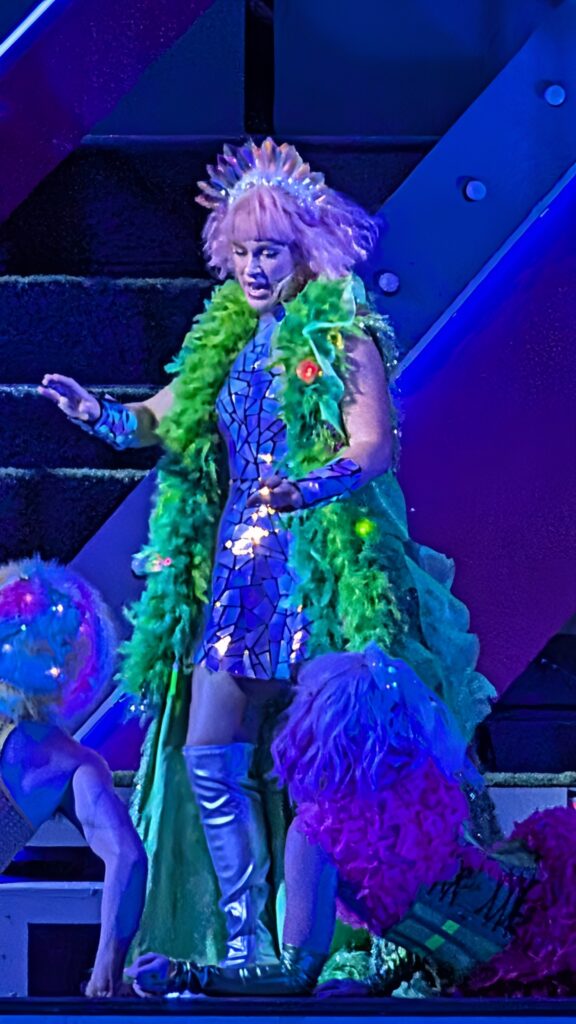
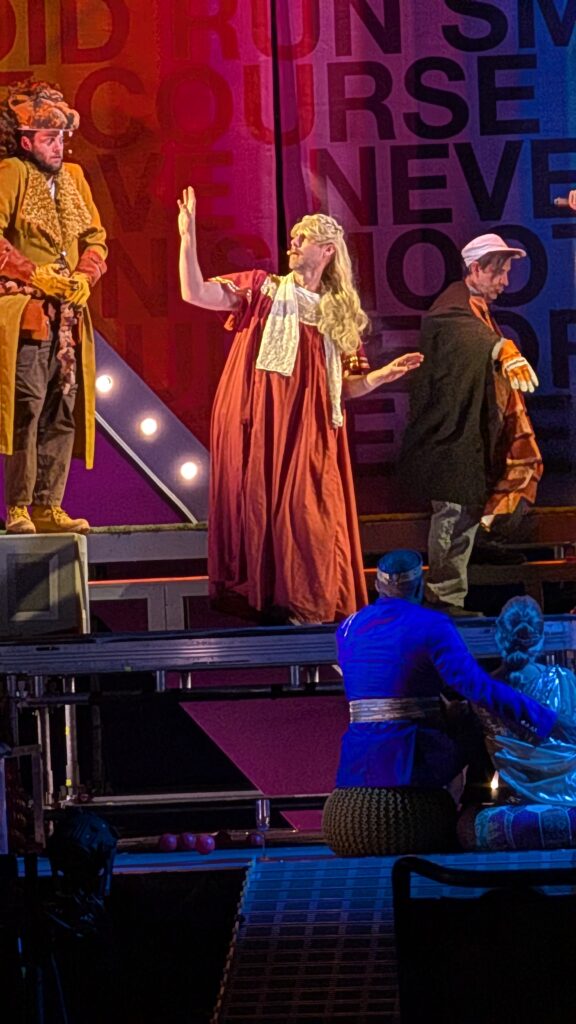
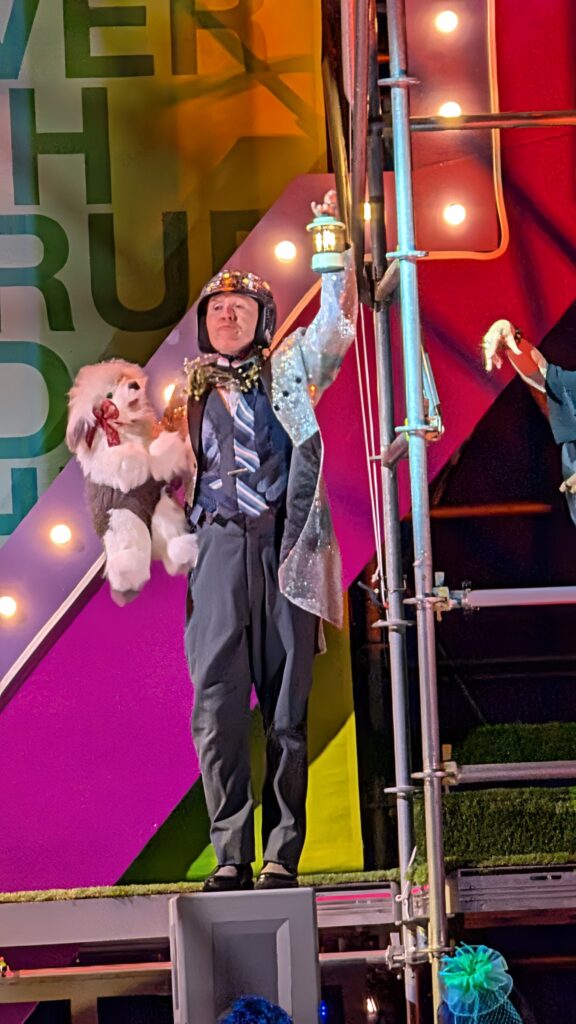
This year we got Twelfth Night, starring: Peter Dinklage (Malvolio), Sandra Oh (Olivia, Jesse Tyler Ferguson (Andrew Aguecheek), Khris Davis (Orsino), and, in an inspired bit of casting, Lupita Nyong’o and her real-life brother Junior Nyong’o as Viola and Sebastian,

Thoughts

Jesse Tyler Ferguson as Andrew Aguecheek
Jesse Tyler Ferguson was unfortunately little to work with as Andrew Aguecheek.

It took me a little while to realize, in the opening scene, that Viola keeps dropping in to Swahili. This had to be confusing for the audience who’d already be struggling to hear the words, only to have them randomly becoming incomprehensible. It’s not a new idea, plenty of tv shows have characters switching back and forth between English and Spanish, or other appropriate language for the context. I get it? As someone who only speaks English I don’t like it, for obvious reasons – but I understand that someone who is bilingual, maybe somebody for whom English is not their native or primary langauge, might actually appreciate this. I still stand by my argument though that it makes Shakespeare just that much harder to understand.

I really liked the way Orsino dealt with “the boys”, his entourage of followers who laugh at his jokes, agree with his pronouncements, and drop to do pushups when he’s displeased. I don’t usually think of Orsino with a posse, but it works here and nicely offsets Olivia’s crew who do this fun little switcheroo number when Cesario first shows up to deliver his message, all “masked” in sunglasses and taking their turn as the lady of the house. Lots of movement on stage, lots of laughs for the audience.

If I had to pick the “big name” from this year’s cast it would be Peter Dinklage. I hate to say things like “he’s easily recognizable in everything he does” but I think that Game of Thrones had a lot to do with that. So when I heard he’d be playing Malvolio, that’s what I looked forward to.

Peter Dinklage as Malvolio
Peter Dinklage kept doing that thing with his hands that Mike Johnson does, I have to assume it was on purpose.

And I have to say, I didn’t love his portrayal. They’ve got him doing the weird “I don’t move my arms when I walk” thing that seems to accentuate his short stature, like they’re playing up some “little people walk funny” clichè. He’s got a silly haircut and he’s doing a silly voice, too. So yes, every time he’s on stage, there’s a good audience reaction for everything he does. But is that acting? He gets the laugh just by showing up, or changing how he stands, without ever saying anything.

Here’s the thing about casting Junior to play Viola’s brother – he’s actually Viola’s brother. That’s an opportunity I’m sure many directors would kill for. They look alike. Viola, as Cesario, spends most of the play dressed up in a man’s suit, which only adds to the charade. Shakespeare did love to play with twins, but I’m sure we’ve all been to many productions over the years where little more than a hat or scarf is all we get to say “Oh, ok, these two are supposed to be indistinguishable” and then go with it. For once, this time, we actually believe that they could easily be confused for one another. Except for the height – Junior’s significantly taller :). But you can’t have everything!

And then … and I love this … Junior speaks Swahili. Now the opening scene makes sense! Of course opening that way was confusing, here she is a little stranger in a strange land, speaking a language only she knows. She’s lost and confused; she has no one. That sets up Viola’s story beautifully.I don’t remember if she slips into Swahili randomly at other times in the play, but it would be great if she did. English is part of her cover story and it’s hard to keep up with it all the time. So, the reunion when her brother arrives, and they can both return to speaking their mother tongue? That’s great stuff, and I’m glad I saw it through to the end.

See It Before It Leaves

It’s Shakespeare, it’s free, it’s got celebrities you know. How can you not see it? Catch it before December 31, 2025! I hope they make this the new standard and we get to see the show this way every year.