Twelfth Night On PBS (Leaving Soon!)

Every year it’s the same, for those of us not living in New York. The play and cast are set for Public Theatre’s summer Shakespeare In The Park performances, and we gasp at the star power, knowing that we’ll never get to see it. Even if you’re in walking distance, apparently you’ve still got to wait in line for hours for “first come first served” tickets.

Not so fast! This year it was recorded, and now showing on PBS Great Performances! Sadly, it’s leaving on Dec 31, 2025, so you’ll have to be fast! Luckily I got to catch it.
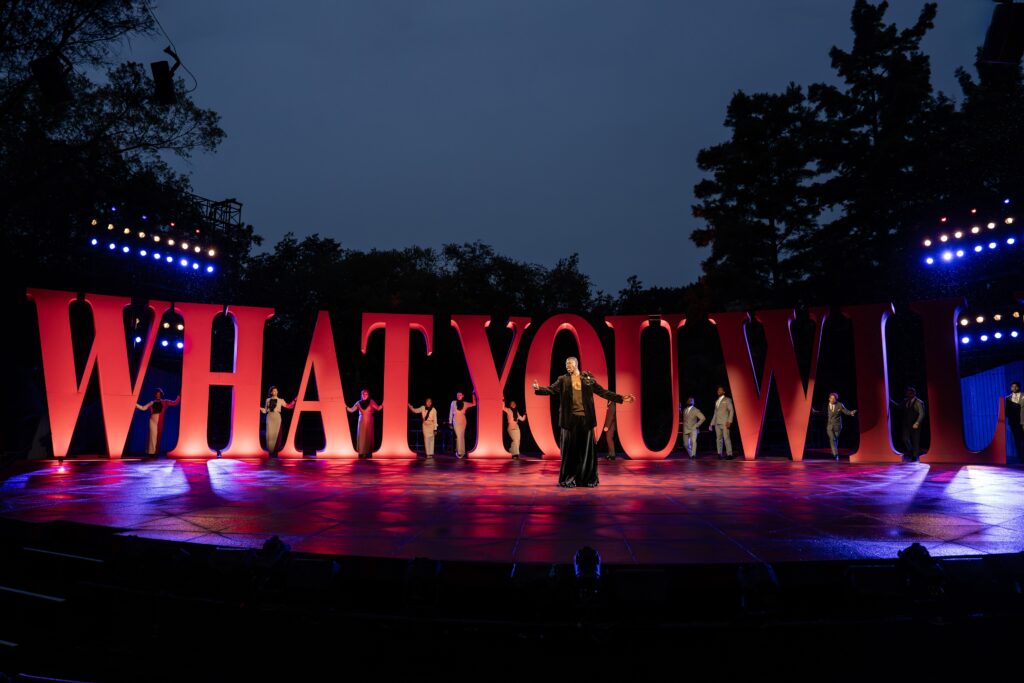
Twelfth Night, or, What You Will

This year we got Twelfth Night, starring: Peter Dinklage (Malvolio), Sandra Oh (Olivia, Jesse Tyler Ferguson (Andrew Aguecheek), Khris Davis (Orsino), and, in an inspired bit of casting, Lupita Nyong’o and her real-life brother Junior Nyong’o as Viola and Sebastian,

Thoughts

Jesse Tyler Ferguson as Andrew Aguecheek
Jesse Tyler Ferguson was unfortunately little to work with as Andrew Aguecheek.

It took me a little while to realize, in the opening scene, that Viola keeps dropping in to Swahili. This had to be confusing for the audience who’d already be struggling to hear the words, only to have them randomly becoming incomprehensible. It’s not a new idea, plenty of tv shows have characters switching back and forth between English and Spanish, or other appropriate language for the context. I get it? As someone who only speaks English I don’t like it, for obvious reasons – but I understand that someone who is bilingual, maybe somebody for whom English is not their native or primary langauge, might actually appreciate this. I still stand by my argument though that it makes Shakespeare just that much harder to understand.

I really liked the way Orsino dealt with “the boys”, his entourage of followers who laugh at his jokes, agree with his pronouncements, and drop to do pushups when he’s displeased. I don’t usually think of Orsino with a posse, but it works here and nicely offsets Olivia’s crew who do this fun little switcheroo number when Cesario first shows up to deliver his message, all “masked” in sunglasses and taking their turn as the lady of the house. Lots of movement on stage, lots of laughs for the audience.

If I had to pick the “big name” from this year’s cast it would be Peter Dinklage. I hate to say things like “he’s easily recognizable in everything he does” but I think that Game of Thrones had a lot to do with that. So when I heard he’d be playing Malvolio, that’s what I looked forward to.

Peter Dinklage as Malvolio
Peter Dinklage kept doing that thing with his hands that Mike Johnson does, I have to assume it was on purpose.

And I have to say, I didn’t love his portrayal. They’ve got him doing the weird “I don’t move my arms when I walk” thing that seems to accentuate his short stature, like they’re playing up some “little people walk funny” clichè. He’s got a silly haircut and he’s doing a silly voice, too. So yes, every time he’s on stage, there’s a good audience reaction for everything he does. But is that acting? He gets the laugh just by showing up, or changing how he stands, without ever saying anything.

Here’s the thing about casting Junior to play Viola’s brother – he’s actually Viola’s brother. That’s an opportunity I’m sure many directors would kill for. They look alike. Viola, as Cesario, spends most of the play dressed up in a man’s suit, which only adds to the charade. Shakespeare did love to play with twins, but I’m sure we’ve all been to many productions over the years where little more than a hat or scarf is all we get to say “Oh, ok, these two are supposed to be indistinguishable” and then go with it. For once, this time, we actually believe that they could easily be confused for one another. Except for the height – Junior’s significantly taller :). But you can’t have everything!

And then … and I love this … Junior speaks Swahili. Now the opening scene makes sense! Of course opening that way was confusing, here she is a little stranger in a strange land, speaking a language only she knows. She’s lost and confused; she has no one. That sets up Viola’s story beautifully.I don’t remember if she slips into Swahili randomly at other times in the play, but it would be great if she did. English is part of her cover story and it’s hard to keep up with it all the time. So, the reunion when her brother arrives, and they can both return to speaking their mother tongue? That’s great stuff, and I’m glad I saw it through to the end.

See It Before It Leaves

It’s Shakespeare, it’s free, it’s got celebrities you know. How can you not see it? Catch it before December 31, 2025! I hope they make this the new standard and we get to see the show this way every year.

Wicked Shakespeare

Ok, show of hands, has everybody seen Wicked yet? How many times? 🙂

Well, it’s now available for streaming, which means we get to take screenshots. And with screenshots and subtitles, we get to do this!

You just knew that if there were any Shakespeare in there, we would find it. Here, of course, Galinda (or Glinda) borrows Malvolio’s quote from Twelfth Night: “Some are born great, some achieve greatness, and some have greatness thrust upon them.”

This got me thinking about something I like to call the “Lion King Rule.” That’s the one that says you only need a handful of recognizable elements of a Shakespeare play to say that a movie is based on that movie. So, is Wicked a retelling of any Shakespeare plays?

We’ve got a father who wants nothing to do with his wife’s new baby and demands it be taken away. There’s even a bear. This makes it Winter’s Tale.

We’ve also got a powerful solo central character who is positioned as a pawn of powerful political forces. When our hero fails to do what they’re told, they’re recast as the villain of the story. There’s also a “frenemy” character who our hero may or may not be in love with but will certainly be instrumental in their downfall. Coriolanus.

Of course, this is a story about witches. Therefore, it is obviously Macbeth.

Anything else?

Review: Twelfth Knight (audiobook)

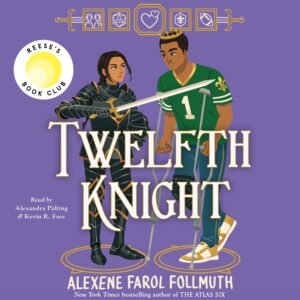
A couple of weeks ago, Drew from Macmillan Publishers reached out to ask if I’d like a review copy of Twelfth Knight by Alexene Farol Follmuth. Specifically, the audiobook version. This was very serendipitous as, (a) I much prefer audiobooks and (b) I was about to go on vacation and needed something to read. I happily said yes. Now here we are! I say this by way of disclaimer – I may get a few details wrong here and there. I don’t have a text to doublecheck when I’m not sure.

Twelfth Knight, by Alexene Farol Follmuth

Retellings of Shakespeare are a staple in modern young adult novels. Our buddy Bardfilm practically has a whole category for reviewing them. Twelfth Knight, perhaps obviously, is going to retell Twelfth Night with high school students. If you’re getting flashbacks to She’s The Man (2006) or Just One Of The Guys (1985) for the Gen-Xers , well, so did I. The natural question with most modern Shakespeare adaptations is how you modernize the, shall we say, less-than-modern aspects? The ghosts in plays like Hamlet and Macbeth are one obvious example. For comedies like Twelfth Night, it’s the “girl dresses like a boy and nobody seems to notice” thing. Not to mention the “I have a twin brother than nobody knows about” thing. You can only stretch the “suddenly I go to a different school where nobody knows me” thing so far.

Twelfth Knight doesn’t bother with any of that. Right from the start, Orsino/Olivia/Viola/Sebastian (“Bash”) all know each other as themselves. They’re all in the same classes together at the same school. Orsino is the football star, Olivia is his former girlfriend. Viola is unfortunately portrayed as the class bitch — and I say it like that for a reason, more on this later. Her brother’s a bit of an add-on, he doesn’t get much storyline unless he’s necessary for somebody else’s. Honestly at one point early in the story when I wasn’t paying attention I thought Bash was the name of Viola’s cat.

Here’s the modern twist that keeps it interesting, though — online videogames. Viola’s big into role-playing games, and as anyone with experience knows, the landscape for a girl trying to play videogames with the boys is just as dangerous as being unaccompanied in Illyria. Her interactions with the fellas come in one of three flavors — either they hate her for being better than them, they think she “owes them” whenever one of them so much as acts human toward her, or they just plain ignore her. See where this is going? Of course she plays online as a male character. (Cesario, in fact. In this world, Cesario is also the name of a character from a popular “Game of Thrones” ripoff that they all watch.)

What does this do to the plot? Orsino the football player / class president is injured, leaving him with only two things to occupy his time. First, he’s of course on the homecoming committee so he has to take part in those meetings, which also involve bitch Viola (again, trust me). Second, however, is when he’s introduced to online videogames as a way to burn off some of his unfulfilled need to compete and win at something. Where, of course, he quickly meets Cesario, a much better player than he is. With context clues it’s not long before he realizes that Cesario goes to his school, so Cesario admits to being … Sebastian.

From there I think you can see how it plays out. The fact that “Viola’s a bitch” plays heavily in the text. She’s called one all the time, by everyone, as if the word is a literal weapon straight out of one of her games. The story’s told primarily from her point of view, so we get the inside look at why she’s like that. She, like many women, lives in a world where standing up for yourself when you feel threatened gets you branded with that label. You get tired of trying to fight it, so instead you adopt it and wear it like armor. From that point forward it’s self-fulfilling, and the vicious cycle repeats.

But we know how this goes. Orsino gets to spend time with Viola (as Viola) via their committee meetings, and enlists her help to figure out why Olivia broke up with him. Olivia, meanwhile, is suddenly Viola’s best friend and confides in her a number of highly personal things that would absolutely give Orsino the answer he wants and are very much not Viola’s to tell. Meanwhile Viola’s playing the double life as Cesario, who Orsino thinks is Sebastian. Who, by the way, has no idea that he’s been pulled into this whole story. Orsino learns who the real (i.e. not a bitch) Viola is, Viola comes out of her armor and learns to trust people. Except there’s still that whole “I’m actually also Cesario” thing that she has yet to tell him. How will that work out?

I like this version. I like how it pretty seamlessly blends the double lives of these kids, going to school with one face and then getting behind the computer with another one. The author manages to tell a new story with new dynamics while still keeping many of the core elements of the original story.

Two things I didn’t love. One, it tries a little too hard to map to the original where it doesn’t need to. This story has all kinds of new characters – parents, best friends, etc… – yet the author still felt obliged to sneak in other football players like Volio, Curio, and Aguecheek. None of those names fit the story’s context (Orsino is borderline as it is), and it would have made the novel stronger to just change them to something unrelated or drop the characters completely.

Second, there are some reasons this doesn’t work well in audiobook. As part of creating an original story, the author has added diversity to the story. Fine. Orsino is black. Viola is Viola Reyes, who I believe is supposed to be Phillipino? Olivia is Olivia Hadid, and presumably Arabic? These details are part of the story. Time is spent with extended families, among other things. Parents’ expectations of their children is a driving force in the main characters’ growth. I’m ok with all of that (and, as I noted at the outset, I apologize if I confused any of the details). My point is that it doesn’t work in audiobook. With just two narrators, the voices all start to blend, and you end up differentiating Olivia and Viola by which one is perky and which one is nerd-bitchy, and not at all by the fact that they’re supposed to be from opposite ends of the world culturally. It ends up feeling like a disservice is done to their backstories. Why add cultural diversity if it ends up whitewashed?

Overall, I’d certainly recommend it. A lot of ground is covered that has nothing to do with Shakespeare. Orsino’s worried that a late injury has destroyed his chances of playing football in college. Viola is not the only girl who discovers the hard way that a boy being nice to you can suddenly turn very dark. All of these kids are in a constant battle of trying to figure out who they can trust (their parents included), while navigating all the obstacles that life’s going to throw in their way. All while trying to come to terms with the difference between the person they want to be and the person they’re projecting to the world, and when it’s safe to reconcile the two. Available now on Amazon (and not just in audiobook!)

Christmas in Shakespeare’s Plays?

I continue playing with ChatGPT in as many varied ways as I can imagine. Last night I asked it to write me a blog post on “Christmas in Shakespeare’s Plays.” Here’s what I got. Let’s dissect!

The celebration of Christmas has a long and varied history, and it has been depicted in literature and art for centuries. In the plays of William Shakespeare, Christmas is often portrayed as a time of joy, celebration, and reflection.

Fine, I guess. Generic.

One of the most well-known references to Christmas in Shakespeare’s plays is in “A Midsummer Night’s Dream.” In this play, the character Bottom describes a dream he had in which he was transformed into an ass and danced at a Christmas feast. This humorous portrayal of Christmas is a lighthearted example of the way in which the holiday was often depicted in Elizabethan England.

…what? After all these years I’ve still got some pretty hefty impostor syndrome when it comes to Shakespeare, so whenever it said Bottom references “dancing at a Christmas feast” my first thought was, “He does? Why don’t I remember that?” So I went looking:

I have had a most rare
vision. I have had a dream, past the wit of man to
say what dream it was: man is but an ass, if he go
about to expound this dream. Methought I was–there
is no man can tell what. Methought I was,–and
methought I had,–but man is but a patched fool, if
he will offer to say what methought I had. The eye
of man hath not heard, the ear of man hath not
seen, man’s hand is not able to taste, his tongue
to conceive, nor his heart to report, what my dream
was. I will get Peter Quince to write a ballad of
this dream: it shall be called Bottom’s Dream,
because it hath no bottom; and I will sing it in the
latter end of a play, before the duke:
peradventure, to make it the more gracious, I shall
sing it at her death.

I even went into the Quarto versions. I’m aware that just searching “Christmas” isn’t going to yield a hit, but so far I see nothing even close. I asked on Twitter, and others didn’t seem to know, either. Hmm. Ok, moving on.

In “Henry V,” Shakespeare references the Christmas season in a more serious manner. The play takes place during the Hundred Years’ War between England and France, and it tells the story of King Henry V’s victory at the Battle of Agincourt. In one scene, the king speaks to his troops on the eve of the battle, reminding them that it is Christmas time and encouraging them to fight for their country.

It’s Christmas Time? <asks Google to remind me when St. Crispin’s Day is> October. Again, I’ll plead ignorance and ask, is there a connection here? Would you call Agincourt “Christmas time”? Ok, one more.

“Twelfth Night” is another play that features Christmas as a prominent theme. The play is set in Illyria during the Christmas season and follows the misadventures of the character Viola, who disguises herself as a man after being shipwrecked on the coast of Illyria. In one memorable scene, the character Sir Toby Belch gets drunk and sings a song about Christmas, declaring it to be “a time for joy, a time for love, a time for peace on earth.”

This is just a no. Twelfth Night is named for when the play was performed, not for the plot. It doesn’t mention anything related to Christmas or the Christmas season at all. And, much like Bottom’s Dream, I have no clue what song of Sir Toby’s it’s talking about. The word “peace” pretty much only appears in the play when people are saying “Hold thy peace.” Joy doesn’t appear at all. No version of “a time for” anything appears at all.

Overall, Shakespeare’s plays depict Christmas as a time of joy, celebration, and reflection. Whether it is through humorous references or more serious themes, the holiday is an important part of the fabric of Elizabethan England and continues to be a beloved tradition today.

And we wrap up with the generic, basically repeating the intro paragraph. This is what I used to teach my kids as the “middle school format”. Make a statement, say what your essay will show. Three paragraphs demonstrating your point. Conclude by restating your original argument.

At first glance I only picked up on Bottom’s Dream and thought, “Oh, interesting, I wonder what bug caused that.” But upon further reading and realization that it’s entirely wrong and just flat out making stuff up, my whole attitude toward the program has changed. A student tasked with looking for Christmas references in Shakespeare’s works could be given this response and assume every word of it is true. I sent me feedback to the creators (which you’re supposed to do, that’s one of the reasons it’s free for people), but I don’t expect it’s something they can address. Where do you even look for the source of something like that?

On that note, Happy Holidays, everyone! I hope everybody gets lots of Shakespeare Geek Merchandise!

Masters Of Their Wealth

So I proposed a question on Twitter the other day:

Which Shakespearean character is most associated with tremendous wealth? Nothing symbolic or metaphorical, I’m talking about good old-fashioned net worth. Shylock’s not really what I’m looking for.

https://twitter.com/ShakespeareGeek

I don’t particularly think of Shylock as wealthy, but I do think of him as being “all about the ducats.” In theory, somebody who’s very … careful? … with their money is a potential candidate for someone who is very wealthy. But I wasn’t looking for technicalities, I was looking for a character that just screamed, “Look how rich I am.”

The responses on Twitter were intriguing, and much more varied than I would have expected! There was one in particular I assumed would win (do you have the same one in mind?) so I was pleasantly surprised to see the other contenders…

Each Receiving One Vote

Orsino and Olivia from Twelfth Night each got a vote (in two separate responses from two separate people).

Lord Capulet from Romeo and Juliet and Baptista from Taming of the Shrew each got a vote, because if you’re going to woo a young Shakespearean lady, make sure she’s got a rich dad.

Speaking of Shylock, Antonio from Merchant of Venice got a vote, with the caveat that he basically lost it all.

Julius Caesar was emperor of Rome, and you have to figure that’s a pretty wealthy position to be in, even if it’s not explicitly discussed in the play.

Tamora (Titus Andronicus) made the list as well, though I don’t know enough about the play to speak to why.

How about Falstaff (Henry IV)? Anybody ever think of him as wealthy? He got a vote.

Receiving Two Votes

Portia, from Merchant of Venice, gets more votes than Antonio for being in the “super-rich tier” where suitors are bankrupting themselves wooing her.

“Any of the English kings” was mentioned, though Richard II specifically was called out twice.

Three Votes

Speaking of kings, King Lear got three votes. At the beginning, maybe, sure.

The Runner Up with Five Votes

Guesses? Anybody? Cleopatra (Antony and Cleopatra) garnered much praise, what with her “poop of beaten gold” and everything.

And the Winner is …

With a whopping ELEVEN votes, more than double any other contender, our winner for “Shakespearean character most associated with tremendous wealth” is …

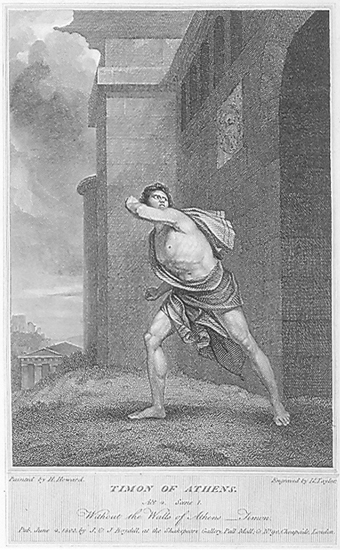
Timon of Athens! Exactly who we thought it would be when we asked the question :). “Easy,” said one response. “Definitely the most obvious,” said another.

But there was a reason why I asked in the first place, too. People also commented “at least on paper” and “maybe in principle”, too. “At least in the beginning,” several responses noted. I was curious whether he’s generally regarded as wealthy, or as someone who lost it all. Now I guess we know the answer!

You’d think he can afford nicer clothes.