If Music Be Whose Food Of Love?

If music be the food of love, play on.

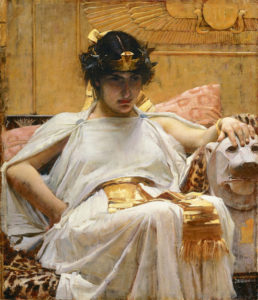
Cleopatra doesn't look very hungry for the food of love.Everybody knows that quote, right?  Duke Orsino, opening line of Twelfth Night.

But check this out.  I was searching the text for music references tonight and a line popped up I’d never noticed before:

Give me some music; music, moody food
Of us that trade in love.

Recognize it?  That’s Cleopatra, from Antony and Cleopatra (duh), Act 2 Scene 5. Sounds almost identical, doesn’t it?  I love finding these obvious examples where Shakespeare had good luck with a particular turn of phrase and went back to it later.

It would be great if A&C was written first and we could say the most famous use of that line actually lifts it from the other, but that’s not the case – Twelfth Night is pretty safely several years prior to A&C.


Wherefore Did I Fail

I’m a horrible father.

My oldest, as I may have mentioned, is studying Romeo and Juliet in school. Today while driving her to school we were discussing Shakespeare and I’d joked about the possibility of creating a “Name That Shakespeare” game along the lines of “Name That Tune.”  You know, “I can name that Shakespeare play in 3 words!” sort of thing.  (More on that in a future post!)

To which she responds, “That would be impossible.” Thinks about it and adds, “Well, I suppose some would be easy. Where art thou.”

Not taking my eyes off the road I ask, “What’s that one from?”

“Romeo and Juliet,” she replies.

I immediately begin hitting the child.  “That’s not even funny!” I yell in mock horror. Maybe it wasn’t so mock.

Defending herself she retorts, “Why? What’s wrong with that? Is that not the line?”

“It’s wherefore art thou,” I correct.

“Right,” she says, “It means where are you.”

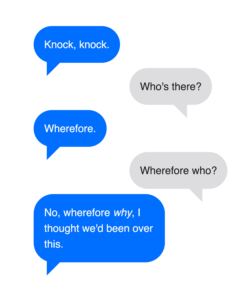
I immediately begin hitting the child again.  “Where did I go wrong? When did I fail you? Of all the things I’ve taught you, how did you miss this?  This is like the line in the sand between people who understand Shakespeare and who don’t.  It’s the go-to inside joke among Shakespeare geeks.  If you google “Shakespeare knock knock jokes“, you get this joke. I literally have a t-shirt with this joke written on it.  Knock knock.”

“Who’s there?”

“Wherefore.”

“Wherefore who?”

“NO, WHEREFORE WHY! WE’VE BEEN OVER THIS!”

“I don’t get it.”

I didn’t actually push her out of the car, or disown her.  I may have thought about one or the other. She goes on to tell me how she honestly thought (up to this point I’d hoped she was kidding) that Juliet was looking for Romeo in the bushes.  *sigh*  I had to explain how, from her point of view, she’s never going to see the guy again, it was just two ships passing in the night. It’s not like they said “Come out on your balcony, I’ll meet you outside.”

I just honestly don’t understand how that went past her.  If you’d asked me I would have thought it was one of my most overdone jokes.  Surely they’d heard it a hundred times.  Shows what I know.  What else do I assume they know that they have no clue about?



Weather As Plot Device

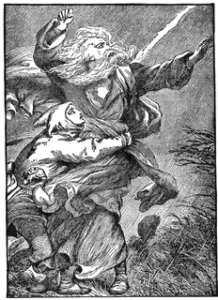
Lear and his Fool on the heathI’m trying to think of plays where the weather plays an important role.  Sure there’s The Tempest, but we get the storm at the beginning and then…nothing.

Macbeth seems to be all about the weather.  So fair and foul a day I have not seen!

King Lear is probably the ultimate example.  If you haven’t seen Act 3 Scene 1 live yet, your Shakespeare life is not complete.  The wind is blowing, the rain is pouring down. Kent staggers in at one level, battling against the wind, hanging on to the scaffolding so he doesn’t blow away.  Enter a gentleman below, also buffeted by the wind.  “Where’s the king?”  first thing Kent asks, only to learn that he’s out in this storm.  “But who is with him?”  “None but the fool.”  Shivers.  Goosebumps. That’s one of my favorite moments in the play.

Hey, here’s a question — the stage direction I read for this scene says “Storm still.”  Does that mean the storm is still continuing, or that there is a lull in the storm, an actual still moment?

What else?  Any of the comedies do something similar to work weather into the plot?


Which Shakespeare Needs a Young Adult Adaptation?


It seems like there are young adult adaptations of Romeo and Juliet and Hamlet coming out of the woodwork lately. Shonda Rimes got her Midas mitts on Still Star-Crossed and is making it a tv series.  Lisa Klein’s Ophelia is going to the big screen, starring Daisy Ridley.  And that’s just two easy ones that are getting all the press – I’ve seen lists lately of half a dozen YA versions at a time.

But it’s always those two, isn’t it? Note that I’m talking about books here, not movies, so I’m not really counting 10 Things I Hate About You, She’s The Man, O, or any of a bunch of high school comedies that as far as I know only live on the big screen.

Bardfilm pays closer attention to this area than I, so he might be able to tell me I’m completely wrong.

Which of Shakespeare’s plays would you like to read in a YA format?  I expect that The Tempest is an obvious choice. But about something harder. Could you do King Lear? Actually I’d be surprised if nobody’s tackled that one yet, I figure you tell it from Cordelia’s point of view you’re half way there.


For Then We Should Be Cockroaches

Mind blowing moment at breakfast with the geeklets this morning, one of whom decided to treat a plastic kitchen ladle like a doll and name him Sampson, and the other who is reading Romeo and Juliet and says, “Gregory” every time her sister says “Sampson.”

As Gregor Samsa awoke one morning from uneasy dreams he found himself transformed in his bed into a gigantic insect.

If you never read it in high school, that is the famous opening line (albeit translated) from Franz Kafka’s “The Metamorphosis”, where the lead character wakes up to discover he has been transformed into a cockroach.

The lead character’s name is Gregor Samsa.

Gregory.  Sampson.

There’s absolutely no connection, of course, but being geeks we research these things.  I consulted the BORED  (that’s Bardfilm’s Oxford Remote English Dictionary), just to rule it out (because how cool would it be!). Bardfilm, of course, can pull out a book called Kafka’s Names at the drop of a hat.  There we learned that Samsa, while no doubt intending to mirror Kafka’s own name, is also likely a reference to the Buddhist samsara, the repeating cycle of reincarnation before achieving Nirvana.  There’s other possibilities, but I like that one. There’s also no reference to any Romeo and Juliet connections, but did you really expect one?

This is how we spent breakfast in my house.