
Giveaway! Free Copies of “If We Were Villains” by M.L. Rio

UPDATE:  Contest over!  Thanks to everyone for participating. Winners will be notified shortly.

We haven’t done a book giveaway in a long time, so let’s fix that right now with a good one!  Introducing If We Were Villains, by M.L. Rio:

As one of seven young actors studying Shakespeare at an elite arts college, Oliver and his friends play the same roles onstage and off: hero, villain, tyrant, temptress, ingénue, extra. But when the casting changes, and the secondary characters usurp the stars, the plays spill dangerously over into life, and one of them is found dead. The rest face their greatest acting challenge yet: If We Were Villainsconvincing the police, and themselves, that they are blameless.
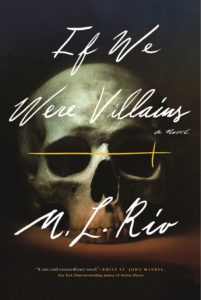
“This is a rare and extraordinary novel: a vivid rendering of the closed world of a conservatory education, a tender and harrowing exploration of friendship, and a genuinely breathtaking literary thriller. I can’t recommend this book highly enough, and can’t wait to read what M. L. Rio writes next.” —Emily St. John Mandel, New York Times bestselling author of Station Eleven
Read a full length excerpt from Scene 1 here!
Sound like your cup of tea? Or something you might enjoy reading over a cup of tea? Well we’ve got five copies to giveaway!

Rules

  1. Since the book is being released on April 11, that’s when we’ll pick our winners. Five winners will be drawn at random from eligible entries received prior to midnight on April 10, 2017.
  2. To enter, leave a comment here on the blog (not on Facebook or Twitter) answering the following question:  You’ve decided to quit your day job and become a full time villain. Which Shakespearean villain is your role model, and why?
  3. Entries must include an accurate, reachable email address, so we can contact you in case you win!
  4. Limit 1 entry per email address.
  5. Contest open to U.S. shipping addresses only.
  6. Publisher will handle  shipping books to the winners.
Any questions?  Good luck!

Review : Wool by Hugh Howey

I first heard about Wool in the same context as The Martian, one of these self published runaway hits that is already fast tracked to become a movie. It’s a pretty standard dystopian story of people living in an artificially constructed society where the worst crime is to express a desire to go “out”. What’s outside and why are they in? The answers seem pretty obvious if you’ve read any of a dozen other books with this same premise.  I guess this came out  back in 2011 and was originally eight books, now it’s been republished as three bigger ones.
So why are we talking about it here? Because for some strange reason it’s loaded with Shakespeare references. There’s even a character named George Wilkins, and I challenge casual fans of Shakespeare to recognize that reference!
The main character’s name is Juliet (or Juliette, I have it on audiobook so who knows), and I keep waiting for a Romeo to appear and the longer he doesn’t the more I’m thinking, “Oh, good, we can actually have a character named Juliet without it requiring the Shakespeare story.”
Soon enough, though, we’re flashing back to when she’s a kid and sees a production of the play. She’s even given a script that she then carries around for the rest of the story.  Once the explicit R&J connection is made, the different sections (chapters? again, audiobook, hard to tell) suddenly become quotes from the play.
I don’t get it. There’s no Romeo and Juliet story here, and I’m stretching to come up with one.  I’m wondering if there’s more Pericles in it (see George Wilkins, above ;)).  I’m not nearly familiar enough with that play.
So, surely others out there have already read this one, and probably the whole series.  Is it right in front of my face and I’m missing it? I once read a Hamlet story told from the perspective of super-intelligent dogs, and I managed to figure that one out (eventually).  Does it come up more in later books? Or did the author just feel like sprinkling around some Shakespeare?  The latter seems unlikely, but you never know in the self-published world, things don’t have to stay strictly to formula.  Besides, there’s no way that he drops George Wilkins into the story and expects anybody to recognize the Shakespeare connection!

UPDATE May 2023

As originally mentioned, the book is now a series on Apple TV+ called Silo. I’ve only just started watching it but we’ve met the Juliet character. Maybe I’ll learn more about where all the Shakespeare references lead us!

At Last, A “Happy” Romeo And Juliet

They’re making a “Romeo and Juliet style musical” about the life of Pharrell Williams, according to the Hollywood Reporter.  If you don’t recognize the name, and thus my joke fell completely flat, he’s the guy behind many things, but probably most notable in recent memory for Happy, a song so catchy that people literally made 24hr loops so it would never stop playing.

Back to the story, there’s some big names attached who have contributed to American Idiot, Spring Awakening, and Toy Story 4, though we’ll forgive that last one.  (Toy Story 1-3 were one of the great movie trilogies and I’m frightened that 4 is just a straight money grab that won’t hold a candle to the originals.)

I also won’t be the first to point out the obvious — given that Mr. Williams is alive and well, clearly their version of the story isn’t going to end the same.  So I am expecting that this is that thing I’ve always talked about when the Lion King comes up, how every “oh noes, boy and girl can’t be together because they’re from two different worlds” story ends up being branded a Romeo and Juliet story.  They do get a bonus that Williams grew up in Virginia Beach, and Virginia/Verona is an easy switch :).

At least we know it’ll have good music.


Geeklet’s Golden Ear

Portia, in Merchant of VeniceBeen awhile since I had a good geeklet story to tell.  I come home from work today and my middle daughter says, “Daddy, my math teacher was dropping these Shakespeare quotes all over the place today.”

“Cool.  I like him.”

“I know, but I was, like, the only one that recognized them as Shakespeare.”

“Which quotes?”

“A bunch of stuff from Merchant of Venice, I think.”

“You recognized Merchant of Venice quotes?”

“I dunno, they kind of sounded like they came from Merchant of Venice.”

As far as I know my daughter’s never actually read Merchant of Venice. But now I’m curious if her teacher threw out a “quality of mercy is not strained,” I think that one’s got higher odds than “if you prick us do we not bleed.”

I did not ask, but last week my daughter was on a field trip to the Museum of Fine Arts and told me that one of her teachers drove her crazy all day by doing things like coming up behind her and whispering, “I see dead people!” or waiting until they were in a room with a statue of a naked guy and saying, “The guide book says there’s supposed to be a picture of a full moon in here, can anybody find it?”  I hope it’s the same guy.

Why Does Hamlet Hesitate to Kill Claudius?

Why does Hamlet hesitate to kill Claudius?

There are a few different ways to answer this question. I assume that most of the time people ask it, they’re referring to III.3 when he catches Claudius at prayer:

Now might I do it pat, now he is praying;
And now I’ll do’t. And so he goes to heaven,
And so am I reveng’d. That would be scann’d.
A villain kills my father; and for that,
I, his sole son, do this same villain send
To heaven.
Why, this is hire and salary, not revenge! [citation]

So the short and easy answer is Hamlet tells us – by killing Claudius at prayer, his soul is clean, and therefore he’d go to heaven. However, this is not a luxury granted to Hamlet’s father, which is why he now roams the earth as a ghost.  Hamlet doesn’t feel that this is an even exchange.

You should, however, be saying, “Seriously?” right now.  “You set the trap to prove Claudius’ guilt, it worked, now you’re behind him, there’s no witnesses, you could absolutely finish him off. And instead you’re thinking ahead to where he soul ends up?”

That is precisely the whole point of the play. Hamlet’s indecisiveness is all. He can talk himself out of anything. Go back to I.5:

But know, thou noble youth,
The serpent that did sting thy father’s life
Now wears his crown. [citation]

So your father’s ghost appears and says, “I was murdered by the king.”  Your first thought is, “I know, I’ll start acting crazy around everybody so they won’t know what I’m up to.”

At least the point has a specific rationale, however. In Amleth, the source material for Hamlet, the hero believes that his life is in danger and decides to pretend that he is an imbecile not to be perceived as a threat to the new king.

In Shakespeare’s version, however, that connection is lost — there’s no reason early in the play to think that Claudius is planning to kill Hamlet (though clearly, he plans to have England do it). So it looks like Hamlet’s just coming up with excuses to delay action.

I’ve always held that his mother’s death, not his father’s, ultimately spurs him into action. The entire play passes without him avenging his father, but it takes just 20 lines of dialogue between his mother’s death (“The drink! I am poison’d.”) and Hamlet’s action (“Follow my mother!”). Some argue that he finally sees his own mortality and knows, from Laertes, that he, too, has been poisoned, and if he does not act now, he will never have the chance. But I’ve always felt that the “Follow my mother” line is a big deal – it’s not as if he mentions his father. Remember his concern over the fate of his father’s soul? How he was not absolved of his sins? Well, now his mother’s met the same fate.