Shakespeare and Porn

Shakespeare would never be considered pornography using the old Kansas common-sense test.

How’d you like to wake up to that quote in your news folder on a Monday morning?  I thought that the art/porn/first amendment issue had been put to bed (ha!) decades ago during the Larry Flynt era, but I guess Kansas is still talking about whether to condemn porn as a public health hazard.

The only argument came from Rep. John Carmichael, who brought up First Amendment concerns and used Shakespeare and Michelangelo as examples. This brought up the quote above from Rep. Chuck Weber, calling the comparison “ludicrous.”

I wonder if Rep. Weber has read anything other than Romeo and Juliet? Do you think he gets the “country matters” line in Hamlet, or “her C’s, U’s and T’s, from which she makes great P’s” joke in Twelfth Night?  How over the top do you think we could get with a production before we changed his mind?


Shakespearean Notepad Found

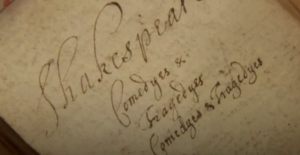
Shakespearean NotepadPerhaps you saw the headline about an episode of Antiques Roadshow where someone brought in a small notepad of handwritten notes about Shakespeare’s work. And, like many of us, you may have noted the story went around on April 1 and thought, “I’m not going to get my hopes up if this is an April Fool’s Joke.”

Well the episode has aired, and if it’s a joke it’s a very anti-climactic one because they’re playing it straight. It’s quite possible that this is indeed a new discovery, which would be fascinating indeed.  The cover sheet says “The Comedyes & Tragedyes” as if it’s a deliberate collection. So is the person reading them, and copying out notes and quotes? Or is it notes on various performances the owner attended?

My first thought was, isn’t that the modern spelling of Shakespeare’s name? Is that clue to a fake? But apparently even though that was not the most common way that Shakespeare spelled his name, it is the most commonly used variant at the time.

Then I thought, oh god why are you touching it with your fingers? Put some gloves on, man!

Then, if you’re with me, you’ll pause on every close up of the text and see if you can spot some quotes.  I found what looked like “enough to make all fellowships,” which is Vincentio in Measure for Measure:

There is scarce
truth enough alive to make societies secure; but
security enough to make fellowships accurst:

How cool is that? I could do that all day.  I’m not worried at all about them saying it’s illegible – there are scholars trained in how to read that hand.

Showing this to my coworker I spotted another one. “Doesn’t that look like it says “heap on your head a packet of sorrows?” I asked him, then flipped to my Open Source Shakespeare:

Than, by concealing it, heap on your head
A pack of sorrows which would press you down,
Being unprevented, to your timeless grave.

Yes, yes it does.  Two Gentlemen of Verona, in fact.  I love this.

What do you think? How excited are you about this new discovery? Should we get a GoFundMe page going to raise the £30,000 to buy it?

(Reading up on what people smarter than me are saying I guess it’s not all *that* rare, we do have plenty of examples of commonplace books from the time period.  So this is not a “never before seen” type of situation. But still, everybody seems in general agreement that it’s a big deal because it’s a new thing, with new information, and everybody wants to see what’s in it.  Me too!)

We Can Say We Knew Him When

I know it’s going to happen. One of these days I’m going to get contacted with a press release for a new Shakespeare book that’s burning up the New York Times Best-seller list, written by Alexi Sargeant.

If you’re a long-time reader of the blog you might recognize that name, because we’ve known Alexi for at least seven years – here he is helping write some Shakespeare sequels in August, 2010.

Among his many other endeavours, he’s also designed a Shakespeare board game that we’ll all be getting each other for Christmas next year called No Holds Bard.  I thought it was still in stealth mode, but heck if he’s going to write about it on his own site, I’m going to help him get the word out:

I’ve been working on-and-off for a few years on a Shakespeare mashup fighting game called “No Holds Bard.” Players battle each other as characters like Hamlet, Macbeth, Beatrice, and Cleopatra—and even the Bear from The Winter’s Tale. It’s meant to be geeky, exciting, and educational.

I can’t wait to see the finished product, Alexi!  Remember us when you’re famous!

Christopher Marlowe and the Baines Note

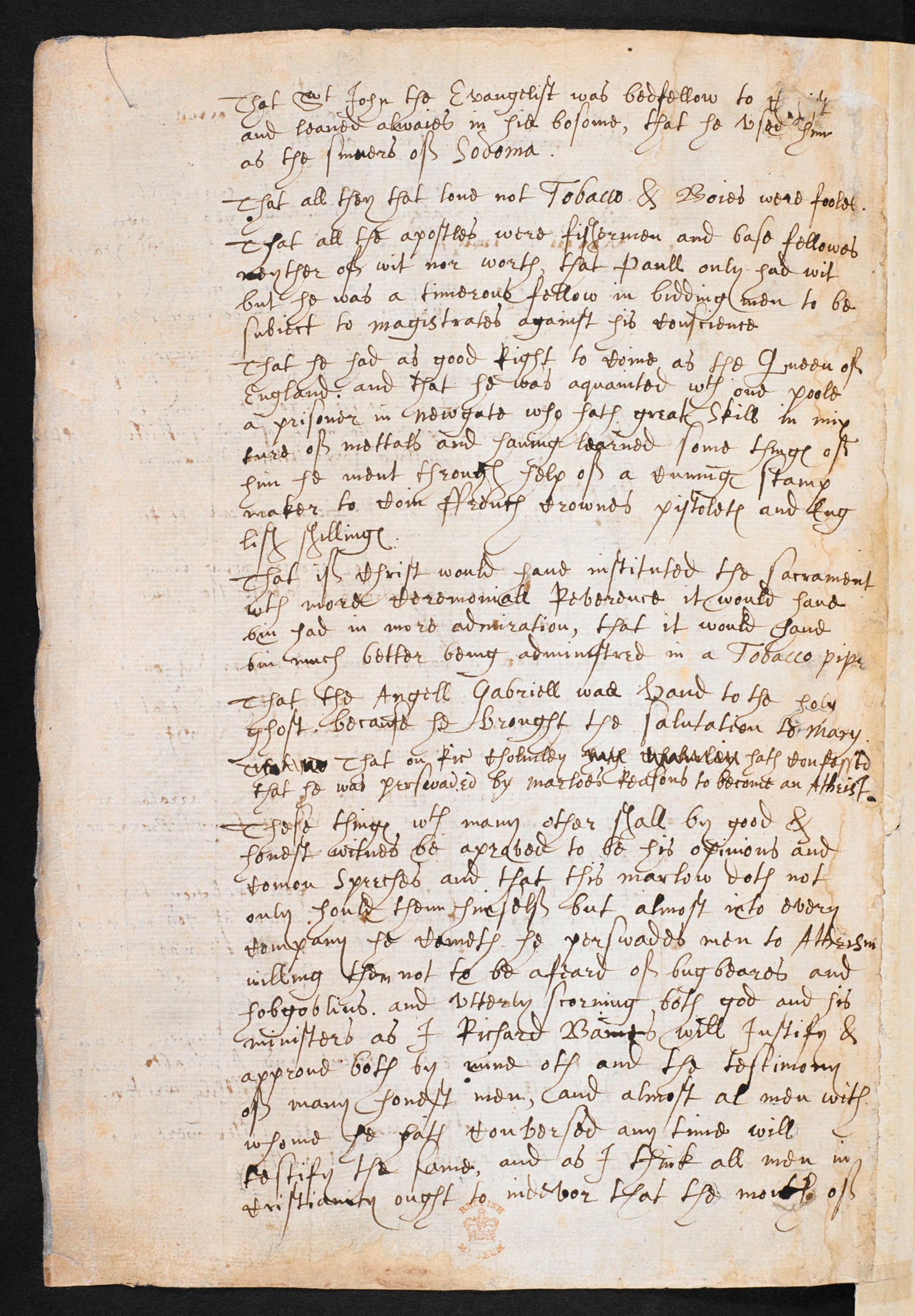
I am no Marlowe scholar. I had never heard of the Baines note.  I asked Bardfilm about it, as I do with all these things, and he replied, “Long written about, seldom seen.”

Until now, because the British Library is making the Baines note public.

The note is reportedly a conversation between Marlowe and police informant / part-time spy Richard Baines, compiled by Baines.  In it, “Marlowe casts doubt on the existence of God, claims that the New Testament was so “filthily written” that he himself could do a better job, and makes the eyebrow-raising assertion that the Christian communion would be more satisfying if it were smoked “in a tobacco pipe”. Not to mention the whole “gay christ” thing.

Baines then adds a personal note that, “All men in Christianity ought to endeavour that the mouth of so dangerous a member may be stopped.”The Baines Note

A few days later, Marlowe is stabbed to death. (“A great reckoning in a little room.”)

Apparently there’s question about the authenticity of the story, and that it was created specifically to get Marlowe is trouble with the authorities.

I love learning new things.  Have we got any Marlowe scholars in the audience?  Tell us more!

I found a link where you can read the transcript of the Baines note, too, if anybody’s interested.  I can’t make out a blessed word.


Who is Ophelia’s Brother?

I never know what to say when I see questions like this in my logs. But then I think of it like this – if I invited my coworkers to see Hamlet, and during intermission one of them asked me, “I’m confused, which one is Ophelia’s brother?” I’m not going to point and laugh and say, “How dumb are you? It’s right there on the page!”  Instead I’m going to appreciate that this person is engaged enough to be here in the first place and is trying to follow along, but sometimes it’s not that easy.

Even though we typically think of Ophelia as Hamlet’s girlfriend, we never actually see them “together”. We first hear about their relationship first from Ophelia’s older brother Laertes before he leaves to return to school:

For Hamlet and the trifling of his favour,
Hold it a fashion and a toy in blood,
A violet in the youth of primy nature,
Forward, not permanent, sweet, not lasting,
The perfume and suppliance of a minute; No more.

Typical big brother stuff – you think Hamlet’s into you, but he’s really not, so don’t let him break your heart. This is typical of all the men in Ophelia’s life, they tell her what to do.

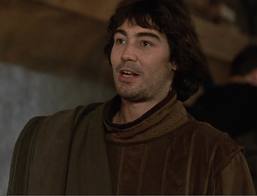
LaertesWe don’t see Laertes again until their father Polonius has been killed. He is then witness to Ophelia’s madness and eventual death. At her funeral he cannot bear the grief and jumps into her grave:

Hold off the earth awhile,
Till I have caught her once more in mine arms:

[Leaps into the grave]

Now pile your dust upon the quick and dead,
Till of this flat a mountain you have made,
To o’ertop old Pelion, or the skyish head
Of blue Olympus.

What he does not realize is that Hamlet has also returned and, seeing this over the top display, starts a fight over which of them loved her more:

I loved Ophelia: forty thousand brothers
Could not, with all their quantity of love,
Make up my sum. What wilt thou do for her?

What Hamlet does not know is that Laertes and Claudius have concocted a plan to let Laertes have his revenge, by poisoning Hamlet.  This plan either works perfectly or horribly depending on whether you see the glass half full or empty, because at the end of it Hamlet does end up dead.  But so do Claudius and Laertes. With his last breath, Laertes asks Hamlet’s forgiveness for betraying him.