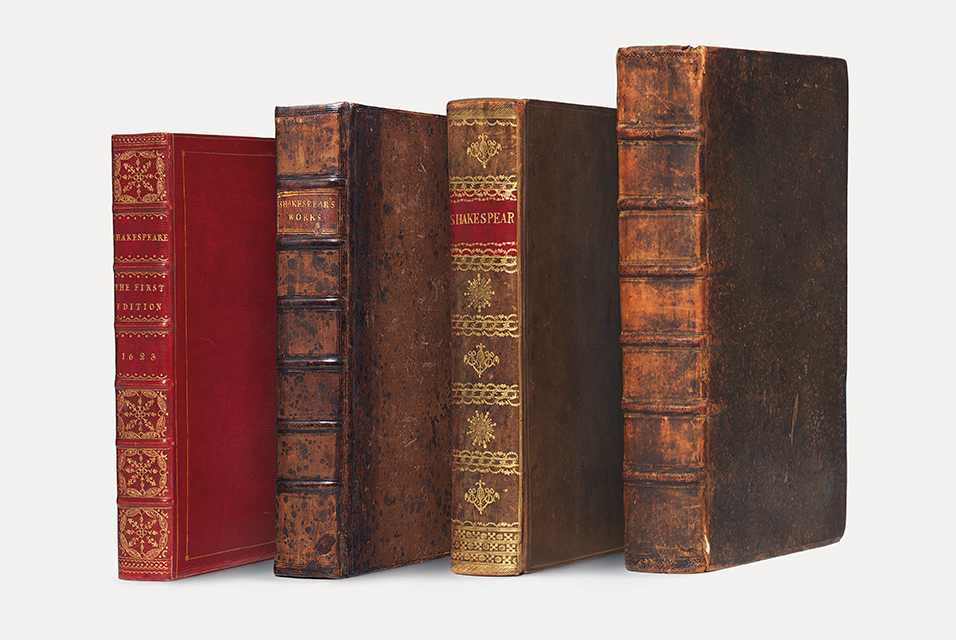
Whoa. Wait. What?

Tell me if something in this headline catches your eye like it did mine:

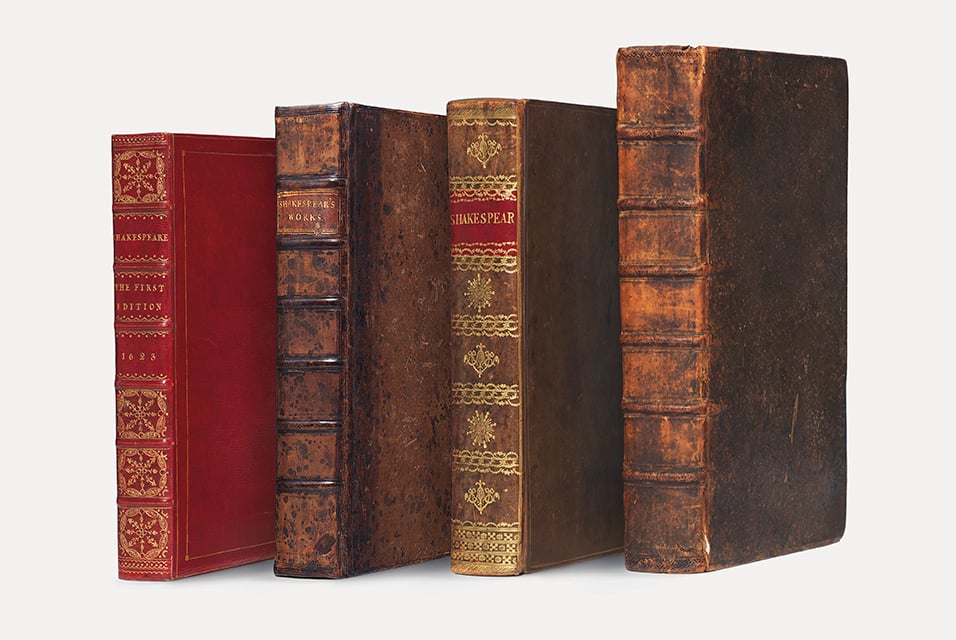
What the heck is a “previously unknown” folio? You don’t just drop something like that into a headline and walk away.  Everybody knows that all the “known” Folios (233) are accounted for and micro-catalogued, and if Christie’s had one in its collection, surely it would not be a secret, would it? Surely this is some fancy word wrangling for publicity, like everybody calling Sir Thomas More “Shakespeare’s Last Play” and “The Only Play Written in Shakespeare’s Handwriting.”

“…and the volume for sale at Christie’s is a new addition to that list.”

Interesting!  Tell me more. How can this be?

Christie’s estimates the previously unrecorded copy currently for sale will fetch £800,000–1.2 million (about $1.16 million–1.74 million). It has not been seen by the public in over two centuries, and last changed hands in 1800, when it was purchased by book collector George Augustus Shuckburgh-Evelyn (1751–1804).

I’m having trouble getting my head around this.  You mean to tell me that the people who run this sort of thing have had one of the most rare and valuable books in the world in its collection, potentially for centuries, and not only did they not let anybody see it, THEY DIDN’T EVEN TELL ANYBODY IT EXISTED??

What’s next up for auction, all of Shakespeare’s personal library, Amelia Earhart’s skeleton and the Holy Grail?

Please Do Not Celebrate The Anniversary of Shakespeare’s Death

Bardfilm pointed this out to me a couple of weeks ago and I’ve been paying careful attention to headlines ever since.

“Celebrate The 400th Anniversary Of Shakespeare’s Death In Style,” says the Huffington Post this week.

Please don’t do this. 
We celebrate his birth, or his existence, or his accomplishments.  We do not celebrate when people die. Can you imagine?  “Phew, thank god that son of a gun is finally dead, huh?  If he’d stuck around a few more years imagine how many he might have written!” 
Commemorate his death if you like. Mark the occasion with much festivity. But celebrate his life, not his death. The world was made a better place because of the former, not the latter.
This has been a public service announcement.

Whoa, Is a Romeo and Juliet Rock Musical About To Sneak Past Us?

All I know about “The Fosters” is that the commercials keep coming up while my pre-teen children try to watch their shows, and those commercials typically want to talk about very not pre-teen things.  So it’s not a show I hold in high regard.  I knew I was on the right track when this story appeared last month about a high school banning Romeo and Juliet because it glorifies teen suicide.  They have the obligatory student debate about it … and “ban it” apparently won.

So last night I’m in the kitchen making dinner and I know the kids have got the ABC Family Channel (now “Freeform”) on, like they do.  So when I hear a random “Juliet” come out of the tv my head naturally whips around to see what’s up. My first thought is, “This must be something having to do with last month’s episode,” while still thinking, “Why would they still be talking about last month’s episode?”

And they’re singing. They are in masquerade attire, and they are singing.  What dark magic is this?

Apparently, in the spirit of Glee, it’s a Romeo and Juliet Rock Musical.

Does anybody follow the plot line of this show and know what’s going on? This could be awesome.  Every television show about high school kids has, at one point or another, done a Shakespeare episode.  And it’s almost always about the balcony scene.  But I don’t recall anyone attempting to do an entire retelling of the play – as a musical, no less!  I’m kind of excited about this.

Death by Shakespeare (A Kickstarter Project)

Despite my own personal experience otherwise, it seems as if we’re seeing a bit of a boom in Shakespeare books.  There’s LOL Shakespeare, Star Wars Shakespeare, Lego Shakespeare … you name it. Every time I see a new one (assuming it’s any good), I bang my head against the wall for a little while wondering why I didn’t think of that first.

Not all of the best ones will show up on the shelf of your local Barnes and Noble, however. For the smaller independent efforts we must turn to Kickstarter, where this week we find Death by Shakespeare.

My first thought was, “Hey, this looks a lot like the Deaths in Shakespeare infographic (by friend of the blog Caitlin S. Griffin).” But is that a bad thing? That’s the joy of public domain, that two different people can take the same source material and go in two different creative directions. I don’t really have the space or the decor to put up a poster, but there’s always room on my bookshelf or coffee table for a nicely illustrated hardcover.

The authors are close to their goal, which is a good thing, but sometimes it’s all about the stretch goals. They’ve got plenty of rewards and add-ons for you to customize exactly what you want. Check out the “Thou Getst Art” rewards, where you can get a special individual print of your favorite character’s demise. Joan of Arc? Bardolph? Adonis?  Looks like they didn’t just stick to the classics we read in high school.

If you want to help support more such independent Shakespeare publishing projects, go check it out! 

Lots and Lots of Monkeys

monkey typing

(Spotted this on a Reddit “Shower Thought” the other day and I liked it.)

Keep searching “Shakespeare” over the years and you’re going to run up against the “Infinite Monkey Theorem” again and again and again.  If you’re not familiar, it’s the philosophical idea that if you sit enough monkeys behind enough typewriters for enough time, eventually one of them will bang out the complete works of Shakespeare.

In 2003 somebody who clearly does not understand infinite number theory actually managed to get grant money to give real typewriters to real monkeys and see what happens. As you could probably imagine, the most interesting results to come out of that experiment were that they held down the S key, and then generally smashed the computer with rocks before peeing on it.

Somebody even simulated the idea in source code. He claims to have proven it, but his interpretation does not solve the same problem.  The theory suggests that eventually a single random string of characters would be generated that matches Shakespeare’s complete works. What he did was to keep looking at substrings, and when he found a match, he’d cross it off and consider it “found”, until all substrings were found. A neat project, no doubt, and a cool bit of code – but not the same thing.

That project was inspired by this Simpsons reference that shows just how pervasive this idea has become:

Anyway, back to the shower thought.  Try this on for size:

The theory has already been proven once. It’s took 4 billion years, I don’t know how many billions of evolving “monkeys” and countless technological advancement in “typewriters”, but the system (known by its other name, “life on Earth”) did, eventually, produce William Shakespeare and his complete works.

Mind blown.  Aren’t we just evolved monkeys?

Who knows. Maybe it’s obvious, maybe it’s a restatement of the premise with no semantic content.  I’d never heard it, and it’s an interesting new way to look at something I’ve seen hundreds of times already. Reminds me a bit of Hitchhiker’s Guide To The Galaxy (which also has its own infinite monkey reference, if you remember ;))