To me, Shakespeare is all about his words. Take away his words and you’ve gone down an interesting path, but not a particularly deep one. Doing a Romeo and Juliet story and calling it Shakespeare is like doing a Cinderella story and calling it Disney. Those are really just cover versions of much older stories.
Review : A Thousand Acres
Bardfilm and I have been discussing “modern adaptations” lately, and I asked for the distinction – did he mean modern setting but original text, or modern language? For this particular context he meant the latter. Since I don’t normally seek out such movies I went out and found one – the King Lear adaptation of the book of the same name, A Thousand Acres.
Jason Robards plays our Lear (“Larry”, as it becomes apparently quickly that the author’s gone with a whole first initial thing) to his daughters Michelle Pfeiffer (as “R”ose), Jessica Lange (as “G”inny) and Jennifer Jason Leigh (as “C”aroline). From that point it’s harder to tell who is who because unless I’m missing something the first initial game goes out the window as Colin Firth’s Jess is plainly the bastard Edmund. As you can see, though, the cast is first rate.
For any “modern adaptation” of this sort that’s clearly only taking inspiration from Shakespeare and not trying to tell his story, I look for a couple of things. How much direct homage to Shakespeare is there? How much of the original story remains? How much new material does this story provide?
In other words does the end result produce something standalone, while still showing respect for the original? It’s very tricky to strike a balance, because every time you diverge from the source material you’re going to have audience like me asking, “Oh, really? So you think you’re about to tell a better story?” and you need to bring it. Safest not to change the story too much, but instead to bring new elements that Shakespeare never touched upon.
How does A Thousand Acres do? It’s not bad. The connection to the source material is clear, and more than minimal. Larry runs the farm, and wants to retire and divide it up amongst his three daughters. R and G find this a great idea, but when C so much as says “Let me think about it” he disowns her on the spot. I mentioned Jess as the bastard character who does all the bastard things, sleeping with the sisters, getting into a fight with his father (Pat Hingle as this sort of Kent/Gloucester combination character), but he’s not really the architect of all the bad that happens. There’s even a nice big storm for the daughters to send their father into.
Other than those story elements the similarities are few and far between. In this story, R and G (makes me think of Rosencrantz and Guildenstern when I say that :)) are actually the good guys, if you can believe it. It’s a very complicated story. Nobody in town likes them because the people think the daughters conspired to steal the farm from their father. Meanwhile the daughters have both got some deep dark secrets that reveal their father is not the nice man he seems, and is well deserving of their hate.
I found the story too confusing to follow in many parts, and that’s one of the reasons that I often dislike modern adaptations. You try to add your own material, but then to really develop a foundation in that material you have to stray farther (further?) from the original, and eventually you hit walls where you can’t go more in any direction. Same here. There are some obvious places where R and G are talking and it seems like the most obvious thing in the world to do is for them to go talk to C…but they can’t. That’s not how the story went. In fact we never really even get C’s side of the story – this is Goneril’s movie, if I have to pick a central character.
The whole thing is additionally complicated with the addition of husbands and children, alcoholism and terminal illnesses. There’s a whole lot going on in this movie besides the Shakespeare. And it’s all set in this weird sort of Tennessee Williams sounding world where full grown women still call their parents “Mommy” and “Daddy” which, when coupled with the deep dark secrets that we learn, is all the more uncomfortable.
See it if you get a moment, if for nothing else than to have something to talk about the next time somebody trots out one of those lists that contains nothing but Lion King, Ten Things I Hate About You and She’s The Man. But don’t go out of your way for it.
Collaborating with William Shakespeare
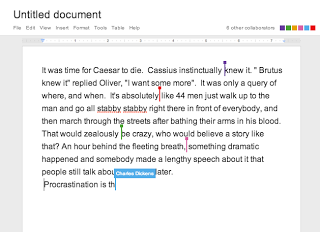
If you’ve ever used Google Docs you might be familiar with the idea of multiple people viewing, and possibly editing, a document right before your eyes.
Well Google’s decided to have a little fun with that, and made a demo where the likes of Charles Dickens, Edgar Allen Poe, Emily Dickinson and yes our dear friend William Shakespeare all watch you as you type … and offer up their edits. I keep trying to force it down certain paths, but detecting plagiarism is not its thing. You can’t just start typing “To be or not to be” and expect Shakespeare to jump in.
The idea is cute. I’ve always loved natural language generation and computer assisted personality. I wish they did more with it — like if you edit someone else’s edit, they get all mad and start fighting with you or something. Who knows, maybe they’ll do some more with it. Love to get a look at the source code behind the idea.
![]() |
| Each colored vertical line represents an edit by a collaborator. Here, Charles Dickens is offering a writing prompt. |
Do The Harlem Shake(speare)
Ok, ok, I know, everybody wants this meme to die. But surely I can’t be the only Shakespeare geek who was hoping for the obvious Harlem Shakespeare version? I combed through a bunch, mostly kids sitting in their English class with little to no Shakespeare content.
Then I found this. I love this. A group trying to drum up attention for their Midsummer production. Bravo.
It’s a shame that the show they’re advertising has apparently come and gone. Had I seen this earlier I would have done what I could to help them out. Bottom does the opening, wearing his ass head? Brilliant.
Will You Buy This Star Wars Shakespeare Book?
I admit, I get frustrated when I see projects like this “Star Wars / Shakespeare” mashup, which appears to be an “officially licensed” ebook that tells Star Wars in iambic pentameter. In other words, there appears to be some sort of a business model for retelling well known stories as if Shakespeare had written them (Two Gentlemen of Lebowski, anybody?)
Once upon a time, an idea like this would have been little more than a blog post. Slap together a scene or two to get the joke across, put up a post, and hope it “goes viral”. Or maybe you take a different approach, maybe you just dip into popular culture for a well known line here and there and give those ye olde’ Shakespeare spin (hint hint hint, hint – how I spent my Twitter time…)
Where does the idea turn into, “We should make a book and sell it”? I’ve actually spoken to an agent on the subject. I mean hey, I’m not stupid, if there’s a gravy train that I could hop on I have to at least see if there’s room. 🙂 What I was told makes perfect sense, that basically ideas like this only work as books *after* they’ve gone viral on their own, and basically that unless somebody like the New York Times notices you or you’ve got a dedicated following of 50,000 fans, don’t bother.
For some projects, like Lebowski, that seems to have been the formula. I remember that one being an online project well before it was a book. Same with some other McSweeney’s piece whose name I can’t remember about Hamlet’s Facebook page. They develop a following online, then a publisher is interested.
I’m reminded of the script comedy show Saturday Night Live, who once upon a time hit it big in movies with Wayne’s World. “Aha!” thought the producers, “Clearly a skit can be turned into a movie! We must TURN ALL THE SKITS INTO MOVIES!” And we all probably know how well that went. Sometimes an idea that is funny for 5 minutes is not funny for 10 minutes, much less 90.
If the author happens to be reading? Nothing personal. See earlier gravy train comment. If there’s a market for these things and a brother can get paid for his trouble? I’m not going to stand in the way. On the contrary I’m probably going to show you my script and see if I can get a meetup with your agent.
I’m asking — is there a market for this? Are any Shakespeare Geek readers waiting for this one?
And perhaps most importantly of all, has anybody called dibs on The Princess Bride yet?
“From forth thy lips that word flies far too oft,
I fear it meaneth not what you may think.”
Where’s my agent?!