Here’s a question that comes up in my life a lot. We talk about Shakespeare here. That’s easy. But when I go and add the site to various boards and services, inevitably I’m asked to place it into a category.
Shakespeare Geek on Pinterest
After the flood of pictures I took in Washington last week, I finally broke down and decided to join pinterest.com. This site’s never been heavy into pictures, but if that’s what people want to follow these days, I’ll do what I can to start adding more visual content.
Unfortunately somebody already beat me to “ShakespeareGeek” as a username, so you can find me as ShakesGeek. Right now I’ve got two ‘boards’ set up — one that will pin stuff directly from the blog (so if you’re already following the blog in some fashion, you’ll have seen it), and another for ‘found Shakespeare’ for all those random Shakespeare related images that I find floating around than don’t always merit their own post.
[EDIT] Oh, and you may also see a “Pin it!” button in the upper right corner of those posts with picture content. If you are someone who uses pinterest and you like the content I’m putting up, sharing it in this way would be a great way to support the site. Thanks!
I Would Challenge You To A Battle Of Wits But I See You Are Unarmed
When I spotted this “battle of wits” quote as attributed to Shakespeare, I immediately thought of the closest thing I could remember, Beatrice’s zinger in Benedick’s general direction in Much Ado About Nothing:
Beatrice
- Alas! he gets nothing by that. In our last
- conflict four of his five wits went halting off, and
- now is the whole man governed with one: so that if
- he have wit enough to keep himself warm, let him
- bear it for a difference between himself and his
- horse; for it is all the wealth that he hath left,
- to be known a reasonable creature. Who is his
- companion now? He hath every month a new sworn brother.
[Citation: Much Ado about Nothing – Act 1, Scene 1. Lines: 56 ]

This ends up pretty close. Roughly translated, “In our last battle of wits he lost most of his, and now he’s only left with one, so I’m going to let him keep it so people can tell the difference between him and his horse.”
Is it even possible to properly attribute the quote in question, though? It seems like the generic sort of thing many people have thought of over the years.
The best answer, I think, came from the ChaCha board. Now and then, for one of these quotes, I’ll see someone who has asked, “What play is that from?” Generally, does the quote always say “Shakespeare” but never say the play? That means he never said it. Anyway, somebody asks what play this wits quote is from. The answer that came back was, and I’m not making this up, “It’s not in a play. William Shakespeare the person said it.”
Oh. Dear ChaCha answerer, if you have access to documents written by Mr. Shakespeare that the rest of us don’t know about, please share! You could be a very, very rich person.
Explore more posts in the Not by Shakespeare category.
Why We Do This : Your Turn
During my Shakespeare Day Marathon I posted 25 different items for people to talk about, ranging from links I’d queued up over the weekend, to information about Shakespeare and the Presidents, the Booth family … leading up to actual images from my invited trip through Folger Shakespeare Library vault and culminating in pictures of Folio #1, The Most Beautiful Book In The World.
And yet the post that got the most clicks that day was my … rant? diatribe? plea? … entitled “Why I Do This : The Big Picture” (I’ll give you a hint, it’s not about my kids). I don’t know why that happened, exactly (I would have thought the pictures would generate more interest), but I’m glad it did. That post, albeit a little over the top, was my reaction to the yearly Shakespeare’s Birthday flood of attention where people come out of the woodwork to say how much Shakespeare means to them, in one or two nice little 140character tweets.
Prove it.
I don’t want to hear what Shakespeare means to you. I want you to show us what it means to you, and show us what you do about it. Do you perform him, research him, teach him? What about all those out there who, like me, can’t claim to be doing this as any more than a hobby?
If Shakespeare means something to you, then you should consider yourself obligated to return the favor and do something for him. For every post about “I love his poetry, his words sing to me!” I’ll show you dozens upon hundreds of posts claiming he’s not relevant anymore, shouldn’t be taught, speaks a different language, banned from schools, too hard, too boring… What are you doing about it?
Here’s your call to action. If you’ve got a place to post something, then post it there and link it here. If you don’t, then tell us in the comments what you’re doing to bring your love of Shakespeare to the rest of the world.
Maori Haka, and Parallel Universes
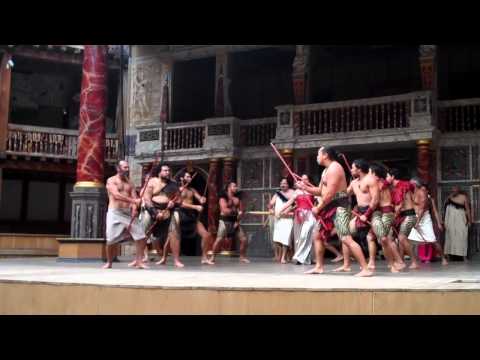
If you’ve not seen it yet, you first need to check out this video. It’s from the The Globe’s season opener, Troilus and Cressida performed entirely in New Zealand’s Maori language and opening with a “haka”, something that I can best describe as a “war dance,” popularized by the New Zealand men’s rugby team:
This is already awesome on a number of levels when you go into it thinking “Ok, the Shakespeare people are doing a Shakespeare play in a language other than English.” The idea that there’s going to be 37 (38?) of these, each entirely unique, makes me giddy in anticipation.
Now imagine, if you can, coming at it entirely from the other angle. Imagine you stumbled across this video with no context at all. You start watching, you think, “Ok, this looks interesting….” Then you realize that a story is being told. You try to figure out characters, and plot (* this is only the trailer, of course – pretend for the sake of argument that you could get video of the entire production). How long would it take you to realize “Hey….this story looks familiar! I think this in the Trojan War story! No, wait, is this Shakespeare? Is this Troilus and Cressida???”
That’s where my “parallel universe” comment in the subject comes from. You see something like this and it’s as if the essence of what drove Shakespeare’s stories exists independently somewhere, capable of driving what is fundamentally the same story, in an infinite number of ways. It is the same, and yet it is entirely different. You know what I’m trying to say? None of Shakespeare’s words are going to be found, yet it’s still Shakespeare. It is the very definition of universal.
Enough geekiness, on to some more practical questions. Can somebody with a better knowledge of the play identify some of the characters for us? Can someone (possibly with knowledge of the language) give us an idea of what’s happening during this clip?
Or for an equal amount of fun, can someone with *no* knowledge of the play and *no* knowledge of the language take a shot? That would sort of get back to my opening point. 🙂