
http://www.bostonherald.com/news/regional/view.bg?articleid=1220227 As a Shakespeare Geek and a New England native, I couldn’t pass up this story of what might become of Tom Brady’s two sons, told with allusions to Richard III … although I wonder if King Lear might be more appropriate? For those who don’t follow the sports – or gossip – page, Tom Brady’s first son is John Edward Thomas, with former girlfriend Bridget Moynihan, who lives off on the Other Coast and was the subject of so much speculation when he was first born (post-breakup) that the rumor going around was that his mother deliberately chose the initials JET, for the long hated rival NY Jets. Just this past week however saw the birth of second son Benjamin to current wife Gisele Bundchen. Benjamin will be the one that grows up with the luxury of playing catch with all-star quarterback dad. I mean, don’t get me wrong, getting a bunch of pop psychologists together to weigh in on somebody else’s family life without even a quote from any member of that family, well, that’s pretty much the definition of “waste of time”. But for those who dig a good story and don’t mind speculating what sports might be like in another 20 years or so? This stuff is gold. These boys are not about to grow up like Peyton and Eli, you can be pretty sure about that.
Rufus! Rufus! Rufus!
I have Rufus Wainwright’s Sonnet 29 in heavy rotation on my playlist (which otherwise consists of some serious heavy rock and metal, headbanging sorts of stuff). I’m always on the lookout for more. Apparently he’s all over YouTube, though. Anybody know if he’s done studio versions of these? Live video from YouTube is fun, but not nearly as good as having an MP3 you can take with you all the time. Sonnet 20:
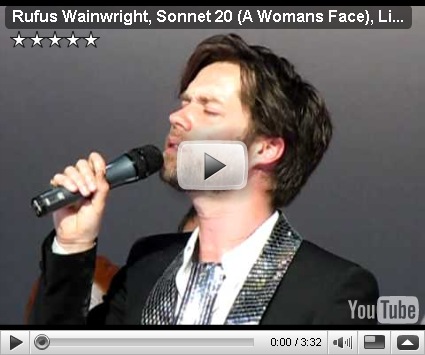
#29:
#43:

Commwealth Shakespeare on Boston Common 2010 Presents Othello!
Rumor has it(*) that our favorite Boston based free Shakespeare will be around next year, and finally getting back to tragedy with Othello! I’m very excited. The comedies are cute, but I much prefer to really dig into the tragedies. What about everybody else? (*) And by rumor I mean Twitter.
Shakespeare Master Class
http://www.videosift.com/video/Hugh-Laurie-Stephen-Fry-Shakespeare-Master-Class Thank Twitter for pointing me at this little gem I’d missed, a very young Hugh Laurie and Stephen Fry doing “Shakespeare Master Class”. Given some of the spirited discussion we’ve had here, I got a kick out of it. “And why did Shakespeare capitalize the T in Time?”
“Because it’s the first word in the sentence.”
“Well…yes, I suppose that’s partly it. But why else?”
Were Shakespeare’s Actors Any Good?
We know what people do with Shakespeare’s words now, sure. And in general we can point to an Orson Welles, Ian McKellen, John Gielgud, Derek Jacobi and say, “Those, those are good actors.” But I’ve often wondered about the people who originally created the roles. Were they any good, to our standards? Or was it completely different? How we interpret Shakespeare changes. Compare the Hamlets of Kenneth Brannagh, Richard Burton, and Laurence Olivier. Going back farther we’d have Gielgud or Barrymore. But what if we kept going, all the way back? I’m not asking if a modern audience would *like* it. They probably wouldn’t, given the different expectations. What I’m asking is, were the actors “good”? Would you look at a person playing Falstaff, his facial expressions however slight, and say “Damn, that is heartbreaking.” Or would he have been more concerned with annunciating everything so perfectly that he could be heard in the cheap seats? Know what I mean?