Dame Judi Dench Appreciation Post

Dame Judi Dench

It’s no surprise that we’re big fans of Dame Judi Dench here at Shakespeare Geek. I feel the same way about Sir Ian McKellen. When legends walk among us we must pay attention, because they do not do so forever. Dame Judi is 90 years old now and almost completely blind, so we’ll not be getting any more stage work from her. But when she speaks, we should listen, because one day that beautiful voice will be a memory. (Unless, I suppose, you waited on the waiting list for her audiobook?)

Maybe it’s the universe, maybe it’s the algorithm. But Dame Judi’s appearing frequently on my radar these days, and if all I can do is help amplify that signal, then so let it be done. She’s not showing signs of ever stopping.

  • Far Out Magazine gives us the role Dench would never play. I’m not click bait here, I’ll just tell you — Nurse (from Romeo and Juliet). Well…yeah? Who in god’s name is casting Dame Judi Dench as Nurse? I’d pay to watch her recite the entire play as a one-woman show (very much like another Shakespeare legend, Sir Patrick Stewart).
  • Readers in the UK might be able to tell me what the “ghost woods” are? Apparently Judi’s leading a petition to “bring them back.” Where’d they go? The petition got over 100,000 signatures in just three weeks. Go sign it!
  • She’s also using her star power to bring attention to early dementia diagnosis, teaming up with Alzheimer’s Research UK. “A diagnosis may not fix everything, but it gives people understanding, clarity, and some control at a time when everything feels uncertain. It allows families to make the most of the moments they have left. That’s why I’ve signed Alzheimer’s Research UK’s petition – and why I’m asking the public to do the same.”

Lastly, a story that I’m glad I missed. When I first started this blog oh so many years ago, I used to tell a Howard Stern story. This was back when he was on “terrestrial” radio, I haven’t actually heard him in years. But for whatever reason, I’ve long since forgotten, there was a Shakespeare reference that I heard on his show in the way in to work. And I thought, “I have no one to talk about that with. Nobody at work cares that Howard Stern just referenced Shakespeare.” It was moments like that which led directly to the blog being born. (Look at that, I found the post!)

Well last month, news-anchor Robin Quivers issued an apology to Dami Judi for accidentally broadcasting that she had died. I’m glad I missed this, because it would have infuriated me. The whole clip is there in the story, and it’s not a case of “the news person was just reading an incorrect story.” Quivers takes it upon herself to say “you’ll never meet her, because she’s dead.” The topper is when she knows it’s true because, “I’m a huge fan of hers.” No, you’re clearly not. We here at Shakespeare Geek are true fans of Dame Judi Dench.

What strikes me most about Dame Judi’s enduring presence is how she continues to use her platform for meaningful causes even as her performing career winds down. The dementia awareness campaign particularly resonates – here’s someone who built her career on memory, on the precise delivery of countless lines, now advocating for those facing the loss of that very faculty. There’s something both heartbreaking and inspiring about that commitment.

And perhaps that’s what separates true legends from mere celebrities. Dame Judi isn’t content to simply rest on her considerable laurels or retreat from public life. At 90, nearly blind, she’s still fighting for causes that matter – whether it’s preserving natural spaces or advancing medical research. She understands that her voice carries weight, and she’s determined to use it while she still can. That’s the mark of someone who truly grasps the responsibility that comes with being beloved by millions.

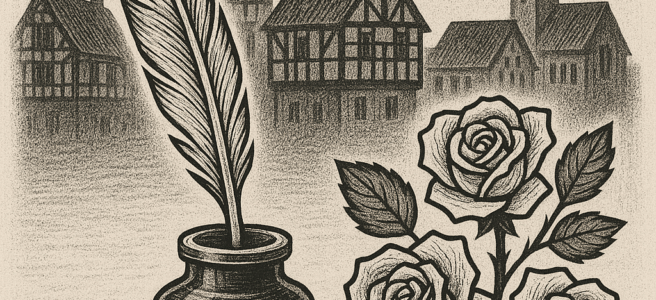
Ink & Roses Chapter 1 : A Nest of Wasps and Nightingales

Ink & Roses A Tudor Tragedy

The following is an experiment in fiction. I’m having a conversation with one of the AIs, and it’s writing the story. What I find fascinating is that it’s arguing with me, and seems to know a lot about the proper historical context. I wanted to write something of a prequel to Shakespeare’s career. I wanted to explore the space where Marlowe and Shakespeare lived concurrently. All I’m doing is asking questions and hinting at how I’d like the story to be structured.

Let me know what you think in the comments. Worth continuing?

-SG

Easter Week, 1592

The Thames stank of spring mud, fish heads, and the slow thaw of winter sins. Southwark’s alleys streamed with apprentices jingling their last pennies, orange-girls lifting skirts to wade through puddles, and two velvet-clad gallants betting how many groundlings would faint before the trumpet sounded.

William Shakespeare arrived unnoticed. His boots leaked, his cloak was mostly holes, but ambition beat in his chest like a second heart. Three days earlier, the Lord Strange’s Men had accepted his new chronicle—tentatively titled Harry the Sixth—for a single performance. One afternoon to turn a scribbled name into London’s next cry of wonder.

He paid his penny, surrendered his dagger at the door, and slipped into the yard. The Rose’s galleries arched like the ribs of a wrecked ship, timbers still weeping sap. Somewhere inside, the company rehearsed the pre-show jig. Will closed his eyes, tasting the future: creak of rope, flare of oil lamps, hush before a thousand strangers drew one breath.

A shoulder rammed his ribs. “Christ’s nails, stand aside!” A tire-man staggered past with spears of pasteboard. Will stepped back, slipped in the mud, and collided with something softer than a post—and infinitely more dangerous.

“Steady, countryman,” a voice murmured, amused. “The groundlings will trample anything that smells of Stratford.”

Will steadied himself, looking down into eyes the colour of gun-smoke shot with violet. The stranger was slight, twenty-six at most, in black velvet cut fashionably short. A silver earring—a single hoop no larger than a farthing—glinted against the pale lobe. To Will, fresh from Warwickshire where only sailors and gypsies wore such ornaments, it looked scandalously elegant: a tiny moon daring every word from that mouth to cut as cleanly as any blade.

“Christopher Marlowe,” the stranger said, extending a gloved hand. “The company calls me Kit.”

William Shakespeare—still unknown, still hungry—felt the name strike him behind the knees. Kit Marlowe: the Cambridge wit whose Tamburlaine had thundered the Rose into legend only last winter. He had pictured a bearded giant; instead he held the hand of a sleek, bright-eyed leopard.

Their conversation—equal parts duel and duet—spun from accents to metaphors, from debts to dreams. Kit recited Will’s own line about “the gaudy, blabbing, and remorseful day” with a grin sharp enough to shave with. “You owe me a cup of Canary for teaching you how to wring a metaphor’s neck,” he teased.

Will flushed. “I’ll stand you the wine the moment receipts are counted.”

“Receipts!” Kit laughed. “You’ll wait longer than Lazarus if you trust Henslowe’s purse. Come, Will-of-Stratford—let’s find somewhere the floorboards don’t slap like wet linen.”

Together they climbed to the lords’ room—close enough to smell pomander and lamp-oil, far enough from the mob to speak truths. A half-circle of gentlemen nodded to Kit; one hawk-nosed man with jewelled fingers shifted aside, eyeing Will’s country garb. Kit produced a flask of Rhenish and two fresh cups.

Below, the Prologue stepped onto the boards:

“Hung be the heavens with black, yield day to night…”

Will’s own lines—trimmed, tailored, terrifying—were coming to life in the mouth of London’s greatest actor. Kit watched, not the stage but Will: the flare of nostril, the parted lips, the moment the Stratford man forgot to breathe.

During the brief hush before Act Two, Kit tipped the last of the wine between them. “Tell me,” he said, voice softer now, “what do you miss most when London shuts its gates on you?”

Will traced a knot in the rail with his thumb. “The quiet. Not silence—Stratford’s never silent—but the sort that lets a man hear his own thoughts without a dozen pamphleteers shouting them down.” He glanced sideways. “I have a daughter sharp enough to bargain with peddlers. Susanna’s seven. She asked why all the women in my plays die; I had no answer fit for seven.”

Kit tilted the pewter cup until the torch-flame caught the silver hoop; for a heartbeat he studied its warped twin grinning back at him, then looked to Will.. “I keep no letters from home. My father still hopes I’ll take the living at St George’s. He thinks ink is a phase, like the pox.” He lifted his cup. “To promises we don’t know how to keep.”

Will touched pewter to pewter. “And to the fields and bells we left behind.”

The trumpet blared for Act Two. Kit brushed Will’s sleeve—an ember of contact, quick as a heartbeat—then turned back to the lights, the thunder, the future neither could yet name.

London, for one bright afternoon, held its breath.

What do you think so far? Should we continue? Did it get anything wrong, that I’m missing? Let me know in the comments!

Sir Ian. Legend. Icon.

My kids are the age where they followed Taylor Swift’s last tour pretty religiously. Every couple of weeks (days?), they’d come screaming into the room about which mystery guest she’s brought on stage, or how a certain guest was expected, but they got somebody else. That was part of the experience. The music was basically going to be the same at every tour stop, so it was the “What makes each show different?” element that made it the kind of event that you could look forward to every day.

The 2025 Glastonbury Festival is going on right now, and somebody called Scissor Sisters, who I don’t know, brought out SIR IAN MCKELLEN, who I very much do. I showed the video to my daughter and said, “I would have died. Ok? Died. I may die just watching the video.”

You know that thing where people say, “He could read the phonebook and people would pay to hear it?” This. I have a clip of Judi Dench reciting Sonnet 29 on the Graham Norton show that I go back and play periodically just because of how beautiful her voice sounds when she says “lark.” I don’t even know what Sir Ian is saying in this song. And I don’t care. Whatever he’s shouting for us to do, I’m going to run up a mountain to do it.

I heard this story because the crowd started chanting his name, and he burst into tears. I’m looking for a video of that, but I’m well aware that it may have the same effect on me.

Until then, enjoy the show. He shows up at about 3:30 if you want to skip. Or you can pretend you’re in the audience, and anticipate the big finish. Either way, I’ll be over here, dead.

King Lear in “We Were Liars”

https://www.upi.com/Entertainment_News/TV/2025/06/18/david-morse-rahul-kohli-we-were-liars-interview/5121750116174

I see a headline like, “‘We Were Liars‘ is modern-day ‘King Lear'” and you know I’m clicking it. I remember reading We Were Liars. I didn’t immediately remember it being a King Lear story. I recall a flashback story about teenagers spending their summers on the beach at Cape Cod, and a house burning down. *shrug* *click*

King Lear

Disclaimer: I’d forgotten that they’re making a tv series, which apparently launches this week. The only knowledge I have of the project is the book, so who knows how they may have changed it.

“He can feel it coming and there’s a kind of a clock ticking for him,” the actor said. “There’s things that he wants to get done before he’s really gone and it makes him very vulnerable and touching to me and unexpected in a character like this. So, in that way, I suppose it’s like King Lear.

Ok, fair enough. Out of curiosity I tried to remind myself of my thoughts on the book at the time, and was actually surprised by what I’d written on Goodreads:

It occurred to me late in the story that this book is a bit of a young adult version of King Lear. There’s definitely King Lear references. The theme of “Once upon a time there was a king that had three daughters” comes up frequently.

I still don’t remember much about it, I clearly wasn’t paying close attention. But now that I mention it, I do remember that the “king who had three daughters” is literally in the story several times, like it’s part of the narration. Maybe now that I’m getting hit over the head with it I should read it again?

Or at least watch it, I guess.

P.S. – I also had no idea it’s a book series? Apparently there’s three of them. Anybody read them all? Should I follow up?

Happy Father’s Day To Me!

I may have mentioned that I have a lot of Shakespeare stuff. T-shirts, jigsaw puzzles, keychains, laptop skins … got it all. So much, in fact, that my family’s taken to creating wholly original items! I was definitely not expecting this for Father’s Day 2025:

Belle The Dog dressed as Shakespeare

I love it! A few months back, my oldest had found a service that would do this for your pet using a number of standard templates – king, queen, princess. Without telling me they scoured the site looking for a Shakespeare template, but alas it didn’t exist.

So my son actually made this! I think it came out really good, I love it. Her face is huge, you really get that feeling that you’re being stared at.

Unfortunately (there’s never a good way to drop this into the conversation!), our dog passed away between the time they made these presents, and Father’s Day. Awkward? Not as bad as you’d think. I think we were all happy for the remembrance. We’ve all been looking through our hundreds of pictures anyway, so it was nice to see a creative surprise.

But I am going to attach something to this post to mark the occasion. In times of grief, I’ve always gone back to Constance’s speech in King John, and I wondered if it could be made relevant here. With a little help from AI, I think the answer is yes, it certainly can. Thank you, Shakespeare. Flights of angels, Belle. See you again someday.

Grief fills up the room of my sweet girl:
Lies in her bed, walks up and down with me,
Carries her leash, drops her worn-out toy,
Noses the door, waits where she used to wait—
She haunts the silence. I am not myself;
I am the echo of a happy life
That padded soft behind me on four paws.

O, that my arms were long enough to reach
Into the quiet place where good dogs go—
I’d pull her back by her velvet-soft ears
And feel her heartbeat warm against my chest.
You tell me time will soften what I feel,
But time is cruel—it will not lick my tears,
Nor lay her head across my feet at night.

Grief is not madness, though you call it so.
I am not raving—I am only empty.
She was my shadow, soul, my loyal girl.
Don’t bid me be at peace. She was my dog.