Review: Hamnet (Movie)

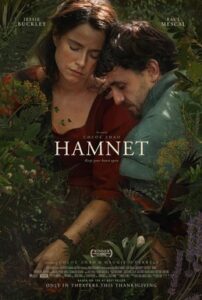
It’s the end of the calendar year, the time when all the most artsy award contender movies all flood the theatres to get it under the deadline. This year, we have to pay more attention than usual, though, because Shakespeare is in the mix. The movie version of Hamnet, by Maggie O’Farrell, is in theatres now. I made sure to read the book before I saw it – review here.

Starring Academy Award Nominees Jesse Buckley and Paul Mescal, and directed by Academy Award Winner Chloé Zhao, this one is absolutely showing up on every list.

But Did I Like It?

Somebody called it Shakespeare In Love 2: Shakespeare Is Sad and I wish I’d thought of that.

This might be the first time I’ve ever said this, but I’m annoyed by how much Shakespeare content is in this. The more you know about Shakespeare, the less you’re going to like this movie.

Let’s back up. This is going to contain spoilers if you don’t already know Shakespeare’s biography, but I’m assuming that most readers of this blog already know the story.

The book did something fascinating that at first annoyed me, but I came to love. Shakespeare’s name isn’t ever mentioned in the book (I think maybe once). He’s barely in it. The book is told from Agnes/Anne’s perspective – a woman forced into a marriage by pregnancy, left in Stratford while her husband runs off to London to build a better life for himself (and, in theory at least, them). All while the plague is all around them, Life is not easy for Agnes, especially once tragedy strikes the family. The book does a spectacular job of telling the story of this wife and mother who just happens to be “Mrs Shakespeare.” The famous guy is secondary to the story.

Well, somebody in Hollywood missed the memo, because all the marketing material says is Shakespeare Shakespeare Shakespeare. Look how pretty Paul Mescal is! Make sure to point the camera directly at his face as many times as you can, and just leave it there. Let them get lost in his eyes.

I’m not even being facetious. You know how some writer / directors are famous for the “walk and talk” style? We’ll call what Zhao does something more like “stare a lot and sometimes talk.” There are many scenes of Buckley and Mescal just staring at each other. There’s also no music to speak of in these scenes, just dragging awkwardness.

The movie also has no faith in telling Agnes’ story, so they inject lots of extra scenes of Shakespeare in London. It was important in the book not to have that, because Agnes didn’t get that luxury. Her husband’s absence was a mystery, and a real point of tension in their relationship. The audience should sympathize with her, especially after their child dies and her husband says, “Well, back to London I go.” Showing Shakespeare’s own grief and pain is completely unnecessary, in my opinion, and weakens the movie.

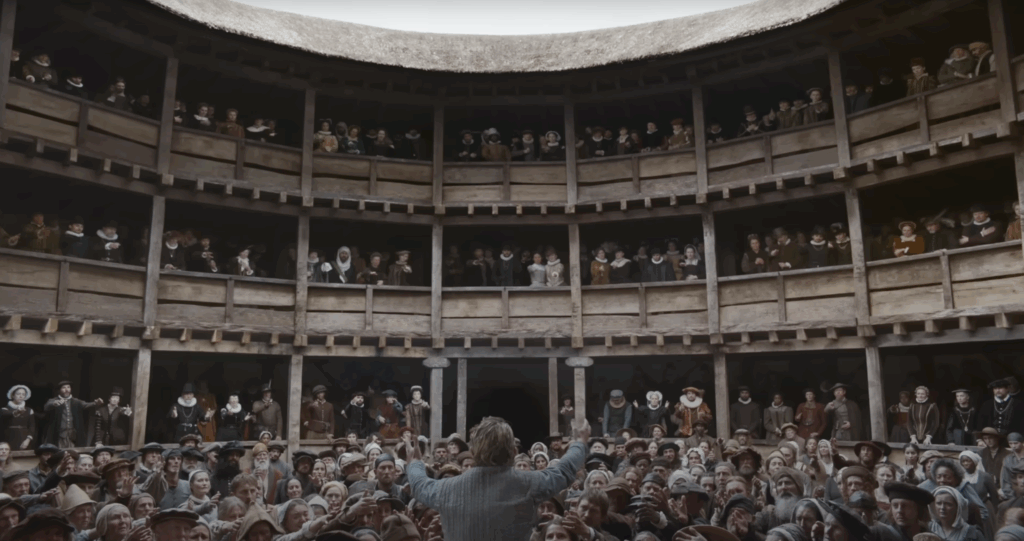
Let me pause for a second and say nice things before getting to the parts I really hate. This is a beautiful movie. The effort that went into the scenery and costumes is outstanding. If this movie’s getting any awards, it should be in those areas.

Jesse Buckley is, to put it simply, her generation’s Meryl Streep. She’s brilliant in every scene, and the movie would be better by having more of her in it. She’s called upon to act out both her child’s birth and death in a single movie. If that’s not range, I don’t know what is. We’ve often referred to Constance’ famous speech from King John about grief (“Grief fills the room up of my absent child, Lies in his bed, walks up and down with me, Puts on his pretty looks, repeats his words..”) and Buckley is the embodiment of that speech. Her fury at her husband stealing their child’s name to use in his little play, storming to London to confront him, literally screaming at the actors mid-performance that it is not theirs, they can’t have it? Amazing. I won’t spoil everything but I will say that even after that moment it gets even better. (Before unfortunately getting worse.)

Let’s talk about the direction. My wife came out of the theatre asking, “I don’t understand why it kept showing the table.” It took me a second to realize what she meant, but she’s right. The camera spends much of our two hour runtime on the scenery, even when the main characters are having a conversation. Agnes and Will are talking, but are they on screen? Nope, let’s look at the table. Or a leaf on a tree outside the window. Or various big black holes, like the gap in the tree roots, or the exit from the stage. I’m sure there’s some deep reason for this choice, but I much prefer a more grounded approach. When people are talking I want to see their faces.

What About The Shakespeare?

As I mentioned, there’s almost no Shakespeare content in the book, except right at the end. I wish they’d kept it that way, the ending would have been more powerful. Instead, some producer somewhere no doubt read the script and said, “Where’s the balcony scene? People love the balcony scene, add the balcony scene.” So yes, spoiler alert, we get a shot of Shakespeare – back when Susannah was just a baby – working upstairs on “But soft what light through yonder window breaks,” tapping out the iambic pentameter as he recites it. Bleh. I think that scene might have already been in Shakespeare In Love but that is not why that one got its Oscar. Never mind that this was probably 10 years before the play was written. The man was just that good, I guess? A regular Earl of Oxford.

But wait, there’s more! Of course, Shakespeare shared his work with the family, being the good, present, and attentive father that he was (at least, in this story). He choreographs stage combat with Hamnet. The children put on a play for their mother. What do they recite? When shall we three meet again, in thunder, lightning, or in rain? Sure, why not? Who cares that Hamnet died in 1596 and Macbeth wasn’t written for another 10 years?

Can it get worse? Oh, gentle reader, brace yourself. You do know for certain that “To be or not to be” is Hamlet contemplating suicide, right? We know, because in this movie, in his grief, we literally get a shot of Shakespeare debating whether to throw himself into the river while reciting that soliloquy. That’s got to be the worst decision they made. The movie’s already being called “grief porn.” They already injected a bunch of scenes of how Shakespeare dealt with the death of his son, because they didn’t have enough faith in the child’s. mother’s grief. Instead they have to take a scene like that and say, “You know what would be great here? What if he recites To be or not to be?” And all the other writers in the room say “Brilliant!” when in reality it ruins the movie.

See It or Not?

People always ask me, “Would you recommend it?” about movies and I never know what to say. My opinion is my opinion, and yours may vary. As noted, it’s a visually stunning movie, and Jesse Buckley alone deserves to be seen. I’d like to say the same about Paul Mescal but really, I so resent the extra footage of him that they jammed in there, I can only really see him as a pretty face they kept shoving in there because they didn’t have enough faith in Buckley’s, which is a true shame. This movie could have stayed far closer to the book, removed all the extra Shakespeare, focused entirely on Agnes, and been an even stronger Oscar contender, if you ask me.

Ready for Hamnet?

The much-anticipated movie adaptation of Maggie O’Farrell’s Hamnet hits theatres this Thanksgiving, and the trailer dropped this week. Let’s watch!

Ok, thoughts?

I never actually read the book. It came out in 2016 as part of the Hogarth Shakespeare series by Random House, a project to create modern novelizations of many Shakespeare classics by well-known authors. I did read Hag-Seed by Margaret Atwood and Macbeth by Jo Nesbø, but something about Hamnet just didn’t work for me. I don’t think it really fit the pattern of the others, first of all. Are you retelling Hamlet, or are you imagining a life where Shakespeare’s son didn’t die? I wasn’t into a story about the latter. When tragedy happens in real life, I don’t find it a useful exercise to imagine how life might have been different. I don’t find it hopeful, I find it depressing.

But, that’s just me. Maybe I’ll try it again, before the movie? I definitely want to see the movie. I saw All Is True, and I loved All Is True – except the bits about Hamnet. I’m nothing if not consistent.

Ok! Let’s talk about the trailer. Somebody who’s read the book, fill me in, because right off … who is Agnes, and is she a witch? When we’re not blaring the soundtrack and the cinematographer is not taking inspiration from Millais’ Ophelia, the first bit of dialogue I got was, “If you touch people, you can see their future.” So, then, this is neither a reimagining of Shakespeare’s life if Hamnet had lived, nor a retelling of Hamlet? It’s a fantasy?

Is he wearing a cardigan?

Really, that’s about all their is to say about the trailer. We see repeated shots of Paul Mescal as Shakespeare and Jessie Buckley as Agnes, and we hear a whole lot of soundtrack. We have no idea what the plot is, we get no meaningful dialogue or meet any supporting cast. It’s almost like the trailer’s made just for people who read the book, which isn’t how these things usually go. Usually the movie goes out of its way to appeal to the audience that hasn’t read the book.

So, people who’ve read the book, what do you think?

Review: Sing Sing

"Sing Sing"

I’m going to say something up front because I had it said to me (well, I read it), and it helped me enjoy the movie Sing Sing. This is a true prison story. But there are no riots, no escapes, no makeshift shivs sticking anybody in the back. It’s not that kind of story. That’s not a spoiler, that’s permission to breathe, relax, and appreciate what’s really going on in the movie. You don’t have to watch in fear that something bad is going to happen.

I admit that I dismissed Sing Sing at first as just another take on “Shakespeare Behind Bars,” which I first saw twenty years ago. That was a mistake, I’m happy to say.

Sing Sing is the best movie I’ve seen in a long time. Too often I’ll watch a movie in that half-listening, “put it on in the background” way that we sometimes do when we treat an item like a todo-list box to be checked instead of an experience to be savored. Not this time. I was hooked in the first minutes. I put down the computer and sat on the edge of my couch cushions straight through to the end.

This movie tells the story of Sing Sing prison’s Rehabilitation Through the Arts (RTA) program. It focuses on the story of John “Divine G” Whitfield, a playwright himself and original member of the group, played brilliantly by Colman Domingo. We also learn that he’s incarcerated for a crime he didn’t commit, and on a continuing quest to prove his innocence.

We open with the close of the group’s most recent performance, A Midsummer Night’s Dream, and the addition of new members to the group. Here we meet Clarence “Divine Eye” Maclin, playing himself. One of the fascinating aspects of this movie is that it’s based on a true story and played by many of the actual original players. If, like me, you’re wondering how the two main characters ended up as “divine” something? Well, that’s not the writing, that’s the reality. Those were their names.

Despite Divine G’s insistence that Divine Eye be admitted to the group, there’s some immediate animosity at Eye’s strong new personality. G is thrilled when the other members of the group suggest they perform one of G’s original plays next, only for Eye to sway the group that a comedy is the way to go. But then they both audition for the only dramatic role in the script (an original, created by the group’s director).

This sets up the first of many confrontations between the two. G loves the program and knows what it’s done for the other inmates. Eye comes from a world where if someone so much as walks too close behind you, your life might be in danger. The evolving relationship between the two is the our major story arc.

What About The Shakespeare?

This is a Shakespeare blog, so let’s talk about Shakespeare. This isn’t a Shakespeare movie. They don’t perform Hamlet in the big final act. But somehow, that makes it an even better depiction of why Shakespeare is universal.

We find out that Eye became interested in theatre after stumbling across King Lear as one of the few books accessible to him. Unprompted, he quotes, “When we are born, we cry that we are come To this great stage of fools” with no fanfare, no “Look at me I’m quoting Shakespeare,” no flourish or fanfare. His interpretation actually made me laugh, saying that “whoever wrote this, man, had to did a bid before.” The idea that Shakespeare can just pop into your life, at any time and place, and you don’t even know what it is, but it still resonates, no matter who you are? Come on now. What have we been trying to say all these years?

Colman Domingo in "Sing Sing"

There is more Shakespeare than that, not to worry. Despite the play being an original time travel comedy featuring time travel, pirates, and zombies, it also features Hamlet. (If that makes you think of Hamlet 2, you’re not alone.) Eye, of course, is playing the role – which affords G the opportunity to direct him. The actual director of the group is not an inmate, so while he can speak to the theatre, he can’t speak to the experience. That’s where G shines. He helps Eye break through from “I walked on stage and said the lines” to “I am the character.” It’s really quite a thing of beauty to behold.

I’ve often said that a key to understanding Shakespeare is realizing that, underneath the words, “there are people in there.” Well, that’s true here, too. These are prisoners, but they are people. There are multiple scenes where they talk about their children, their lives outside the prison, and how they got there. There’s a scene where they all meditate on their “happy place” and talk about it, and an inmate realizes that his happy place is right there, right now. He is happy where he’s found his people.

I could keep on like this, describing the scenes I loved, but I’ll tell the whole movie. There is a story that we want to see resolved. Eye, knowing he’s innocent, struggles to get out – no matter how much value he’s found in the RTA program. G, who slowly but thankfully becomes part of the RTA program, can’t imagine any world other than the one he’s made for himself. Both these characters are changed individuals by the movie’s end credits.

One more scene, and then I’ll wrap up. During an early confrontation, Eye is still throwing around N-words like they’re part of the normal prison vocabulary. “We don’t say that here,” G tells him. “We say beloved.”

I get it, I think, at least as much as a white person can. Both, in their way, are expressions of a bond that exists, a way of saying, “We are the same, we come from the same world, there are things that we share that not everyone shares.” But they can achieve the same purpose and still be completely different ways of doing it.

And at first, you think, “Yeah, sure.” This is the guy still packing a knife in his waistband, ready to cut one of his fellow actors just because the blocking called for him to get a little too close. But you know what’s going to happen, And when it does, it’s … just so natural. The director doesn’t call your attention to it with over-the-top background music. There’s no meaningful pause for the audience to have their “Ohhhhhh, ok!” moment.

That’s why I love this movie. You don’t spend the whole time thinking, “Somebody created this story, somebody wrote a script, somebody directed it and told the actors what to do and where the camera should look.” This isn’t just a real story, many of the original actors perform the story including Divine Eye. If you love something about it, love it more because it really happened. It’s not someone’s wishful thinking. Score one for Shakespeare.

Image from performance in "Sing Sing"
The actual play performed by the inmates is … something.

Somebody Produce This

Some ideas you know you’ll never execute on. Better to free them into the universe and see if they take on a life of their own.

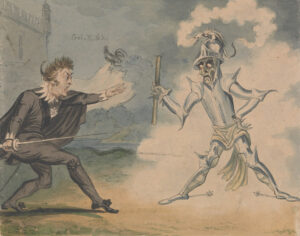
I’ve always been fascinated with the character of Francisco in Shakespeare’s Hamlet. He’s only got eight lines in the first scene when Marcellus, Bernardo, and Horatio relieve him at his post. If it ever comes up in trivia, Francisco delivers the line “Not a mouse stirring.” Then, he leaves and isn’t seen for the rest of the play.

Here’s my question. Did Francisco see the ghost? I like to think he did. Why not? Why would the ghost pick and choose which random guards he appears to? I have to believe that he keeps showing up, figuring that eventually, someone will get Hamlet. Or in this case, Horatio, who says, “We should get Hamlet.” Luckily, Marcellus had Bernardo to say, “Are you seeing what I’m seeing?” But poor Francisco didn’t.

And thus my idea. I’d like to see a one-man show centered around Francisco. We open with Francisco on stage and play the same scene from his point of view. But instead of Francisco exiting, the others exit, leaving him alone. What does he do next?

Maybe he doesn’t know what he saw. Perhaps he’s seen the ghost multiple times, and it’s become obvious. Francisco can’t exactly tell anyone. They’ll think he’s gone mad. So he’s left to deal with it himself. The ghost isn’t going to speak with him, just like it didn’t speak with Horatio.

The whole play would be about mental health and what it’s like inside someone’s head who feels like they’re alone in the universe and dealing with things beyond their ability to understand or control. Sometimes, he debates whether to tell someone but always concludes that no one is to be trusted. He’s not that close to anyone. So then he ponders how to handle it himself. Can he talk to the ghost? Can he prove to himself that the ghost is even real? But everything he tries fails, keeping that “Is any of this even real or am I going insane?” thought alive.

Ultimately, sadly, I think this story ends with Francisco committing suicide. This reinforces a similar theme in the main story. Did Ophelia, alone in the world, take her own life? Though he may have soliloquized about it, Hamlet ultimately moves on from the thought because he latches on to Horatio. Whatever’s in Hamlet’s head, he tells Horatio. He has that outlet. I’d say it saves him, but, you know, obviously not. Maybe more accurate to say having that close confidante, something that Ophelia and Francisco didn’t have, but even Marcellus and Bernardo did, saved him from himself.

<shrug>

Just an idea that came up in conversation last night that I thought would be fun to flesh out and document for posterity. In college, I saw a few of my plays performed, and I’d absolutely be writing this down if I still had that option. Maybe somebody else out there is still in that environment and wants to run with it. Just give me a shout-out in the credits and send a link!

Enjoying The Infinite Variety Podcast?

Art!

Loyal readers probably know that Bardfilm and I finally did something we’ve talked about for years — we started a podcast!

The Infinite Variety Podcast

Hamlet and Ophelia, sitting by a tree. -- Infinite Variety Podcast
Hamlet and Ophelia, sitting by a tree.

Infinite Variety: The Shakespeare Rewatch Podcast will involve us watching anything inspired by Shakespeare—movies, television shows, music videos, commercials … If we can watch it and find some Shakespeare in it, it’s up for discussion.

We decided to start with one of the most well-recognized examples of how to put Shakespeare on screen. Don’t anybody dare say Lion King. I’m talking about Slings & Arrows, a Canadian television show about actors fighting to preserve the integrity of live theatre against the unending onslaught of commoditization and commercialization. Each of the three seasons is mirrored against a Shakespeare play—Hamlet in season one, Macbeth, then King Lear.

Darren Nichols -- Infinite Variety Podcast
He is Darren Nichols, and you’re not.

You have to watch a few episodes of S&A to understand why we love it so much. This isn’t just Hamlet — we have plenty of options to choose from if we want to watch Hamlet. This is a Hamlet mirror story. Geoffrey, the director of Hamlet, was an actor who played Hamlet. Who may or may not have gone insane. Who definitely sees ghosts.

If you’re an actor, love live theatre, or love Shakespeare, there are so many reasons to watch this show. Multiple times per episode, you’ll gesture wildly at your screen, yelling, “Exactly!” or “Oh my god that is so me!”

You’ll want to share the experience with people who get it. It’s people who love what we love, reminding us why we love it in the first place. Plus, it includes some stars you’ll no doubt recognize, including Mark McKinney, Luke Kirby and Rachel McAdams.

It’s been a joy to rediscover this show. I’m thankful to Bardfilm for getting the ball rolling and creating the opportunity to start the conversation. Join us, won’t you?

https://www.infinitevarietypodcast.com