Why Did Iago Leave Roderigo At Brabantio’s House?

The Shakespeare Answers category is here to answer questions people may have about Shakespeare’s work. If you’re just looking for the homework answers then you’ll find them here. I don’t love that, but I look at it this way. First, I can’t stop you, and if you didn’t find the answer here you’ll easily find it elsewhere. Second, by answering the question here maybe I can convince you that Shakespeare is interesting and worth learning more about.

Like so many of Shakespeare’s plays, we don’t actually see the title figure in the first scene.  Othello opens with Iago and Roderigo standing outside the window of Brabantio, a Venetian senator, and father to Desdemona.

Roderigo lusts after Desdemona, and Iago knows this.

Desdemona has run off with Othello, and Iago knows this.  Iago does not like Othello, to put it mildly.

Brabantio will not be happy to discover that his daughter as run off with Othello, and Iago knows this.

Iago’s manipulation drives everything in this play. He wants to get Othello in trouble, possibly to the point of having his command stripped, and sees an opportunity to use Roderigo as a puppet in making that happen.

So here we are, standing outside Brabantio’s window when the two begin hurling some of the vilest, most racist comments you’ll find in all of Shakespeare:

Even now, now, very now, an old black ram
Is topping your white ewe…

…the devil will make a grandsire of you…

…you’ll have your daughter covered with a Barbary horse…

It is Iago, not Roderigo, that hurls all those comments, as well as the most famous one:

…your daughter and the Moor are now making the beast with two backs.

But, here’s the thing.  When Brabantio asks for their names, the only one to answer is Roderigo.  Iago’s not stupid.  Roderigo still thinks that the plan is some version of “we’re going to get Othello in trouble by telling on him,” not fully appreciating the level of psychological manipulation going on.

Once Brabantio comes down the stairs, Iago runs for it.  He tells Roderigo:

…for I must leave you:
It seems not meet, nor wholesome to my place,
To be produced–as, if I stay, I shall–
Against the Moor

Which translates as, “It’s not a good idea for people to see me here, speaking out against my boss.”  Which is true. You can’t play the puppet master once people realize that you’re the one pulling the strings, and then realize that you’ve got strings attached to them as well.

Does that make him a coward? Hurling insults behind the mask of anonymity and then fleeing into the night?  That would suggest that Iago feels some degree of remorse or shame for his actions, which is hardly accurate.

The scene does a great job of setting up both characters. Roderigo is easily manipulated here and will be again.

Behold! Behowl The Moon by Erin Nelsen Parekh

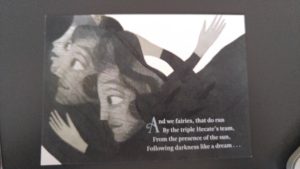
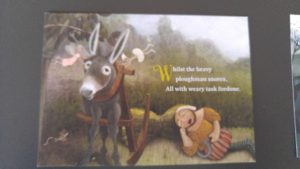
In September 2016 I found this Kickstarter project for a “baby board book” based on A Midsummer Night’s Dream called Behowl the Moon.  Look what came in the mail today!


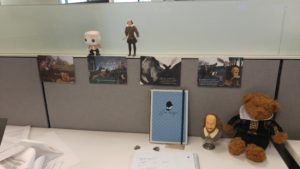
These images came as some lovely postcards representing the illustrations within the book. They’ve now been added to the ever growing shrine at my desk!  New employees rapidly learn that I’m the Shakespeare guy.

I love that this exists, and that we helped make it happen. My kids are too old for baby books now, but there’s lots of new parents out there that can have this. My coworker just had a baby 10 months ago and was happy to pick one up.  “I just hope he doesn’t eat it,” he told me today. “He’s starting to gnaw on everything he can reach.”

If you didn’t get in on the Kickstarter it’s not too late!  The book is available on Amazon in both Kindle and “board book” formats.

In a different world I might have read this book to my kids.  Instead I get to do this. I love it.

Why Does Hamlet Hesitate to Kill Claudius?

Why does Hamlet hesitate to kill Claudius?

There are a few different ways to answer this question. I assume that most of the time people ask it, they’re referring to III.3 when he catches Claudius at prayer:

Now might I do it pat, now he is praying;
And now I’ll do’t. And so he goes to heaven,
And so am I reveng’d. That would be scann’d.
A villain kills my father; and for that,
I, his sole son, do this same villain send
To heaven.
Why, this is hire and salary, not revenge! [citation]

So the short and easy answer is Hamlet tells us – by killing Claudius at prayer, his soul is clean, and therefore he’d go to heaven. However, this is not a luxury granted to Hamlet’s father, which is why he now roams the earth as a ghost.  Hamlet doesn’t feel that this is an even exchange.

You should, however, be saying, “Seriously?” right now.  “You set the trap to prove Claudius’ guilt, it worked, now you’re behind him, there’s no witnesses, you could absolutely finish him off. And instead you’re thinking ahead to where he soul ends up?”

That is precisely the whole point of the play. Hamlet’s indecisiveness is all. He can talk himself out of anything. Go back to I.5:

But know, thou noble youth,
The serpent that did sting thy father’s life
Now wears his crown. [citation]

So your father’s ghost appears and says, “I was murdered by the king.”  Your first thought is, “I know, I’ll start acting crazy around everybody so they won’t know what I’m up to.”

At least the point has a specific rationale, however. In Amleth, the source material for Hamlet, the hero believes that his life is in danger and decides to pretend that he is an imbecile not to be perceived as a threat to the new king.

In Shakespeare’s version, however, that connection is lost — there’s no reason early in the play to think that Claudius is planning to kill Hamlet (though clearly, he plans to have England do it). So it looks like Hamlet’s just coming up with excuses to delay action.

I’ve always held that his mother’s death, not his father’s, ultimately spurs him into action. The entire play passes without him avenging his father, but it takes just 20 lines of dialogue between his mother’s death (“The drink! I am poison’d.”) and Hamlet’s action (“Follow my mother!”). Some argue that he finally sees his own mortality and knows, from Laertes, that he, too, has been poisoned, and if he does not act now, he will never have the chance. But I’ve always felt that the “Follow my mother” line is a big deal – it’s not as if he mentions his father. Remember his concern over the fate of his father’s soul? How he was not absolved of his sins? Well, now his mother’s met the same fate.

What Makes or Breaks a Romeo and Juliet?

I can’t believe it’s taken this long, but this week my oldest is finally seeing an actual live Shakespeare production as part of her studies (i.e. not because I made it happen).  The production in this case is Romeo and Juliet (why is it always Romeo and Juliet?) and I’ve already told her that my assumption is she already knows moRomeo and Julietre about the play going in than anybody else in her class.

Since she’s already seen and read the play on her own, plot and character and all that stuff are out of the way (as has always been the plan).  So what I’d like to do is give her some suggestions to watch out for that will make this particular interpretation different.  In other words, it’s a great opportunity to discuss how everybody gets the same script, but every production is different.

What do you suggest?  For instance, I’m a big fan of watching the minor characters. I think they can really fill out the play when you give them a chance.  How’s Friar Laurence?  Is he just an incompetent adult, or should we see him as more of a villain who brings about all the tragedy because he is overly zealous in his desire to be the one who ends the feud?

Similarly consider Lord Capulet.  Which face is the right one? The one that says Juliet must decide for herself to marry Paris? Or the one that says do what I tell you or get out of my house?  I’ve always thought of him as a bad guy. But I’ve had people defend him, saying he’s merely a man with a temper who doesn’t mean what he says.

Another question I like to ask is how violent is the conflict between the two families in this version?  I don’t like the overly violent interpretation where both sides are always this close to killing each other. I prefer to believe that the grudge is dying out. Both sides now are all talk and bluster but neither is really serious about doing injury to the other. That way, Mercutio’s death is an accident. Even Tybalt is surprised – which makes Romeo’s revenge darker because while Tybalt accidentally killed Mercutio, Romeo deliberately killed Tybalt.

See what I’m talking about? When you see Romeo and Juliet for the umpteenth time, what are you paying close attention to?

Naught Without Mustard

Sometimes you find yourself in those situations that make you feel like more of a geek than usual.

A reddit user had asked about Touchstone in As You Like It and I was going through some quotes when I found this:

Of a certain knight that swore by his honour they
were good pancakes and swore by his honour the
mustard was naught: now I’ll stand to it, the
pancakes were naught and the mustard was good, and
yet was not the knight forsworn.

Hmmm, that rang  a bell. I immediately thought of, “Not without mustard,” and had to go do some research.

For those that don’t get it, “Not without mustard” is a line from Ben Jonson’s Every Man out of His Humor, and is thought by some to be a joke reference to the coat of arms that Shakespeare had recently acquired for himself bearing the motto Non Sans Droit, or, “Not Without Right.”


So, then, is Touchstone’s line a response to Jonson’s? It’s unlikely we’d ever truly know for sure, but it can be fun to pursue the line of reasoning.

Dating the plays is already notoriously tricky, not to mention answering the question of who knew what when.  Would Shakespeare have had to see a performance of Jonson’s play to know the line, or would they have been sharing scripts while it was being written?

Jonson’s play was acted by the Lord Chamberlain’s Men in 1599, and it is technically a sequel to the 1598 Every Man in His Humour, so we have a pretty small window to work with there.

But what about As You Like It?  The Wikipedia entry reads, “believed to have been written in 1599 and first published in the First Folio, 1623.” Even if we don’t always trust Wikipedia, the Royal Shakespeare Company page says, “Typically dated late 1599.”

Not Without Right
Not without mustard.

Looks like it’s certainly possible.  After some cursory research I called in Bardfilm, who is much better at this sort of thing than I, and has access to all the best resources. He tells me that the Arden edition offers no notes on the connection, but then goes on to find this amusingly “relevant” article from an author named Mustard.

So who knows.  Either we’ve uncovered a joke between playwrights that nobody else has thought to mention, or it’s just a coincidence.  This is why we’re geeks about this stuff!