Sword Fights Galore!

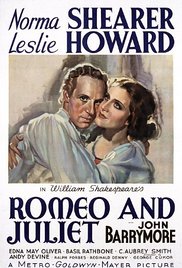
Sitting on my DVD shelf is the old 1936 Romeo and Juliet starring Norma Shearer.  I keep telling myself to watch it, but this the year 2016 and “watch the DVD” in this house means, “rip it on the computer, put it on the video server, and watch it at will on television.”  But of the four computers floating randomly around my house at any time – two modern Macbooks and two Chromebooks – none of them have a DVD drive. 🙁

So I was looking on YouTube for clips to post, and I discovered a channel called Sword Fights Galore! which is nothing but clips of sword fights from classic movies.  Awesome!

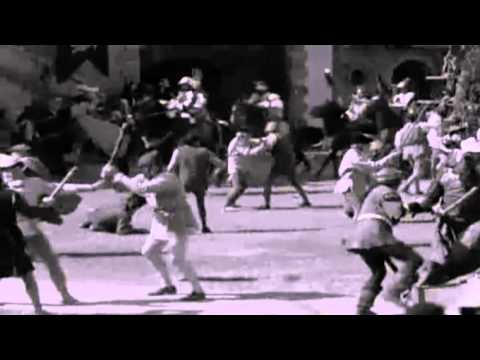
So, check it out – 1936 Romeo and Juliet, just the sword fights:

We start with Benvolio vs. Tybalt in the “Peace? I hate the word, as I hate hell, all Montagues and thee” opening:

Then we jump right to Mercutio vs Tybalt.  “Come, you rat catcher! Will you walk?”

Doesn’t end well for Mercutio.  Enter Romeo the avenger! I love Tybalt’s death scene.

Poor Paris was just in the wrong place at the wrong time.

One of these days I’ll get the DVD into my online collection and get to watch the whole thing.  Of course now I’ve spoiled it for myself by watching all the good parts 😉

Silent Hamlet

What did Hamlet look like in 1910?  I’m not talking about the Sarah Bernhardt version (1900), although it’s awesome that we have that.

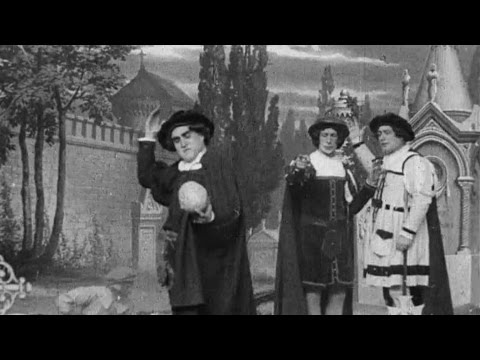
No, I’m talking about this Italian production, which at first confused the heck out of me until I realized that it is just a collection of scenes, and not the whole play:

How many scenes do you recognize? I see Hamlet enter, reading. I see crazy Ophelia with her flowers. The special effects for the ghost scenes are lovely!  Wonderful to get an example of how they were experimenting with the medium over a century ago. There’s not even any sound, but they’re making ghosts.  Awesome.

The YouTube description calls this an Italian production, so I was surprised to see a card that reads “Der Wahnsinn Der Ophelia,” which I’m gonna go ahead and guess is actually German. Google translate happily tells me it means, “The madness of Ophelia.”

I could sit and watch this all night.  They actually add a scene where Ophelia discovers the dead body of her father!  How cool is that, that even without any text to work with, they’re still open to the interpretation of adding new scenes?

I tried to get more details on who these people are, but would you believe that IMDB lists two different 1910 Hamlets?

Data Mining Shakespeare with Wolfram

I love finding stuff like this, it really bring out my inner geek.

The people over at Wolfram, who are perhaps best known these days as the acolytes in charge of the Wolfram Alpha search and research engine, have unleashed a tool to do word analysis on Shakespeare’s plays.  The sample make it pretty plain – they point to the MIT version of the text, then count words, then graph words. You’ve seen graphs like this often, I’m sure — how often are the words “love and death” used in Romeo and Juliet? What about darkness in Macbeth? Or blood?

The best part is that they didn’t just unleash a raw textual analyzer and say have at it like we’re all still college students looking for a thesis topic.  They’re crowd sourcing it.  They ask, “Could you think of data mining analysis or visualizations to apply to Shakespeare’s works?”


I bet we could! Who’s got ideas?

Shakespeare Take 2 : Hamlet and Ophelia in Couple’s Therapy

I was sent this video from the producer/creator/Ophelia, Emily Newhouse, and I found it amusing enough to post for Shakespeare Day.

What if Hamlet and Ophelia went to couples therapy?  Yes, “You killed my dad!” / “Why can’t you let that go?!” does come up.

[ Full link here, in case the player’s not working properly for you. ]

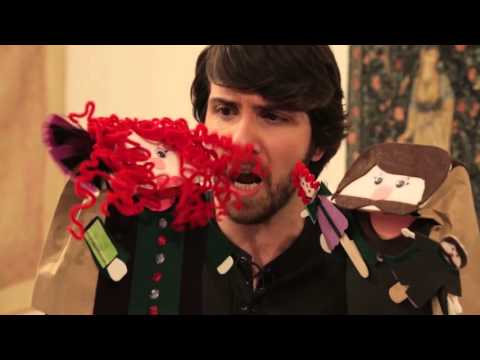
I think my favorite part (which happens to be in the screenshot, I notice) is when Hamlet shifts over to puppets, and puppet Hamlet is also manning tiny puppet Ophelia and puppet Hamlet.

Of course, counseling or psychoanalyzing Shakespeare’s characters has been popular fodder for ages. Who can forget Monty Python’s Hamlet at the Psychiatrist?

My Kids Have Never Read The Plays (Part 2)

So, what to do?  An expectation has been set – by me, by my daughter, by her friends – that since she’s grown up with this stuff, she will walk through Romeo and Juliet. Then she opens the text and is lost just like everybody else.

I knew what I had to do.  I fired up the home video server and went to the 1968 Zeffirelli movie, which I’m pretty sure they’re going to watch in class (some classes have already sent around a permission slip because of the infamous nude scene).

I quickly realize this isn’t going to work, because they’re not on the text. My daughter’s got the text in her lap and fully plans to use the video as a supplement to the source material, and right from the start, this movie is writing its own text.

Well that’s not going to work.  Hello again, Mr. DiCaprio.  I don’t think I ever would have imagined using Baz Luhrmann’s 1996 Romeo+Juliet to help my daughter with her homework, but here we are.  Say what you want about the acting and the directing, but the thing is they actually are using the text. And I think that’s important.  Right within the first few minutes, during the showdown at the gas station, the whole “bite your thumb at us” scene really gets the point across.  There’s real tension there, like it could all explode at any moment.  Which it does, by the way, as if this was a Michael Bay film.

Picture it.  I’m there manning the remote control, pausing and declaring, “Shh! This is the best part!” every other scene.  I realize I sound like my son when we tell him to turn off the YouTube video he’s watching for the twentieth time, but I don’t care.  To me they are all the “best” parts because what I really mean is, “This is something you should not miss.”

This is how the afternoon went.  My daughter’s got the text in her lap, and periodically looks up at the screen, then flips a page to catch up to where they have skipped. She’s clearly not doing that thing teachers fear where the students say “Forget this, why read it if I can watch the movie?”  We’re doing this voluntarily before the assignment has even begun specifically so that she can deep read the text later.

While the movie is going on, we get to what’s always been my big point.  Friar Laurence comes on scene, and I pause.  “Something to consider,” I tell her, “Is whether you think Friar Laurence is a good guy or a bad guy.”  Or why some people chose to interpret Mercutio as gay. Or whether Lord Capulet is a good father who has a bad moment later in the play, or if he never really meant everything he said to Paris in the early scenes.  “This particular movie,” I tell her, “will make choices for all of those questions.  A different production would make different choices. When you read the text, you get to decide for yourself which interpretations you think are correct, for your vision of the play.”

I just realized, writing this, that I also have the Norma Shearer / John Barrymore 1936 Romeo and Juliet.  May have to fire that up and see how it handles the text, for comparison!  Can’t have her seeing just the one version and using that as her baseline for future interpretation.

We’re on school vacation so it’s still a few days before they actually start studying the text for real. I have no idea if the teacher is going to do what they did to me thirty years ago, working through it a line at a time and not letting any word go unanalyzed.  “What do you think he means by carry coals?”  “Who cares?”  Maybe teaching methods have gotten a little more … flexible, since my time?  I have no idea.  Whatever it ends up being, all I know is that I’ll be right there with all the tools at my disposal to make sure she’s got everything she needs.