
How did Cordelia die?

It’s not uncommon for Shakespeare’s characters to die offstage, no matter how significant the character is. Unfortunately, this can make it difficult to understand how that character died. There’s a world of difference between seeing someone drink poison and someone running on stage to announce, “She’s dead, she drank poison!”

So it is with King Lear‘s Cordelia. Her death, and the way Shakespeare chooses to present it, is easily one of the most tragic scenes ever put on stage.
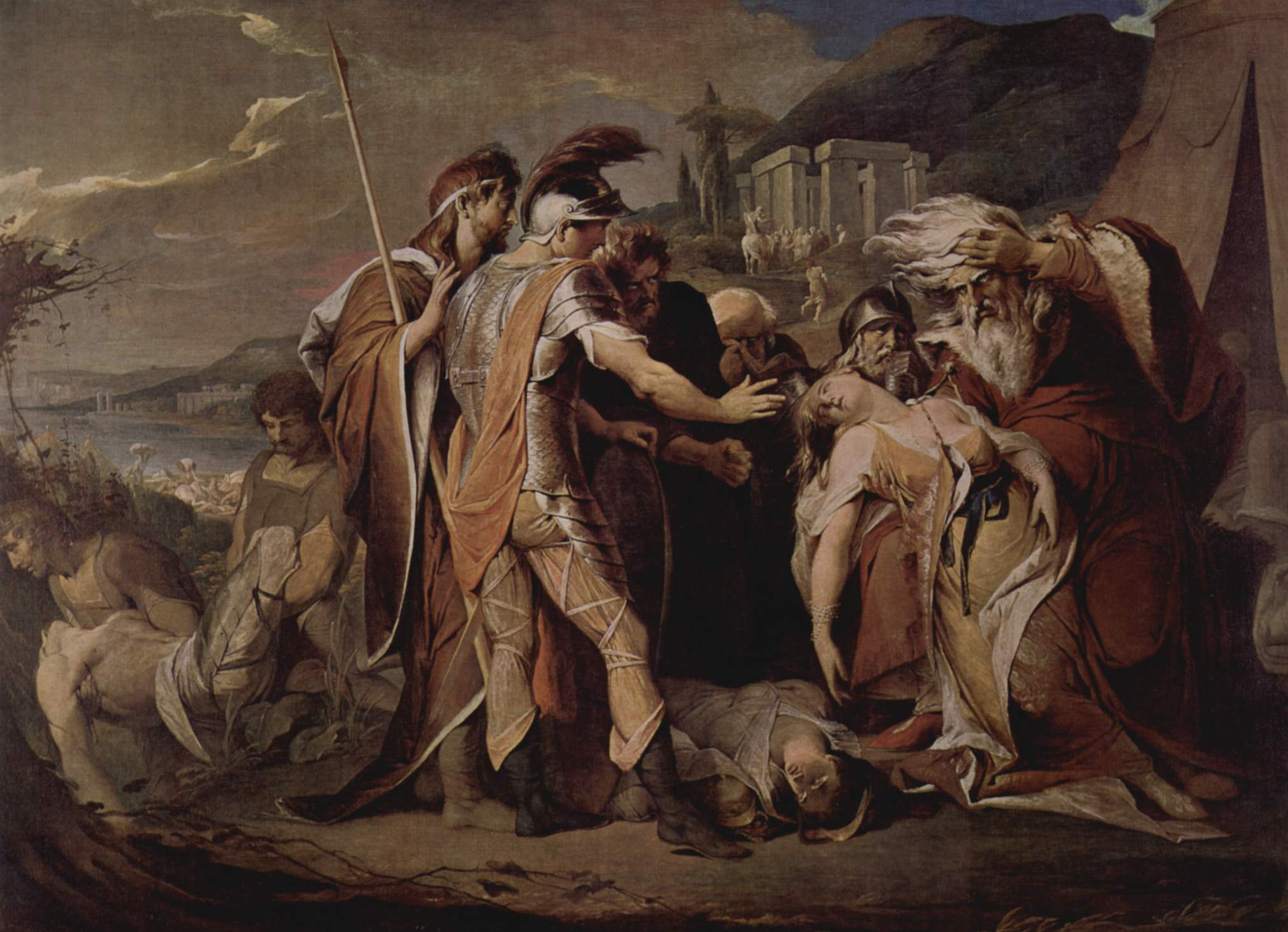
King Lear with Cordelia's dead body
Image via Wikimedia Commons

Edmund has captured Lear and Cordelia, but Lear doesn’t even seem to mind because he’s so happy to be with the daughter that he thought had left him forever. As they are taken away to prison, he says:

Lear. No, no, no, no! Come, let’s away to prison.
We two alone will sing like birds i’ th’ cage.
When thou dost ask me blessing, I’ll kneel down
And ask of thee forgiveness. So we’ll live,
And pray, and sing, and tell old tales, and laugh
At gilded butterflies, and hear poor rogues
Talk of court news; and we’ll talk with them too-
Who loses and who wins; who’s in, who’s out-
And take upon ‘s the mystery of things,
As if we were God’s spies; and we’ll wear out,
In a wall’d prison, packs and sects of great ones
That ebb and flow by th’ moon.

Edmund is challenged to a duel by a mysterious opponent who turns out to be his brother Edgar. Edmund is defeated and tries to make amends for the wrongs he has committed before he dies. He tells his guards:

Edmund. I pant for life. Some good I mean to do,
Despite of mine own nature. Quickly send
(Be brief in’t) to the castle; for my writ
Is on the life of Lear and on Cordelia.
Nay, send in time.

“My writ is on [their] lives” means that he has ordered their execution.  Quickly, messengers are dispatched to the prison to stop the order.

What happens next? Does the messenger arrive in time? No, this is a tragedy; we know that’s not the case. Does a messenger return and say, “Too late!”  No. That would be too easy. (This is exactly how the end of Romeo and Juliet plays out, with that glimmer of hope that Romeo will reach Juliet in time…)

King Lear enters, carrying the lifeless body of his daughter, and the audience sees for themselves that it is too late.

Lear. Howl, howl, howl, howl! O, you are men of stone.
Had I your tongues and eyes, I’ld use them so
That heaven’s vault should crack. She’s gone for ever!
I know when one is dead, and when one lives.
She’s dead as earth. Lend me a looking glass.
If that her breath will mist or stain the stone,
Why, then she lives.

If the question is how exactly did Cordelia die, her father answers it while weeping over her body, conversing with her as if she is still with him:

Lear. A plague upon you, murderers, traitors all!
I might have sav’d her; now she’s gone for ever!
Cordelia, Cordelia! stay a little. Ha!
What is’t thou say’st, Her voice was ever soft,
Gentle, and low- an excellent thing in woman.
I kill’d the slave that was a-hanging thee.

That last line provides the detail – they were in the process of hanging Cordelia when he attempted to rescue her.
Review : Strange Magic

When I first heard that Strange MagicLucasfilm’s new animated effort was “inspired by Midsummer Night’s Dream” I wanted to be excited. I really did. I wasn’t exactly holding my breath, however.

Good thing. Whoever started throwing around Shakespeare’s name in the marketing for Strange Magic seems to have had about a high school student’s knowledge of the subject, at best.  A C student.

The way I explained “inspired by Shakespeare” to my kids went a little something like this:

There are basically three different ways that a movie can use Shakespeare. I’m not talking about actual movie versions of Shakespeare plays, I mean original movies that say they’ve got something to do with Shakespeare. First are the movies that come right out and talk about Shakespeare and use his words. Like Gnomeo and Juliet. Then there’s movies that don’t use any of his words, but try to tell a modern version of one of his stories.  (10 Things I Hate About You is the classic example here, though my kids don’t know that movie.) Then there’s movies that just take a single idea that came from Shakespeare and throw the rest away, thinking that just because they’ve got a boy and a girl whose parents don’t like each other they can call it Romeo and Juliet, or just because a king gets killed by his evil brother you can call it Hamlet with lions.

Strange Magic sits firmly in this final group.  There’s a love potion and there’s fairies, therefore we can claim it’s got something to do with Shakespeare. No humans.  No war between a king and queen of the fairies. There’s an “imp” who I guess we’ll call Puck who runs around throwing the potion on people for fun, but entirely minor characters in a single montage, that has nothing to do with the story. There is no parallel at all for Helena/Hermia/Demetrius/Lysander that I could figure out.

In fact, as I also pointed out to my kids, this story has more in common with a completely different Shakespeare story, and I bet the creators didn’t even realize it.  The king of the fairies has two daughters – Marianne and Dawn. (Trivia for you – on the television show Gilligan’s Island, the character of Marianne was played by Dawn Wells).  Marianne, for reasons that are obvious in the first two minutes, has sworn off love for good. Dawn, the younger sister, is boy crazy. The king basically won’t let Dawn get married until Marianne does.

Ok, show of hands, sound familiar to anybody?  That’s right, it’s Taming of the Shrew.

But, again, that’s as far as it goes. The actual story is all over the place, and honestly a pretty shameful product from a name like Lucasfilm. More than once I felt it was the kind of thing that seemed like it was written in about a half a day, and felt like one of my middle daughter’s straight-to-video Barbie movies.  There’s a good forest and a scary dark forest, and along the border between the two is the only place that the primroses grow.  And primroses are used to make love potion, of course. But only the Sugar Plum Fairy can make love potion. But the evil Bog King, ruler of the dark forest, has captured her and ordered that all the primroses be cut down (the latter, by the way, is a plot point that has absolutely zero bearing on the plot as the hero finds a primrose petal as soon as he goes looking for one). So of course the meek little best friend of the younger sister, who is secretly in love with her, gets convinced by the other bad guy, who wants to marry the older sister in order to raise an army (something else that’s never really explained), that he (the shy one) should go get a love potion, and then it all just gets weird.

Oh, and it’s a musical. Of cover songs.  Like a big Glee episode. When someone gets hit with the love potion they apparently just start singing “Sugar pie, honey bunch” over and over again.

Skip Strange Magic. I can’t really find anything worth recommending. It looks nice, I’ll give it that. But even that is weird, as none of the characters have that “I wish I could get that in a stuffed animal or action figure” appeal. The fairies look so human that every time they sprout wings you think “Where did THOSE come from?” and the goblins are so shapeless and generic that there’s even a joke in the script that they can’t tell their own gender apart.

Why does Hamlet call Polonius “Jephthah”?

A stained glass image of Polonius. Image via Wikimedia Commons.

Jephthah is not a word you hear every day. How often does phth show up in the middle of a word? Sounds onomatopoetic, like blowing someone a raspberry every time you say it. With words like that scattered around the play, of course it’s got a reputation for being difficult to read and understand.

Before we look at who Jephthah was, let’s first look at the scene where Hamlet uses the term (in Act 2 Scene 2). Hamlet has already visited with the ghost of his father, learned of his father’s murder, and has enacted his plan to “put an antic disposition on,” in the hopes of gathering evidence against his uncle Claudius. So basically he can say whatever he wants to whoever (whomever?) he wants. Part of the fun for Hamlet is in saying seemingly random things that actually have a deeper meaning.

Polonius, meanwhile, is convinced that Hamlet’s madness is love sickness, because he can no longer see Ophelia. Polonius even offers to prove his theory by putting out Ophelia as bait while they hide and watch how Hamlet reacts to seeing her, but Hamlet figures out their plan.

Hamlet. O Jephthah, judge of Israel, what a treasure hadst thou!

Polonius. What treasure had he, my lord?

Hamlet. Why,
‘One fair daughter, and no more,
The which he loved passing well.’

Polonius. [aside] Still on my daughter.

The story of Jephthah is recounted in Judges 11:31, where Jepthah is about to go into battle with the Ammonites and makes a vow to God, offering as a sacrifice, “whatever comes out of the door of my house to meet me when I return in triumph from the Ammonites will be the LORD’s, and I will sacrifice it as a burnt offering.”

Well, his daughter is the first to come out and meet him. So he inadvertently sacrifices his own daughter.

Polonius is so caught up in his own “love sick” theory that as soon as he sees a daughter reference he sees it as proof of his own theory (“He’s still obsessed with my daughter!”) He doesn’t appear to get the “sacrificed his own daughter” connection.

Irony : The expression “There’s a method to his madness” comes earlier in this scene, spoken by Polonius. So he does recognize that there’s a deeper, relevant meaning in the seeming gibberish that Hamlet is spouting. He just doesn’t realize it’s anything more than coincidence.


What lie does Iago tell Montano about Cassio?

Governor Montano falls for Iago’s lies.

Othello has appointed Cassio to the job that Iago wanted. It is Iago’s ultimate plan to bring about the downfall of Othello, but he’s not above ruining Cassio’s career at the same time. In Act 2 Scene 3, Iago gets Cassio drunk and then plants the idea in Governor Montano’s head that Cassio is an alcoholic, and that he worries about the trust Othello has put in him:

Iago You see this fellow that is gone before;
He is a soldier fit to stand by Caesar
And give direction: and do but see his vice;
‘Tis to his virtue a just equinox,
The one as long as the other: ’tis pity of him.
I fear the trust Othello puts him in.
On some odd time of his infirmity,
Will shake this island.

Montano But is he often thus?

Iago ‘Tis evermore the prologue to his sleep:
He’ll watch the horologe a double set,
If drink rock not his cradle.

(Literally, Iago is saying “You’ve seen the virtues the man has to offer, but now you realize he’s got just as many vices.” He then goes on to suggest that Cassio drinks himself to sleep every night.)

The truth of the situation is that Cassio is a lightweight drinker and he knows it. When Iago first offers him wine he responds , “I have very poor and unhappy brains for drinking” and “I have drunk but one cup to-night, and…
dare not task my weakness with any more.” What Cassio does not realize is that you can’t tell Iago something like that. He’s going to use it against you.

Why does Iago hate Othello?

The Tragedy of Othello, the Moor of Venice actually opens with Iago and Roderigo discussing this exact subject, though the audience does not yet realize the subject of their conversation:

Roderigo. Thou told’st me thou didst hold him in thy hate.

Iago. Despise me, if I do not.

Iago goes on to offer several reasons why he hates this person, whoever this person is.

…Three great ones of the city,
In personal suit to make me his lieutenant,
Off-capp’d to him: …and, by the faith of man,
I know my price, I am worth no worse a place:
But he; as loving his own pride and purposes,
Evades them, with a bombast circumstance
Horribly stuff’d with epithets of war;
And, in conclusion,
Nonsuits my mediators; for, ‘Certes,’ says he,
‘I have already chose my officer.’
And what was he?
Forsooth, a great arithmetician,
One Michael Cassio, a Florentine,
A fellow almost damn’d in a fair wife;
That never set a squadron in the field,
Nor the division of a battle knows
More than a spinster; unless the bookish theoric,
Wherein the toged consuls can propose
As masterly as he: mere prattle, without practise,
Is all his soldiership. But he, sir, had the election:
And I, of whom his eyes had seen the proof
At Rhodes, at Cyprus and on other grounds
Christian and heathen, must be be-lee’d and calm’d
By debitor and creditor: this counter-caster,
He, in good time, must his lieutenant be,
And I—God bless the mark!—his Moorship’s ancient.

What does that all mean? Iago was lobbying for the lieutenant’s position under Othello (“his Moorship”) and even had some high-powered citizens/politicians (“great ones of the city”) go and offer their personal recommendation, only to find that Othello had already chosen Michael Cassio. Iago is not happy with this decision, and has nothing good to say of Cassio, who has no battle experience (as Iago does), and is instead what today might be called “book smart.”

But! Is this the real reason? Or is this just the reason that Iago is feeding Roderigo? At the close of Act 1, alone on stage, Iago reveals a deeper reason for his hatred:

…I hate the Moor:
And it is thought abroad, that ‘twixt my sheets
He has done my office: I know not if’t be true;
But I, for mere suspicion in that kind,
Will do as if for surety.

“Twixt my sheets done my office” is a polite way of saying, “Slept with my wife.” Iago even admits to not knowing if it is true, but doesn’t care.

So, again, is this the reason? Or is this again another justification for something deeper? This sounds more like he’s preparing an alibi, in case he ultimately needs one.

Does it go back to the racist thing? Maybe Iago doesn’t even want the lieutenant’s job, maybe he’s furious that Othello is in charge at all? He’s not shy about hurling racial epithets at Desdemona’s father in Act 1, Scene 1:

Iago. ‘Zounds, sir, you’re robb’d; for shame, put on
your gown;
Your heart is burst, you have lost half your soul;
Even now, now, very now, an old black ram
Is topping your white ewe. Arise, arise;
Awake the snorting citizens with the bell,
Or else the devil will make a grandsire of you:
Arise, I say.

…Because we come to
do you service and you think we are ruffians, you’ll
have your daughter covered with a Barbary horse;
you’ll have your nephews neigh to you; you’ll have
coursers for cousins and gennets for germans.

Twice he refers to Othello as an animal (along with the associated suggestions of bestiality) and once as the devil.

But, again – maybe he’s just saying these things because he knows that they will upset Desdemona’s father Brabantio?

Maybe it’s none of these things. Maybe Iago is a sociopath who truly has no specific reason for his hatred of Othello. That’s what makes this character one of Shakespeare’s greatest creations. Every actor must decide for himself the source of Iago’s motivation. Maybe we can never truly know because there just isn’t a single right answer.