Review : Shakespeare At Play’s “Romeo and Juliet”

By very strange coincidence I received two independent requests for review recently for almost the exact same thing – interactive Shakespeare for my iPad. Here’s the thing, though – one is an interactive book, and one is an app. Other than this technicality they are nearly identical both in function as well as what they hope to accomplish. As such I cannot help but review them against each other. Here we look at the app.


Read the plays or see them performed?

It’s a question we’ve beaten into the ground over the years and my position has always been that it’s the “or” that causes trouble. You absolutely positively without doubt should do one and the other. The constraints of daily life are what decide which you have the better opportunity to accomplish.

Every time I have a new project I think to myself, book or app? The traditional book format reaches a wider audience with simpler requirements, but you sacrifice  your ability to really dig in and create a truly interactive experience.  An app is a more complex beast, taking longer to produce for what is ultimately a smaller audience, but you get to make it do exactly what you envisioned.
Today we have the Shakespeare At Play app for review.  Much like other offerings in this space, this product walks you through Shakespeare’s work by providing half a page of text and half a page of video.  Each scene gets an audio description, a textual description, and a textual description of the characters.
Before getting into the quality of the content, I want to mention a few other features. Under the global Menu option is a Shakespeare FAQ, whose purpose I did not truly understand. It’s just a text file, not even searchable. There is an integrated glossary, which is a nice touch.  As you read you’ll see some words in boldface.  Hold your finger on one, and you’ll get the definiton.
There is also a Download Manager. In my previous post I mentioned that without internet connectivity I was unable to stream the videos, thus giving a point to the more traditional book format. However, you can opt to download all the videos and take them with you. The thing is you need to plan to do that ahead of time, it’s still not going to work if your internet goes out :).
This is also a player app for multiple titles, and as such it has its own Library (unlike iBooks, where going to Library takes you out of each individual title).  As of this moment I think that their Library functionality needs work, it took me ages to figure out that I’m supposed to click on the unadorned price box under each title in order to complete the in-app purchase and actually get my book.
Lastly, what I think is perhaps the most useful feature of the entire app.  Running alongside the text is not what I’d call modern translation, but more like “director’s notes” telling you what’s going on, and why.  An example:

Presumably Gregory sees Tybalt approaches, which is confusing as it is Benvolio who arrives first. This could mean that Tybalt is seen by Samson and Gregory, but is positioned so as to surprise Benvolio.

This commentary runs throughout the play, and I thought it was an excellent addition.
Ok, with features out of the way let’s talk about the content.  In this particular case I’ve chosen Romeo and Juliet, since I did Macbeth in a previous review.  The company’s Hamlet is listed as “Coming Soon”.
Similar to the previous title I reviewed, each scene is a bare stage (that in this case blends almost completely into the page), tightly focused on the speaking characters. This puts an unfortunate focus on the quality of the acting, which is far from award winning.  It’s more like people just got in front of the character with the intent of demonstrating how the lines should go.  But that’s fine, it’s not like Sir Ian and Sir Patrick are just hanging out waiting for their phone call.  The value of these apps is in their interactivity, not their stagecraft.  I don’t mean to fault the enthusiasm of the actors who made this, I just don’t think that this nothing-but-character-closeups method of filming is the best way to present Shakespeare. 
Each video represents an entire scene, which you follow along by vertically scrolling the text in a separate frame. I would love it if these could be synced up in some way.  If you let the video run for a few minutes and then actually have a question, it’s going to take you awhile to find that spot in the text. Similarly if you’re reading ahead and want to jump the video to a certain place, you’ll have equal trouble.  
I’m at a complete loss as to what I’m supposed to do when I get to the end of a scene.  There’s no obvious way to move to the next one.  The unobvious way is to tap the current Act and Scene button at the top of the page, which brings down a menu and allows you to pick another scene.  I find this so unintuitive that I assume I’m just missing something.  Sure, it allows you to easily jump around the play.  But aren’t most reader/watchers going to most often want to simply say “next scene”?
What else….  the audio commentary I suppose is a nice idea, but the interface needs work. Unlike the video player which has the traditional pause buttons and progress bars, the audio offers none of that, just a play button. Every time you stop and start, it starts over.  Which I’d be fine with except for the fact that there’s no way to tell how long he’s going to talk!  Is this a 45 second commentary or a 12 minute one?  That makes a big difference.
I’d like to see many more features to bring an app like this on par with a book.  Highlighting passages and taking notes would be a big one.  That seems like an easy add.  As I mentioned I’d like the video and text to stay in sync, even going so far as to seamlessly jump between scenes so you could if you wanted just watch the whole book end to end.
Right now I think that the “director’s commentary” I spoke of is the best part of this app.  Perhaps they could marry this together with the video syncing and the audio commentary to produce something more like a modern DVD?  Where the user could opt to turn on the commentary track and then following through the play in text and video, while listening to the director’s notes?  That would be seriously cool.
Shakespeare at Play comes in both iPhone and iPad editions. The app itself is free, but in-app purchase is required for the plays you wish to study.

Shakespeare’s Storybook


So a few weeks ago I’m at one of those elementary school fairs you see from time to time, where they set up some inflatable jumpy houses for the kids and a few arts and crafts picnic tables, and a bunch of local vendors set up tents on the lawn and showcase their wares.  This one actually is for my niece, and until that morning I had no idea I was even going.

I spy a booth with books!  As I always do, I scan for Shakespeare and quickly spot Shakespeare’s Storybook by Patrick Ryan.  The shopkeeper tells me, “That one is actually a collection of the fairy tales that Shakespeare used as the source for some of his stories!”

I give her the raised eyebrow.  “According to whom?”

“….research?” she replies, likely having never been asked that question before.  She flips to the back of the book and shows me the bibliography.

Fair enough. I buy it and take it home.  Worst case I’ve got blog content, and something for the kids to read.

The book itself is simply structured, offering up a very high level summary of the play, followed by its connection to the fairy tale.  Some connections are more questionable than others.

First we have Romeo and Juliet connected to a story called Hill of Roses, about the star-crossed couple who use red and white roses to communicate their plans to meet secretly.  That is, until Julietta’s kinsman Tibbott causes the death of Romeus’ friend Quicksilver, and tragedy piles upon tragedy.

What I can’t fully figure out is whether these are supposed to be stories that already existed, that Ryan has compiled?  Or originals that he has rewritten?  Because when I search for “hill of roses” and “shakespeare” I get literally no hits … other than references to this book.

But then later in the book we get the comparison of King Lear to the “Cap-o-Rushes story”, a connection which is well documented, if tenuous.  The story itself has almost nothing to do with Lear, other than the opening about what disagreement might have caused the falling out between father and daughter in the first place.  Other than that the story is classic fairy tale and looks more like Cinderella than Shakespeare.

It’s a fun book, and I think the kids will enjoy it, but there’s not really any Shakespeare in it other than a couple of plot devices. We learn that As You Like It is really a cross between Snow White and Robin Hood.  Our Petruchio and Katherine have to deal with an evil water spirit, and our Portia is happy to live the single life.  So I’m finding it amusing to read about how closely each fairy tale mirrors Shakespeare’s story, and where I’ve seen elements of it elsewhere (such as the Cinderella one).

The really neat coincidence, and I mentioned this in a previous post, is that my son’s second grade teacher brought up the fairy tale connection to Shakespeare before I could suggest it.  So it looks like this book will fit in perfectly!  Either I can pick a story they know (like Snow White) and cross over, or I can pick some Shakespeare they are more likely to know (Romeo and Juliet / Gnomeo and Juliet) and come in that way. Should be fun!

We’ll Always Have Paris, Or Will We?

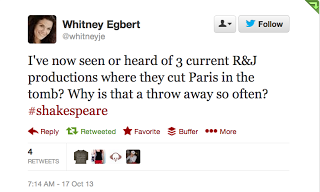
On Twitter we’re discussing an apparent trend toward cutting out the Romeo/Paris confrontation at Juliet’s tomb.

@WhitneyJE got us started earlier today, and it’s been going from there:

What do you think?  Check out the link to see the whole conversation as of this posting.  Is it just an easy place to cut an unnecessary scene?  Does it break the momentum of Romeo getting to Juliet?  Do we not care enough about Paris at that point?

While I agree that the audience doesn’t have much opportunity to feel for Paris one way or the other, I don’t think that makes him a bad guy who needs to die. He’s an innocent in this. From his point of view, he’s doing everything right. His betrothed died, he’s gone to the tomb, he thinks Romeo is going to do something bad, he tries to do the right thing and pays for it.  Is it necessary?  Maybe not.  But it’s still a good scene.

I think it adds to Romeo’s character, though.  Just like we have to stop and consider that Hamlet sent Rosencrantz and Guildenstern (again, two relative innocents) to their death, Romeo plows right through this guy who gets in his way.  It’s not as if Romeo has time to say, “Aha, Paris! You’re the one who caused this whole problem, and I shall take my revenge!”  I’m pretty sure that Romeo doesn’t even recognize him until after he’s dead.  This is one of the reasons I like this scene in the Luhrman version of the movie, because DiCaprio’s “Tempt not a desperate man!” scream really does make me feel like he’s a guy that knows exactly what he’s doing, he just isn’t going to let anything stop him.

What do you think?  I won’t ask “Keep it or cut it” because who voluntarily cuts Shakespeare?  Instead I’ll ask, “When you go to a production and discover that it’s been cut, how upset are you?”

Guest Review : ROMEO & JULIET, Adapted by Julian Fellowes, Directed By Carlo Carlei

John Ott is a writer, filmmaker and founder of the website Making the Movie. You should follow him on Twitter here, Google+ here or Facebook here.

Thanks to Duane for letting me nerd out a bit more on the Shakespeare side than I would for my usual film reviews on Making the Movie.

Every generation has its cinematic Romeo and Juliet. There are some still alive who, in 1936, saw 34-year-old Norma Shearer’s Juliet embrace 43-year-old Leslie Howard’s Romeo on the big screen. It was the 1968 version, directed by Italian impresario Franco Zeffirelli, that I watched in Junior High, on one of those rolly-cart televisions, when I first studied the play. Then my generation’s entry came: the Baz Luhrmann-directed Romeo + Juliet (1996), the old text slung at great velocity into the modern, operatic setting of “Verona Beach.”


Now, for better or for worse, we have this generation’s entry: Romeo & Juliet directed by another Italian, Carlo Carlei (Daredevil, I Am Legend) and adapted by Julian Fellowes (Gosford Park, Downton Abbey). If you don’t want to read spoilers — and by spoilers, I mean how it was adapted, not the story, which I will assume you know — then let me just state my opinion of the film broadly. I feel bad for this generation.


Now, the details — or shall I say, little atomies? Three lines into the film, a Shakespeare fan will notice that Fellowes and his collaborators have made a bold choice: to completely change some dialogue. I’m not talking about traditional dramaturgy, where scenes are omitted or lines moved between characters or archaic words and phrases modernized — though this film does all that too. I’m talking about re-writing Shakespeare.


I know, some of you traditionalists are probably spitting bile right now. But the kicker is, according to the press notes for the film, Fellowes and producer Ileen Maisel “wanted to give the modern audience a traditional, romantic version of the story.” (Setting aside the idea there is a version of Romeo and Juliet that is somehow not romantic…) The key word is “traditional” — and there’s the rub. While perhaps most would agree that an Italian setting and medieval costumes are acceptably traditional, only during the Restoration was it traditional to re-write the Bard. (And how did that work out for them? Quick show of hands. How many of you have seen The Enchanted Isle? How many The Tempest?)


But stay, there is a secondary goal the filmmakers had. Fellowes continues: “we also wanted to make it accessible and new.” So that’s why the text is changed, a determination “not to exclude” the “young audience”. Let us examine how they did.


How much of the text is changed? On a recent radio program, he estimated that only 20% of the text has changed, which — not having the play memorized myself — sounds about right.  But what a 20%. And most of the changes are on the order of simplifying elaborate metaphors… you know, the poetry.


Fellowes is a clever writer, and his alterations are in the spirit of the original play. Most of them will pass unnoticed by those who haven’t studied the text. A few of them are conspicuously out of tune, as when Romeo tells the Friar “intentions pave the road to Hell” or Juliet “if your heart like mine is full then tell the joy that ‘waits us this night.” The super-famous lines are left intact, near as I could gather, with all the ‘thees’ and ‘thous’ and ‘wherefores’. I was baffled, frankly, by what didn’t change. Surely it offends modern sensibilities to have Juliet compared to the jewel that hangs on an Ethiope’s ear.  And why reproduce the extended, culturally outmoded wordplay about palmers and pilgrims but change “utters” to “issues” in the Apothecary’s line Such mortal drugs I have; but Mantua’s law / Is death to any he that utters them.?


In other words, Fellowes and his collaborators are like the second suitor in Merchant of Venice who chooses silver over gold. In compromising, they bungle both goals of being traditional and accessible. (For those keeping score at home, the Lead Casket option — jettisoning Shakespeare’s text altogether — was the correct answer. See West Side Story — or, more recently, Warm Bodies.)


As any Shakespeare-lover can tell you, accessibility is the job of the actors and the director. In the recent BBC/PBS version of Richard II (Part I of The Hollow Crown) actor Ben Whishaw and director Rupert Goold brilliantly brought forward the messiah complex of the title character through performance, camera angles, costumes and set decoration. You could watch the film with the sound off and understand it perfectly. (But you never would because dang, that Shakespeare guy could write!)


So how did Carlei, his crew, and his actors fare? They did okay. Douglas Booth (“Romeo”) is actually a decent actor, much better than you expect from a guy who looks like a male model. I liked him more than the Oscar-nominated Hailee Steinfeld (“Juliet”), who strikes me much the same way Clare Danes did: a bit gawky and uncomfortable with the language. (Sorry, but Olivia Hussey is still the only Juliet on film I believe Romeo would fall for instantly.) The chemistry between them was never allowed to build much erotic charge, since they were blocked to speak to each other and kiss almost immediately in every scene they shared together.


Of the supporting players, I would single out Damian Lewis (“Lord Capulet”), Natascha McElhone (“Lady Capulet”) and Kodi Smit-Mcphee (“Benvolio”) as particularly good. Some of the bigger names, like Paul Giamatti (“Friar Laurence”) and Stellan Skarsgard (“Prince Escalus”) I could take or leave. Lesley Manville does what she can with a “Nurse” who has most of her funny lines cut.


As far as Carlei & company’s handling of the visuals, I liked the handsome, detailed art direction of the film, but found the lighting over-wrought. It looks like a perfume commercial, or the cover of a bodice-ripper come to life. (This may be no accident, since the film was funded in part by the Swarovski family’s entertainment arm, they of the crystal curtain at the Academy Awards.) It wouldn’t have been so bad, but the score, by Abel Korzeniowski, insists on underlining every kiss with a swell of syrupy violins.


If you had any doubt that this was a movie to appeal to young women over young men, you need only look at the short and perfunctory sword fights, which display little in the way of imaginative choreography or visceral thrills. The love scenes are innocent and chaste, without a whiff of adolescent hormones.


The movie chooses one “tradition” that may irk purists, popularized, according to my research, by David Garrick’s 19th Century version of the play. In this version, Juliet awakens after Romeo has ingested the poison but before he has died. Thus the lovers are allowed to share a final moment before they shuffle off their mortal coils. This might’ve even seemed like an innovation — if we hadn’t just seen it in the Baz Luhrmann/Craig Pearce version.


Of all the adjustments, I was not a fan of how the film removed Shakespeare’s ironies surrounding Friar John’s inability to deliver Friar Laurence’s letter and instead replaced it with a bit of PR for the church.  I can only guess the filmmakers felt a mention of the plague didn’t fit in their glossy, romantic world.


But, at the end of the day, this story — which was itself adapted by Shakespeare from a centuries-old tradition — can withstand much more than a few well-intentioned-but-misguided filmmakers have thrown at it (Cf. Gnomeo & Juliet which does the story with garden gnomes, Elton John songs and a happy ending). Even in my cynical Los Angeles press screening, there were a few tears at the end. (Not mine, I only cry tears that are earned. And also at most Nic Cage performances.)


I try to judge filmmakers by their own goals. In my opinion, this film’s approach does not find the right balance of “traditional” and “accessible” — but do you, fellow Shakespeare geeks, disagree? Or are those goals simply mutually exclusive? And what would a faithful version consist of? Most film versions of the story, including Zeffirelli’s, have only used one third of the lines Shakespeare wrote. Will we ever see a film version that, like Branagh’s Hamlet, seeks to do justice to a complete text? I am eagerly awaiting the next generation’s answers.

Why I Love My Shakespeare Life

This post brought to you by three or four glasses of cabernet sauvignon, so put it in its appropriate context.

We had company this evening, one of the dads came over to watch the baseball game while his daughter (and mine) were off at their first middle school dance, and the moms were off at some other mom’s house.  So eventually the guests depart, the game is over, and we’re left to clean up.

I realize that the television has stopped showing baseball and is now showing some old dude with a bushy beard talking to some other guys in poofy clothes. I run to the kitchen and grab my wife by the face while she is mopping.  “Henry IV Part 2!” I squeal at her.  “Do you have any idea how happy Shakespeare makes me?!”

“Who is that?” asks my 7yr old son.

“That is Prince Hal who at the end of the movie is King Henry,” I tell him.  “It is a very sad scene, one of the saddest scenes in all of Shakespeare, and it is awesome. It is one of my favorites.”

“Why is it sad?” he asks.

“Well,” I tell him, “Pretend that I am the king. That would make you the prince, right?  That means that one day you’re going to be the king.  Well, until then, you are just out hanging around with your friends, partying, doing crazy stuff, you know, like friends do.  And then one day you find out that the king, that’s me, has died, and that means that you’re the king now. And your best friend is all, ‘Oh, cool, you’re the king, we are going to do awesome stuff together!’ and you turn to him and you say, “We’re not friends anymore.”

“Why can’t I be friends with my friend anymore?” he asks.

“Because you’re the king now, and the king has very important responsibilities, and he’s not allowed to hang out with regular people and do crazy wild things like he’s been doing.  It’s very sad, and his friend knows it’s sad, and the king knows it’s sad, but they both know that it has to be that way.”

With that I race to the remote control and start bringing up my copy of Chimes at Midnight.

At this point my son begins to cry.  “I don’t want to see it if it’s sad!” he wails.  Despite my overwhelming desire to jump right to that scene, I resist and go help my wife clean the kitchen.  “I’ve shown you that scene, right?” I ask her.  I then begin reciting the scene.  “My jove, my king!  Speak to me, my heart!   I know thee not, old man…..so, so sad.  And so amazing.  Have I shown you that scene yet? You know I’m going to.”

My son is apparently now on a Shakespeare kick.  “I want to see where somebody says To be or not to be,” he tells me.  Being a Shakespeare Geek I happen to have Richard Burton’s Hamlet ripped and ready to go, and move to start it.  But then I realize that he’s already vetoed the sad stuff, and it’s not like Hamlet is a laugh riot.  So I ask him whether he wants to see To be or not to be, or if he wants to see one of the funny ones. He tells me he wants to see one of the funny ones.

Can do!  I fire up Elizabeth Taylor and Richard Burton in Taming of the Shrew. Here’s how I explain it to my boy.  “There’s this girl, Katherine, and she hates boys. She’s sworn that she’s never going to marry a boy because all boys stink. Well along comes this boy Petruchio, and he says I’m going to marry Katherine! And then they get into a whole big fight and she chucks things at his head, and it’s really funny.”

So there we sit, my son and I, watching Taming of the Shrew.  I fast forward to the famous “wooing” scene, and I do play by play as it approaches.  “Ok, see in there? That’s Katherine, and she hates to be called Kate. She’s pitching a tantrum and breaking all of her stuff.  Petruchio is outside, and he knows he has to go in there and woo her, and he’s building up his courage, telling himself that no matter how much she yells, he’s just going to tell her that her voice sounds like an angel singing…”

And we go through the entire scene, my son asking questions and me doing my best to keep him interested.  “What is that pile of stuff she fell in?” That’s feathers, in the old days you had to make your own pillows.  She thinks she got away from him, but he’s not done chasing her yet. See? Here he comes again…

“She’s holding an apple, is she going to throw an apple at him?” Probably, yes.  Sure enough Richard Burton pops his head up through the trap door and she hurls a macintosh at him.

At one point I realize that my wife has gone up to get into her pajamas and is now just hanging around waiting for our eldest to get home from the dance.  “I’m watching Taming of the Shrew with my son!” I tell her. “And he is paying attention! I am so very, very happy! And hey this isn’t even like it’s just Shakespare, this is Liz Taylor and Richard Burton, this is a classic love story we’re talking about here!”

Meanwhile I get random questions, like “So if I was king, would I still be able to be best friends with David?”  “Absolutely,” I tell him, “The rules were different back then.  Hal’s friend Falstaff was kind of a bad guy.”

“Kind of?”

“Well…how can I explain it? Not like a bad bad guy, he was…..hmmm…”

“Medium.”

“Yeah, medium.  He was hanging out with guys that were medium.  And when you’re a  king you can’t hang out with those kind of people anymore.”

Eventually Petruchio catches Katherine, and I end that particular movie.  I ask if my son still wants to see to be or not to be, he tells me yes.  “Ok,” I tell him, “This is going to be cool. Because the man that was just playing Katherine’s boyfriend, who was chasing her all over the place?  Well, now he’s Hamlet.”

Just picture this, for a moment.  My 7yr old son is curled up under a blanket on the couch waiting for the To be or not to be scene.  I am standing in front of the television with a remote control in one hand and my phone in the other, where I have brought up the text of Hamlet and am now working back and forth to determine whether I’ve fast forwarded too far.  At last I hit the right moment, and pause it.  “Ok here we go!” I tell him.  “See that guy? That’s Claudius, the bad guy king.”

“Why is he a bad guy king?”

“Because he stole the throne from Hamlet.  And that guy there?  That’s Polonius. He works for the king, so he’s a bad guy too.  That girl? That’s Hamlet’s girlfriend.  Polonius has told her that she has to go to Hamlet and say that she doesn’t love him.”

“Why can’t she just say no?”

“Because that guy is her father. And when you were a girl back in Shakespeare’s time, when your father told you to do something, you had to do it, even if he was a bad guy and you didn’t want to.”

And with that, I was watching Richard Burton perform Hamlet while sitting on the couch with my son.  It was….bliss.

I explain to my son, “Now see you have to wait for the end, because this is a very important scene.  Ophelia, Hamlet’s girlfriend, is going to come up to Hamlet and give him back his presents and tell him that she doesn’t love him.”

“Why?”

“Well because her father told her she has to. Also, because she thinks he’s a little crazy, like everyone else does. Hamlet doesn’t know that, though. Hamlet thinks that she’s the only person left who understands that he’s only pretending.”

“Why is he pretending to be crazy?”

“So he can spy on the bad king. He thinks that the bad guy king cheated to win the throne, and Hamlet wants to win it back, so to do that he has to get close to the bad king to learn more about whether he is guilty, and he thinks that the way to do that is to pretend to be crazy so nobody will pay attention to him. Now,shhhh, here comes Ophelia…”

Funny thing? I don’t like the way they do this scene.  I race to my iPad and begin googling.

At this point, by the way, my daughter has arrived home and she is now off to bed, along with my wife. They are both calling down that my son needs to go to bed. I call back that he’ll be up in a minute.

I then bring up Kenneth Branagh’s rendition of this scene.  “Watch this,” I tell my son, “It is the same scene, only different people doing it.  When Ophelia gives the presents back I want you to watch Hamlet’s face.”  *play*  “Wait…..wait……..see? SEE? Right here, SEE?  He’s so happy to see her, he knows that she’s the only one that believes him…and then he realizes that she thinks he’s crazy too, and at first he is so sad, you can see how he’s almost going to cry…and now look how mad he gets….”

I then go on to show him the Derek Jacobi and Kevin Kline versions of the same scene, before deciding that he only wanted to hear To be or not to be, and having now heard it, all he wants to do is go to bed.

I finally shut it all down, and tell him how very happy it makes me to be able to watch Shakespeare with him. He tells me that he only wanted to hear somebody say to be or not to be and, having heard that, he’s fine with going to bed.

And that’s precisely what he did. Me? I ran to my laptop to blog this whole evening, because it’s been one to remember.