Review: Hamnet (Movie)

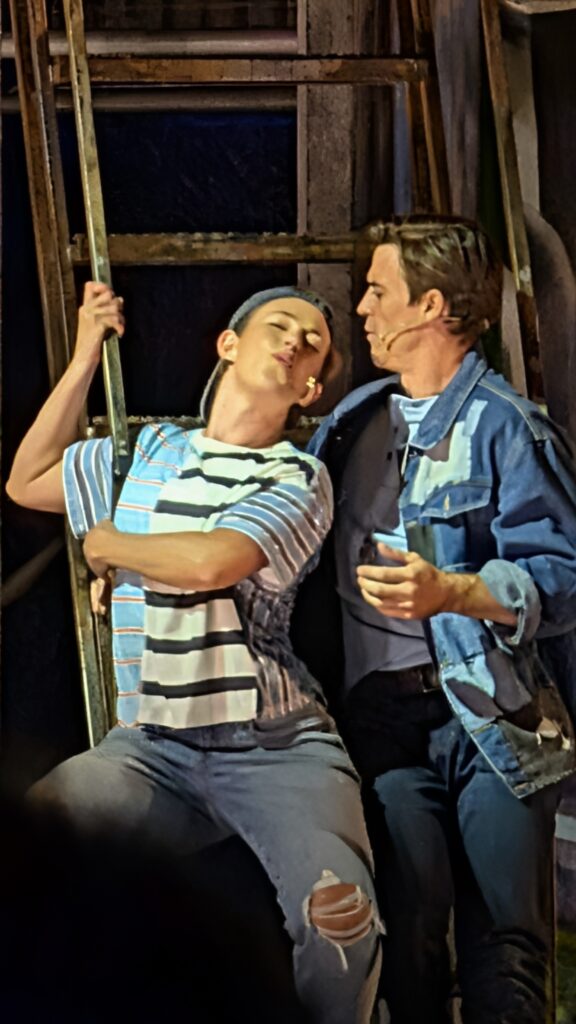
It’s the end of the calendar year, the time when all the most artsy award contender movies all flood the theatres to get it under the deadline. This year, we have to pay more attention than usual, though, because Shakespeare is in the mix. The movie version of Hamnet, by Maggie O’Farrell, is in theatres now. I made sure to read the book before I saw it – review here.

Starring Academy Award Nominees Jesse Buckley and Paul Mescal, and directed by Academy Award Winner ChloƩ Zhao, this one is absolutely showing up on every list.

But Did I Like It?

Somebody called it Shakespeare In Love 2: Shakespeare Is Sad and I wish I’d thought of that.

This might be the first time I’ve ever said this, but I’m annoyed by how much Shakespeare content is in this. The more you know about Shakespeare, the less you’re going to like this movie.

Let’s back up. This is going to contain spoilers if you don’t already know Shakespeare’s biography, but I’m assuming that most readers of this blog already know the story.

The book did something fascinating that at first annoyed me, but I came to love. Shakespeare’s name isn’t ever mentioned in the book (I think maybe once). He’s barely in it. The book is told from Agnes/Anne’s perspective – a woman forced into a marriage by pregnancy, left in Stratford while her husband runs off to London to build a better life for himself (and, in theory at least, them). All while the plague is all around them, Life is not easy for Agnes, especially once tragedy strikes the family. The book does a spectacular job of telling the story of this wife and mother who just happens to be “Mrs Shakespeare.” The famous guy is secondary to the story.

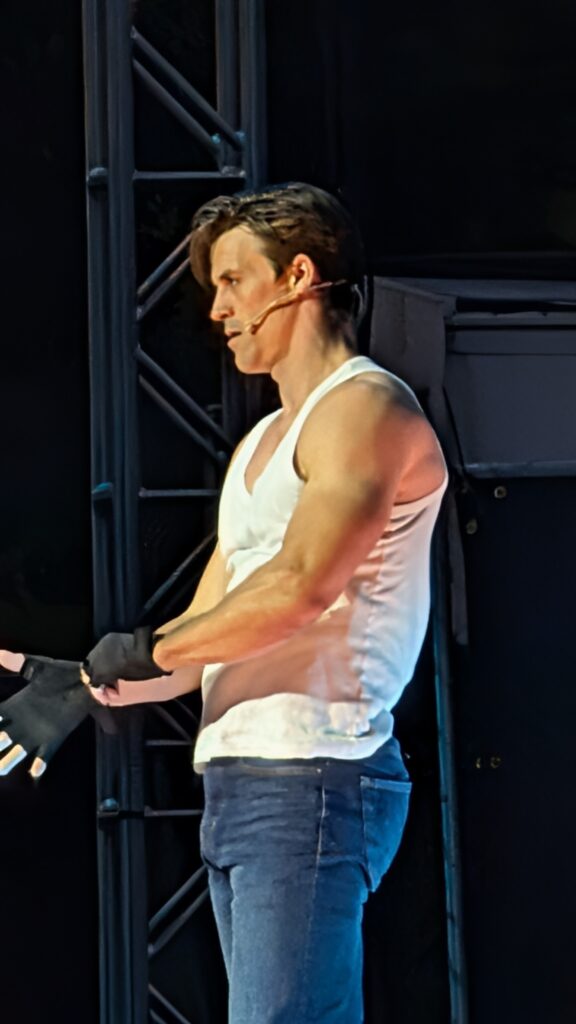
Well, somebody in Hollywood missed the memo, because all the marketing material says is Shakespeare Shakespeare Shakespeare. Look how pretty Paul Mescal is! Make sure to point the camera directly at his face as many times as you can, and just leave it there. Let them get lost in his eyes.

I’m not even being facetious. You know how some writer / directors are famous for the “walk and talk” style? We’ll call what Zhao does something more like “stare a lot and sometimes talk.” There are many scenes of Buckley and Mescal just staring at each other. There’s also no music to speak of in these scenes, just dragging awkwardness.

The movie also has no faith in telling Agnes’ story, so they inject lots of extra scenes of Shakespeare in London. It was important in the book not to have that, because Agnes didn’t get that luxury. Her husband’s absence was a mystery, and a real point of tension in their relationship. The audience should sympathize with her, especially after their child dies and her husband says, “Well, back to London I go.” Showing Shakespeare’s own grief and pain is completely unnecessary, in my opinion, and weakens the movie.

Let me pause for a second and say nice things before getting to the parts I really hate. This is a beautiful movie. The effort that went into the scenery and costumes is outstanding. If this movie’s getting any awards, it should be in those areas.

Jesse Buckley is, to put it simply, her generation’s Meryl Streep. She’s brilliant in every scene, and the movie would be better by having more of her in it. She’s called upon to act out both her child’s birth and death in a single movie. If that’s not range, I don’t know what is. We’ve often referred to Constance’ famous speech from King John about grief (“Grief fills the room up of my absent child, Lies in his bed, walks up and down with me, Puts on his pretty looks, repeats his words..”) and Buckley is the embodiment of that speech. Her fury at her husband stealing their child’s name to use in his little play, storming to London to confront him, literally screaming at the actors mid-performance that it is not theirs, they can’t have it? Amazing. I won’t spoil everything but I will say that even after that moment it gets even better. (Before unfortunately getting worse.)

Let’s talk about the direction. My wife came out of the theatre asking, “I don’t understand why it kept showing the table.” It took me a second to realize what she meant, but she’s right. The camera spends much of our two hour runtime on the scenery, even when the main characters are having a conversation. Agnes and Will are talking, but are they on screen? Nope, let’s look at the table. Or a leaf on a tree outside the window. Or various big black holes, like the gap in the tree roots, or the exit from the stage. I’m sure there’s some deep reason for this choice, but I much prefer a more grounded approach. When people are talking I want to see their faces.

What About The Shakespeare?

As I mentioned, there’s almost no Shakespeare content in the book, except right at the end. I wish they’d kept it that way, the ending would have been more powerful. Instead, some producer somewhere no doubt read the script and said, “Where’s the balcony scene? People love the balcony scene, add the balcony scene.” So yes, spoiler alert, we get a shot of Shakespeare – back when Susannah was just a baby – working upstairs on “But soft what light through yonder window breaks,” tapping out the iambic pentameter as he recites it. Bleh. I think that scene might have already been in Shakespeare In Love but that is not why that one got its Oscar. Never mind that this was probably 10 years before the play was written. The man was just that good, I guess? A regular Earl of Oxford.

But wait, there’s more! Of course, Shakespeare shared his work with the family, being the good, present, and attentive father that he was (at least, in this story). He choreographs stage combat with Hamnet. The children put on a play for their mother. What do they recite? When shall we three meet again, in thunder, lightning, or in rain? Sure, why not? Who cares that Hamnet died in 1596 and Macbeth wasn’t written for another 10 years?

Can it get worse? Oh, gentle reader, brace yourself. You do know for certain that “To be or not to be” is Hamlet contemplating suicide, right? We know, because in this movie, in his grief, we literally get a shot of Shakespeare debating whether to throw himself into the river while reciting that soliloquy. That’s got to be the worst decision they made. The movie’s already being called “grief porn.” They already injected a bunch of scenes of how Shakespeare dealt with the death of his son, because they didn’t have enough faith in the child’s. mother’s grief. Instead they have to take a scene like that and say, “You know what would be great here? What if he recites To be or not to be?” And all the other writers in the room say “Brilliant!” when in reality it ruins the movie.

See It or Not?

People always ask me, “Would you recommend it?” about movies and I never know what to say. My opinion is my opinion, and yours may vary. As noted, it’s a visually stunning movie, and Jesse Buckley alone deserves to be seen. I’d like to say the same about Paul Mescal but really, I so resent the extra footage of him that they jammed in there, I can only really see him as a pretty face they kept shoving in there because they didn’t have enough faith in Buckley’s, which is a true shame. This movie could have stayed far closer to the book, removed all the extra Shakespeare, focused entirely on Agnes, and been an even stronger Oscar contender, if you ask me.

Twelfth Night On PBS (Leaving Soon!)

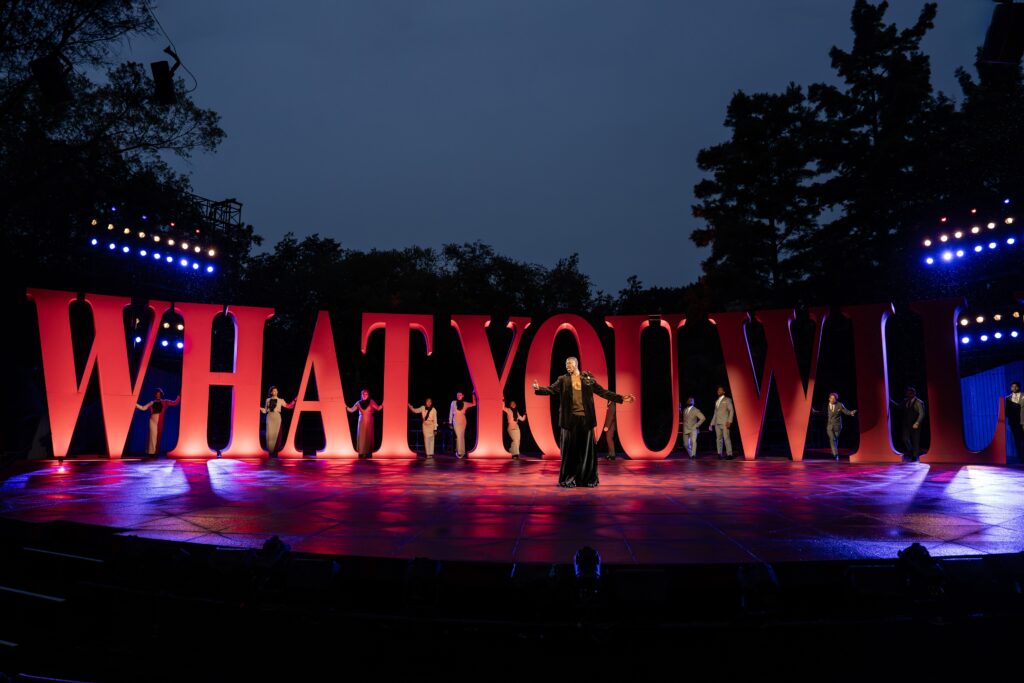
Every year it’s the same, for those of us not living in New York. The play and cast are set for Public Theatre’s summer Shakespeare In The Park performances, and we gasp at the star power, knowing that we’ll never get to see it. Even if you’re in walking distance, apparently you’ve still got to wait in line for hours for “first come first served” tickets.

Not so fast! This year it was recorded, and now showing on PBS Great Performances! Sadly, it’s leaving on Dec 31, 2025, so you’ll have to be fast! Luckily I got to catch it.

Twelfth Night, or, What You Will

This year we got Twelfth Night, starring: Peter Dinklage (Malvolio), Sandra Oh (Olivia, Jesse Tyler Ferguson (Andrew Aguecheek), Khris Davis (Orsino), and, in an inspired bit of casting, Lupita Nyong’o and her real-life brother Junior Nyong’o as Viola and Sebastian,

Thoughts

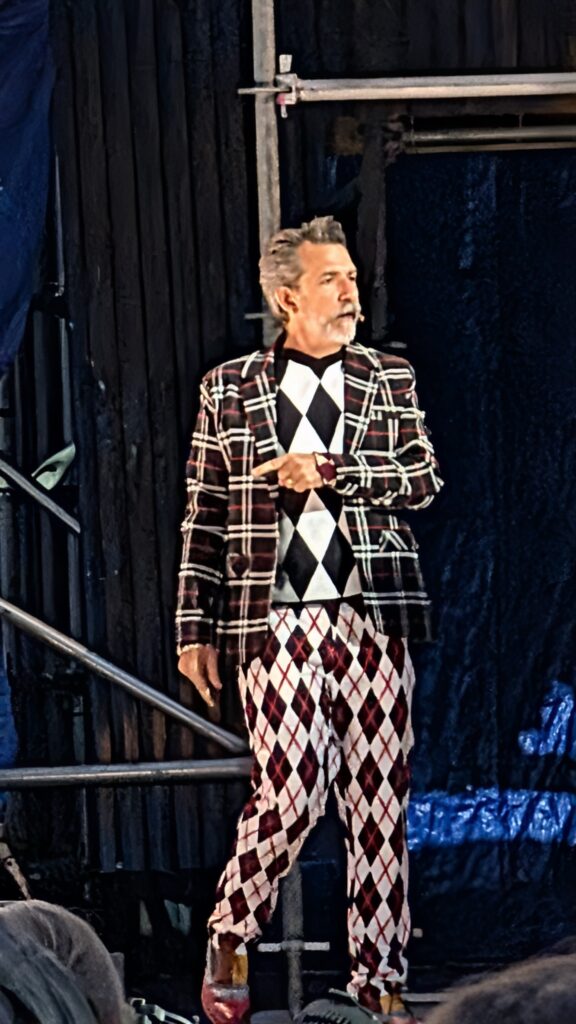
Jesse Tyler Ferguson as Andrew Aguecheek
Jesse Tyler Ferguson was unfortunately little to work with as Andrew Aguecheek.

It took me a little while to realize, in the opening scene, that Viola keeps dropping in to Swahili. This had to be confusing for the audience who’d already be struggling to hear the words, only to have them randomly becoming incomprehensible. It’s not a new idea, plenty of tv shows have characters switching back and forth between English and Spanish, or other appropriate language for the context. I get it? As someone who only speaks English I don’t like it, for obvious reasons – but I understand that someone who is bilingual, maybe somebody for whom English is not their native or primary langauge, might actually appreciate this. I still stand by my argument though that it makes Shakespeare just that much harder to understand.

I really liked the way Orsino dealt with “the boys”, his entourage of followers who laugh at his jokes, agree with his pronouncements, and drop to do pushups when he’s displeased. I don’t usually think of Orsino with a posse, but it works here and nicely offsets Olivia’s crew who do this fun little switcheroo number when Cesario first shows up to deliver his message, all “masked” in sunglasses and taking their turn as the lady of the house. Lots of movement on stage, lots of laughs for the audience.

If I had to pick the “big name” from this year’s cast it would be Peter Dinklage. I hate to say things like “he’s easily recognizable in everything he does” but I think that Game of Thrones had a lot to do with that. So when I heard he’d be playing Malvolio, that’s what I looked forward to.

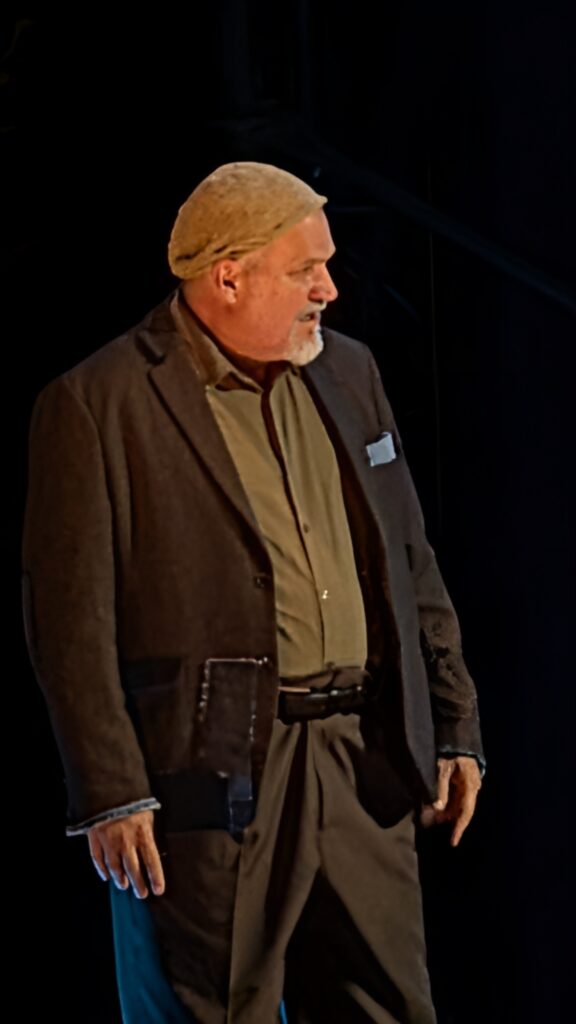
Peter Dinklage as Malvolio
Peter Dinklage kept doing that thing with his hands that Mike Johnson does, I have to assume it was on purpose.

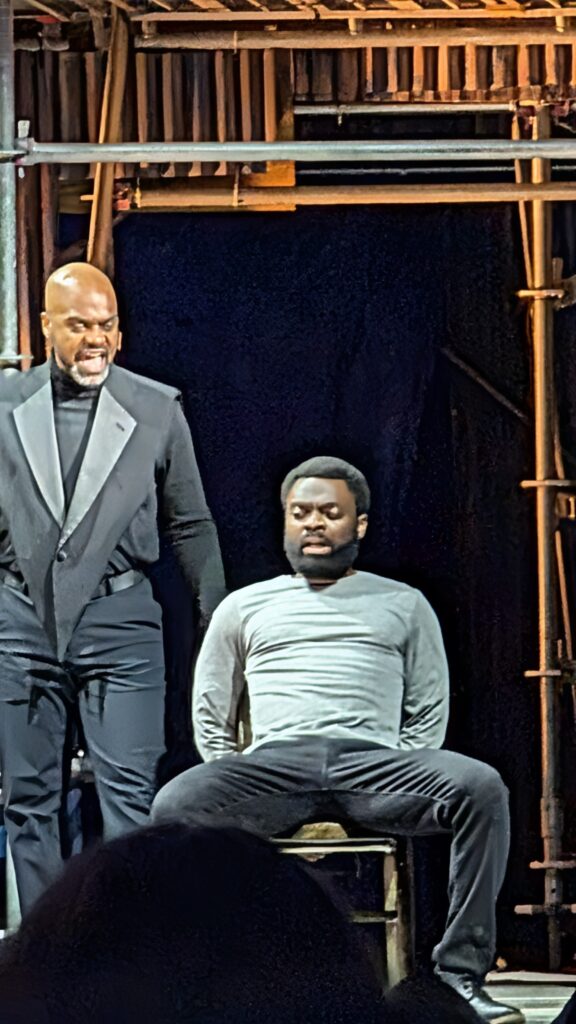
And I have to say, I didn’t love his portrayal. They’ve got him doing the weird “I don’t move my arms when I walk” thing that seems to accentuate his short stature, like they’re playing up some “little people walk funny” clichĆØ. He’s got a silly haircut and he’s doing a silly voice, too. So yes, every time he’s on stage, there’s a good audience reaction for everything he does. But is that acting? He gets the laugh just by showing up, or changing how he stands, without ever saying anything.

Here’s the thing about casting Junior to play Viola’s brother – he’s actually Viola’s brother. That’s an opportunity I’m sure many directors would kill for. They look alike. Viola, as Cesario, spends most of the play dressed up in a man’s suit, which only adds to the charade. Shakespeare did love to play with twins, but I’m sure we’ve all been to many productions over the years where little more than a hat or scarf is all we get to say “Oh, ok, these two are supposed to be indistinguishable” and then go with it. For once, this time, we actually believe that they could easily be confused for one another. Except for the height – Junior’s significantly taller :). But you can’t have everything!

And then … and I love this … Junior speaks Swahili. Now the opening scene makes sense! Of course opening that way was confusing, here she is a little stranger in a strange land, speaking a language only she knows. She’s lost and confused; she has no one. That sets up Viola’s story beautifully.I don’t remember if she slips into Swahili randomly at other times in the play, but it would be great if she did. English is part of her cover story and it’s hard to keep up with it all the time. So, the reunion when her brother arrives, and they can both return to speaking their mother tongue? That’s great stuff, and I’m glad I saw it through to the end.

See It Before It Leaves

It’s Shakespeare, it’s free, it’s got celebrities you know. How can you not see it? Catch it before December 31, 2025! I hope they make this the new standard and we get to see the show this way every year.

Review: Commonwealth Shakespeare’s As You Like It 2025 (Part 2)

Ok, I had to get all those stories out of the way, sorry about that. For me, those were the highlight of the night.

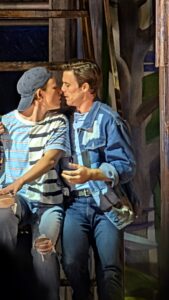
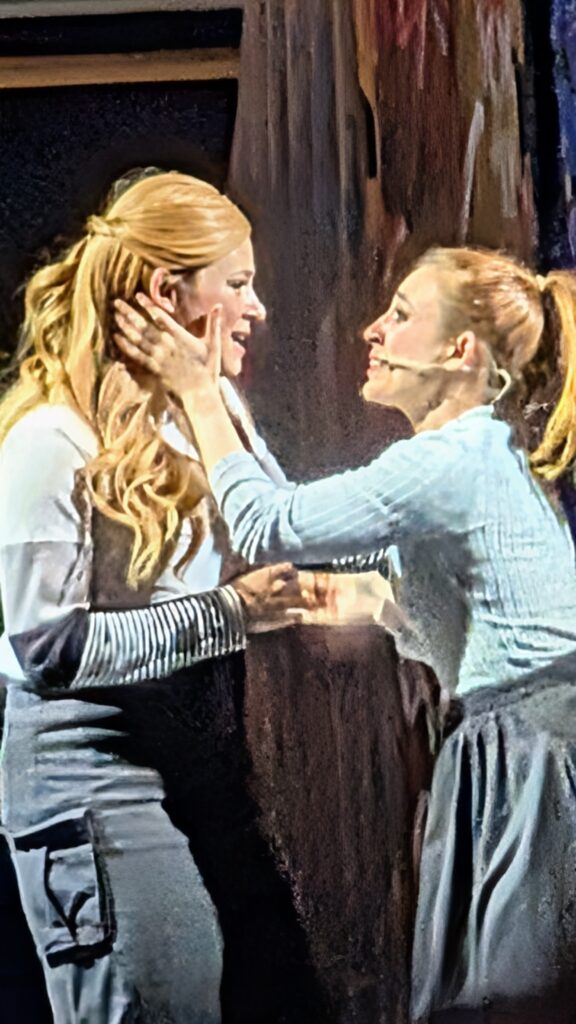
Ganymede and Orlando

How was the play? It was good. Fine. I’m not a big fan of this one because there’s not really a lot to work with. The plot is thin, the characters for the most part are so shallow a casual audience-member will easily lose track of which one is which. And the ending is just nuts.

It dawned on me this year that AYLI is basically a teen sitcom storyline. It’s all “OMG he likes me what do I do what do I say?!!” with lots of giddy screaming and running around. It’s definitely funny at parts, a real crowd pleaser when it’s being over the top obvious and not lost in the wordplay. But there’s nothing to sink your teeth into and discuss.

Or is there?

I don’t know if I just never noticed it, or this production really played up the angle, but it seemed this year that Ganymede leaned really heavily on the “How can you not see that I’m Rosalind?” moments. He says, talk to me like you’d talk to Rosalind Just go ahead and call me Rosalind. There’s even an awkward scene with a kiss. Orlando’s confused about a lot of feelings, to put it mildly.

Which got me thinking, Maybe this is obvious to the younger crowd maybe I’m just an old man trying to understand. But …let’s start the play in the forest. Orlando meets a new friend, Ganymede. Ganymede certainly looks and talks and presents himself like a fellow boy. But Ganymede’s also obviously much more comfortable talking about girl things. He wants to tell Orlando what girls want. He wants Orlando to talk to him like a girl. And then, just like that, one day Ganymede is gone and Rosalind is in their place.

We the audience know that it’s Rosalind disguised as Ganymede. But, and I’m sure I’m going to get my terminology wrong here, what if Ganymede was in fact a character that on the outside was presenting themselves to the world like a male, but inside, identified as female? Until one day they are?

Orlando, for his part, doesn’t seem to have a problem with his attraction for this character, either. I don’t think Orlando cares who Ganymede identifies as. Is that what they mean by “pan”?

I don’t really know where I’m going with this. Like I said, I’m just an old dad trying to understand a lot of new things. Tell me that AYLI isn’t just about “gender bending” and “cross dressing,” tell me it’s about gender identity, and suddenly I’m paying attention. Then it’s something more than just a farce to laugh at. Then it’s got a point to make the audience think about.

How about I get off my soapbox now and share some pictures?

Review: Commonwealth Shakespeare’s As You Like It 2025 (Part 1)

Here we go again! As I’ve gotten older I’ve started telling myself, “It’s ok if I miss Shakespeare on Boston Common this year.” The kids have gotten older, schedules are busy. And, perhaps most importantly, they’re doing As You Like It which they did back in 2008, which I saw, and reviewed.

But then I tell myself, “This is my night. This over all other days is my chance to bask in my Shakespeare world and go surround myself with all things Shakespeare.”

Commonwealth Shakespeare As You Like It
A little taste of Arden Forst while I get the interesting stories out of the way.

So I did what I also do every year. I dressed up in merch – this time donning my “Shakespeare Makes Life Better” long-sleeve – and filled up my little goodies sack with an assortment of stickers, magnets, and 3D Shakespeares, and we were off. We had a special guest this year, as my daughter’s got a new friend who is both obsessed with Shakespeare and has never been to a free Shakespeare in the park show. So she’s all in.

We stop for gas before heading into Boston, pulling in behind a big (big) pickup truck. That happens to have its backup lights on. So as I get out, not wanting him to roll into me accidentally or something, I say, “Hey did you know that your…” and then they go off. “Never mind, I say.” The driver of the big (big) pickup is a big fellow in his own right. He’s not giving “biker,” but he’s definitely the size and shape of somebody who you wouldn’t want to mess with at the bar.

So he’s pumping his gas, I’m pumping mine, and I can see out of the corner of my eye that he hasn’t stopped looking at me. Have I offended him in some way by mentioning his lights? Does he think I’m stupid because I didn’t know they’d go off? I avoid his gaze for as long as I can.

“Are you an English teacher?” he asks.

I get it immediately. “No,” I say, “Just a fan.” He looks confused. “I assume you’re referring to my shirt?” I ask.

“Yeah,” he says.

“We’re big Shakespeare fans. We’re actually going in to Boston tonight to see Shakespeare in the Park.”

“Oh,” he says. “What play?”

“As You Like It,” I tell him.

“That’s a good one!” he says, looking … wistful? I wonder what he was thinking.

So, that’s one Shakespeare encounter I did not expect. You never know who you’re going to connect with around Shakespeare.

We get to the park, and the normal routine begins, which basically amounts to keeping busy for almost 2 hours waiting for the show to begin. I take the easy way out of my mission, handing my bag of Shakespeare goodies to the kids and saying, “Your mission is to find people to give stuff to.” And off they go. Once they’re gone I of course think, “I should have kept some for myself, I hope they don’t give everything away.” But they don’t, they’re back soon enough to let me know that they gave out some stickers.

The night progresses, the crowd grows There are volunteers walking around who have programs to give out, as well as stickers of their own. The longer I wait, a plan forms in my head. I’ll give something to a volunteer. I’ll tell them, “How often does somebody give you something?” I have two 3d printed Shakespeares left. One is bigger than the other. I will wait until one of the volunteers comes by alone because it would be rude to give two different sizes. Yes, I think about these things. Maybe it comes from having kids and having “everybody gets the same” drilled into my brain. Or maybe I’m just thinking of excuses to chicken out like I do every year.

The darker it gets, the less they wander, and I’m missing my opportunity. Finally a young man walks by who we’ve already seen before. He’s given a program and stickers to the young couple next to us. He’d asked me if I needed a program, too, but we already had a couple. I try to get his attention, but he walks past, and I think that’s it, it’s dark, show’s starting, my chance is past.

Until he’s standing next to me. “Did you need something?” he asks.

I brandish a tiny Shakespeare. “For you,” I say.

He’s speechless. “Wait, really?” he says. “Seriously?”

“You’re out here giving everybody free stuff, how often does anybody give you anything?” I ask.

“Never!” he says, “Nobody’s ever given me anything!”

“Well exactly!” I tell him. “Now you can go show off to the other volunteers that you got something.”

And he does, I watch as he goes over to the two nearest volunteers to excitedly show them his prize, gesturing back at me (probably, “Look what the guy in the Shakespeare Makes Life Better shirt just gave me!”) One of them looks over to me, I make eye contact and smile. Had she come over, I would have given her the other Shakespeare. I don’t know what I would have done if both of them had.

It gets better.

I’m enjoying this. I made somebody happy with Shakespeare. Many people have commented on my shirt. It’s a good night, I don’t want it to end (even though the show hasn’t even begun!) The young woman next to us has been friendly and polite, having first asked if she could sit there (not a courtesy that is always shown), and asking me questions about how the show is organized. So I fish one of my magnets out of the bag and reach it over to her. “Would you like a magnet?” I ask. She definitely would. There’s a funny age gap at work here – as somebody of Dad age, I think that giving out stuff like stickers is childish and, no, nobody wants a sticker. But I have yet to meet a 20-something, all my kids now included, who doesn’t say, “Hell yeah I want a sticker.” Or in this case, a magnet.

“You’re bringing so much joy,” she says.

She has no idea how much that meant to me. I’ve tried to build up the courage for years to be the guy who exudes Shakespeare wherever he goes. “Shakespeare makes life better” isn’t just a tagline for a website. I deeply and truly believe it and want to put actions to words. Tonight, finally, I got to do that. I got to bring joy to people, through Shakespeare, and even have it acknowledged. I don’t remember when I’ve been happier.

This is a long post, and I never even talked about the play. I guess that’ll have to be part two!

Review: Sing Sing

"Sing Sing"

I’m going to say something up front because I had it said to me (well, I read it), and it helped me enjoy the movie Sing Sing. This is a true prison story. But there are no riots, no escapes, no makeshift shivs sticking anybody in the back. It’s not that kind of story. That’s not a spoiler, that’s permission to breathe, relax, and appreciate what’s really going on in the movie. You don’t have to watch in fear that something bad is going to happen.

I admit that I dismissed Sing Sing at first as just another take on “Shakespeare Behind Bars,” which I first saw twenty years ago. That was a mistake, I’m happy to say.

Sing Sing is the best movie I’ve seen in a long time. Too often I’ll watch a movie in that half-listening, “put it on in the background” way that we sometimes do when we treat an item like a todo-list box to be checked instead of an experience to be savored. Not this time. I was hooked in the first minutes. I put down the computer and sat on the edge of my couch cushions straight through to the end.

This movie tells the story of Sing Sing prison’s Rehabilitation Through the Arts (RTA) program. It focuses on the story of John “Divine G” Whitfield, a playwright himself and original member of the group, played brilliantly by Colman Domingo. We also learn that he’s incarcerated for a crime he didn’t commit, and on a continuing quest to prove his innocence.

We open with the close of the group’s most recent performance, A Midsummer Night’s Dream, and the addition of new members to the group. Here we meet Clarence “Divine Eye” Maclin, playing himself. One of the fascinating aspects of this movie is that it’s based on a true story and played by many of the actual original players. If, like me, you’re wondering how the two main characters ended up as “divine” something? Well, that’s not the writing, that’s the reality. Those were their names.

Despite Divine G’s insistence that Divine Eye be admitted to the group, there’s some immediate animosity at Eye’s strong new personality. G is thrilled when the other members of the group suggest they perform one of G’s original plays next, only for Eye to sway the group that a comedy is the way to go. But then they both audition for the only dramatic role in the script (an original, created by the group’s director).

This sets up the first of many confrontations between the two. G loves the program and knows what it’s done for the other inmates. Eye comes from a world where if someone so much as walks too close behind you, your life might be in danger. The evolving relationship between the two is the our major story arc.

What About The Shakespeare?

This is a Shakespeare blog, so let’s talk about Shakespeare. This isn’t a Shakespeare movie. They don’t perform Hamlet in the big final act. But somehow, that makes it an even better depiction of why Shakespeare is universal.

We find out that Eye became interested in theatre after stumbling across King Lear as one of the few books accessible to him. Unprompted, he quotes, “WhenĀ weĀ areĀ born,Ā weĀ cryĀ thatĀ weĀ areĀ come ToĀ thisĀ greatĀ stageĀ ofĀ fools” with no fanfare, no “Look at me I’m quoting Shakespeare,” no flourish or fanfare. His interpretation actually made me laugh, saying that “whoever wrote this, man, had to did a bid before.” The idea that Shakespeare can just pop into your life, at any time and place, and you don’t even know what it is, but it still resonates, no matter who you are? Come on now. What have we been trying to say all these years?

Colman Domingo in "Sing Sing"

There is more Shakespeare than that, not to worry. Despite the play being an original time travel comedy featuring time travel, pirates, and zombies, it also features Hamlet. (If that makes you think of Hamlet 2, you’re not alone.) Eye, of course, is playing the role – which affords G the opportunity to direct him. The actual director of the group is not an inmate, so while he can speak to the theatre, he can’t speak to the experience. That’s where G shines. He helps Eye break through from “I walked on stage and said the lines” to “I am the character.” It’s really quite a thing of beauty to behold.

I’ve often said that a key to understanding Shakespeare is realizing that, underneath the words, “there are people in there.” Well, that’s true here, too. These are prisoners, but they are people. There are multiple scenes where they talk about their children, their lives outside the prison, and how they got there. There’s a scene where they all meditate on their “happy place” and talk about it, and an inmate realizes that his happy place is right there, right now. He is happy where he’s found his people.

I could keep on like this, describing the scenes I loved, but I’ll tell the whole movie. There is a story that we want to see resolved. Eye, knowing he’s innocent, struggles to get out – no matter how much value he’s found in the RTA program. G, who slowly but thankfully becomes part of the RTA program, can’t imagine any world other than the one he’s made for himself. Both these characters are changed individuals by the movie’s end credits.

One more scene, and then I’ll wrap up. During an early confrontation, Eye is still throwing around N-words like they’re part of the normal prison vocabulary. “We don’t say that here,” G tells him. “We say beloved.”

I get it, I think, at least as much as a white person can. Both, in their way, are expressions of a bond that exists, a way of saying, “We are the same, we come from the same world, there are things that we share that not everyone shares.” But they can achieve the same purpose and still be completely different ways of doing it.

And at first, you think, “Yeah, sure.” This is the guy still packing a knife in his waistband, ready to cut one of his fellow actors just because the blocking called for him to get a little too close. But you know what’s going to happen, And when it does, it’s … just so natural. The director doesn’t call your attention to it with over-the-top background music. There’s no meaningful pause for the audience to have their “Ohhhhhh, ok!” moment.

That’s why I love this movie. You don’t spend the whole time thinking, “Somebody created this story, somebody wrote a script, somebody directed it and told the actors what to do and where the camera should look.” This isn’t just a real story, many of the original actors perform the story including Divine Eye. If you love something about it, love it more because it really happened. It’s not someone’s wishful thinking. Score one for Shakespeare.

Image from performance in "Sing Sing"
The actual play performed by the inmates is … something.