Reddit’s Favorite Shakespeare

Hello /r/Shakespeare!Anybody that knows me knows that when I see a post titled 1000 Most Mentioned Books on Reddit (or, really, anywhere), the first thing I’m going to do is search it to see where Shakespeare shows up.  Any guesses?
I’d love to say more about who made the list and why and how, but there doesn’t seem much to go on. The post, on Medium, was made by BookAdvice.  Have to look more into that, see what other cool lists they have.  All we know about the methodology is, from the summary, “Sorted based on the number of upvotes and the number of different users linking to them in post and comments.”  I suppose that’s got a certain chronological bias — a book that came out last year couldn’t possibly compete with those that have been around since before Reddit.  But it does say “most mentioned” and not “best” or “most loved” or anything like that, so I suppose it’s accurate to say that a book that has existed for ten years will typically be mentioned more than a book that’s only existed for one.

Much of the list is highly predictable, if you know anything about Reddit.  Lord of the Rings, Game of Thrones, Hitchhikers’ Guide To The Galaxy all rank in the top ten.  I’m pleasantly surprised to see To Kill A Mockingbird in there, and The Count of Monte Cristo (though not so pleasantly Catcher in the Rye.  Really, reddit?)  Thrilled to see J.K. Rowling’s name not appear until well after the 250 mark.  Not that her work is bad, just that I’m tired of seeing such brand new books always top the lists of “all time classics”.

Ok, you want the data?  Drum roll, please. Presented in reverse order, from least to most mentioned, we have …

905. The Taming of the Shrew

754. The Tempest

674. Merchant of Venice

625. King Lear

578. Much Ado About Nothing

568. Othello

371. A Midsummer Night’s Dream (*)

295. Macbeth

237. Romeo and Juliet

and the most mentioned work of William Shakespeare on Reddit is……

144. Hamlet

What do we think, any surprises?  Surely not the great tragedies, I think those became self-fulfilling long long ago.  Is Romeo and Juliet popular because it’s so good, or is it considered so good because it’s popular?  Little surprised about Othello, that one doesn’t usually get much love, and I’m kind of wondering if they took the time to rule out references to the board game.

When I first made this list, searching for the word “Shakespeare”, I was surprised to see A Midsummer Night’s Dream not make the list.  I had to go back and double check.  It’s because they’ve got it listed by, and I’m not kidding, SparkNotes.  I wondered if there were many on the list marked this way, but it turns out that’s the only one.  Glad I checked, I almost missed it!

Anything you think should be on the list that’s not there?  Hey, wait … where’s Twelfth Night?


Review : Eleanor and Park by Rainbow Rowell

What about Romeo and Juliet?
Shallow, confused, then dead.

I honestly thought that Eleanor and Park by Rainbow Rowell as a new release, after seeing it on some random “must read this summer” list.  It had some sort of Romeo and Juliet connection, so I thought, “I’m in.  Maybe it’ll be something my kids will like.”  Turns out it’s published in 2013 so I’m late to the party.

The first line of the book is, “He’d stopped trying to bring her back.”

Interesting!  I immediately wondered whether the book was taking a page from Romeo and Juliet and giving us ye olde “star-crossed lovers take their life” right there in the prologue.  So I was hooked for the rest of the story thinking, “When’s it all gonna go down?”  The boy (Park) is still narrating so I guess he doesn’t die, but then again, no one says that we’re starting at the very end.  This could be the middle.  He could be telling us the equivalent of standing in front of her tomb holding his own poison.

Eleanor and Park does have some Romeo and Juliet in it.  On the surface, it’s just the standard “boy and girl decide they like each other to the backdrop of high school English class,” where of course they’re studying Romeo and Juliet. This gives us a chance to learn about the modern teenager’s interpretation of love at first sight:


‘I just don’t think it’s a tragedy.’ She rolled her eyes again. She knew Mr Stessman’s game by now. ‘But he’s so obviously making fun of them. Romeo and Juliet are just two rich kids who’ve always gotten every little thing they wanted. And now, they think they want each other.’

‘They’re in love …’ Mr Stessman said, clutching his heart.

‘They don’t even know each other,’ she said.

‘It was love at first sight.’

‘It was “Oh my God, he’s so cute” at first sight. If Shakespeare wanted you to believe they were in love, he wouldn’t tell you in almost the very first scene that Romeo was hung up on Rosaline … It’s Shakespeare making fun of love,’ she said.

The rest of the book, of course, is two teenagers from different worlds (he from the nice happy family, she from the broken home with the abusive step father) who fall head over heels in love and can’t bear to live life without each other.

I still can’t figure out if it’s supposed to be a Romeo and Juliet story or I’m just looking for parallels.  It’s got some weird gender flippy things going on, with the weird girl who likes to dress in boys’ clothes and the longer boy who discovers he really likes how he looks in makeup.  I thought that would be cool to run with.  But the girl’s still got violent family members and her boyfriend couldn’t be caught dead at her house, so I guess she’s still playing the Capulet role. She’s welcome at his house, though, which was the motivation for my earlier post “Dinner At The Montagues.”

Without the Shakespeare? I suppose it’s good, but maybe it’s too far removed from my world to fully appreciate.  I get what it’s like to be young and in love, I’m not that old.  The author does a great job of painting that slow, slow crawl from “Oh god I hate you” to “I hope that girl I hate sits next to me again” to “Maybe today I’ll tell her I liked what she said in English class” to “I should ask her about those song lyrics written on her book cover…” until one day you’re deciding whether or not you’re boyfriend and girlfriend and should you tell anybody? Eleanor and Park ride that entire rollercoaster right before our eyes.

I was expecting a Bridge to Terabithia twist through the whole thing. I thought I knew where it was going.  I was mistaken.  I think I would have liked my ending better.


Shakespeare’s Greatest Characters? How would you … why would you …

Spotted first on Facebook via Will Sutton’s “I Love Shakespeare” page, let’s talk about this list of Shakespeare’s 25 Greatest Characters.

What does that even mean?  Most famous? Most beloved?  Like many lists, I think it ends up meaning “author’s favorite” but I’m going to be generous and treat it as, “Characters only Shakespeare could have created.” Mercutio’s a great example.  The Romeo and Juliet story existed before Shakespeare, but one of the reasons why we remember his version is because of character creations like Mercutio (who technically existed in the Brooke original, if I recall, but you know what I mean. Shakespeare gave him life.)
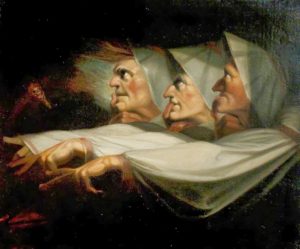
It’s a good list, and it’s probably not what you expect.  Lear is on it … but Hamlet is not.  Falstaff is … but no Portia.  Meanwhile, the list includes Autolycus, Nurse, and Lance.  Each entry comes with its reason for inclusion.

I wonder if we could make a claim to greatest play, then, by looking at which plays provide the most characters for this list? As You Like It, Henry IV and King Lear provide two characters, but Macbeth and Romeo and Juliet each bring three.  (Othello has one, Julius Caesar one.)
 

Not appearing on the list at all?

Hamlet.

Bold move!

Now That’s What I Call Shakespeare Music

I’m a big Shakespeare music fan.  From David Gilmour’s rendition of Sonnet 18 (which I later learned was actually Bryan Ferry’s version of Sonnet 18) to the complete works of Rufus Wainwright (with a little Loudon Wainwright thrown in for good measure), I’m always interested in hearing people put the text to music.  Driving my daughter to school the other day to wrap up her English class and finally finish Romeo and Juliet I told her about how “Romeo’s last words” shot me up to the front of the Google search results because it’s a popular New York Times crossword puzzle clue (the answer is, “I die”).  So then I had to play The Flesh Failures, the big finale from the musical HAIR, where the chorus comes in singing, “Eyes, look your last, arms, take your last embrace…” and I even flipped out in the car, while driving.  “GOOSEBUMPS, EVERY TIME!” I told her. (I even linked to an amateur production because it doesn’t matter who sings it ;))

Sorry, got a little sidetracked there.  Anyway.  The other day I got email from Tom Harrison, who had his own version of Sonnet 18 he wanted me to hear. This let me to the discovery of the week – by looking at the Shakespeare tag on this Bandcamp.com site I discovered a whole new audience of musicians doing Shakespeare music!

Sonnet 18I won’t pretend to suggest the “best” ones I’ve found because it’s going to take me forever to browse. There’s every genre you could imagine.  Sometimes it looks like the band is just named / inspired by Shakespeare and the work itself is not so much about the text, but in most cases I’ve seen it’s actually putting the text to music.  In some cases it appears to be music that was produced for actual Shakespeare performances.

Report back in the comments when you find the good stuff you think everybody should hear!

I’m going to go predictable here and point to some Tempest music that I liked :).


Why Do We Read?

I suppose this post isn’t specifically about Shakespeare. But I am assuming that many (most?) of us enjoy the subject so much that we don’t limit ourselves to waiting for a performance, and are pretty familiar with the text. Maybe not every play, but for your favorites, I’m assuming that you’ve read them. Probably closely, and probably more than once.

Why do we read?
Words, words, words.

Why?

I run a virtual bookclub at work (which is really just a Slack channel where I brain dump the audio books I go through on my commute at a rate of about 2-3 per week).  We were bouncing around recommendations and a coworker asked what kind of things I like to read. I said, “I like stuff that explores humanity’s place in the universe, and our purpose in life, if there is one.  How an individual’s actions and motivations affect everyone and everything around him.  If technology is involved, AI and stuff like that, all the better.  But that’s extra.”

In a previous discussion on the same topic, though, here’s what I’d told somebody:  “I like books where you feel changed at the end. Most books I read, I’ll forget.  Sure they were entertaining for a little while, but if they don’t leave me with something that I’m going to carry with me, I don’t feel like I got anything of value out of it.”  I’m trying to figure out if that is the same answer or the opposite answer.

Either way, I got to wondering if the same logic applies to my love of Shakespeare, and I believe that it does.  Tell me that Hamlet and King Lear don’t perfectly fit both my answers above?  I tend to trivialize the comedies (just like I would for movies or television shows), but even a Midsummer or Much Ado has a certain depth that touches on what I’m seeking.  I don’t get that from Love’s Labour’s Lost, or All’s Well That Ends Well.  Maybe that’s personal opinion, or maybe there actually is something in one play that’s not in another that strikes a universal chord.  Who knows.

What’s your story?  Why you do this? What do you get out of it?