
Why Do We Read?

I suppose this post isn’t specifically about Shakespeare. But I am assuming that many (most?) of us enjoy the subject so much that we don’t limit ourselves to waiting for a performance, and are pretty familiar with the text. Maybe not every play, but for your favorites, I’m assuming that you’ve read them. Probably closely, and probably more than once.
Why do we read?
Words, words, words.

Why?

I run a virtual bookclub at work (which is really just a Slack channel where I brain dump the audio books I go through on my commute at a rate of about 2-3 per week).  We were bouncing around recommendations and a coworker asked what kind of things I like to read. I said, “I like stuff that explores humanity’s place in the universe, and our purpose in life, if there is one.  How an individual’s actions and motivations affect everyone and everything around him.  If technology is involved, AI and stuff like that, all the better.  But that’s extra.”

In a previous discussion on the same topic, though, here’s what I’d told somebody:  “I like books where you feel changed at the end. Most books I read, I’ll forget.  Sure they were entertaining for a little while, but if they don’t leave me with something that I’m going to carry with me, I don’t feel like I got anything of value out of it.”  I’m trying to figure out if that is the same answer or the opposite answer.

Either way, I got to wondering if the same logic applies to my love of Shakespeare, and I believe that it does.  Tell me that Hamlet and King Lear don’t perfectly fit both my answers above?  I tend to trivialize the comedies (just like I would for movies or television shows), but even a Midsummer or Much Ado has a certain depth that touches on what I’m seeking.  I don’t get that from Love’s Labour’s Lost, or All’s Well That Ends Well.  Maybe that’s personal opinion, or maybe there actually is something in one play that’s not in another that strikes a universal chord.  Who knows.

What’s your story?  Why you do this? What do you get out of it?
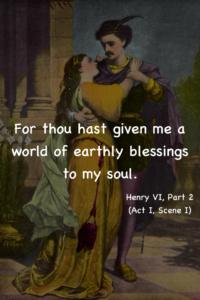
 

Shakespeare Wedding Season

Remember when I wrote a book? Spring is peak season for weddings, and frequently I get traffic for people looking for Shakespeare wedding ideas. So I thought it was a good opportunity to revisit the story…

Has it been seven years? Man I forget how long it’s been that I’ve been doing this.  Then I realize that there’s probably a whole slew of readers who never saw the original project.

Back in 2010 I told myself, “Listen, take one of those ideas running around your brain and actually finish it.”  Ideas are the easy part.  Execution and completion are the hard part.  That’s the story of my life right there.  This was my pure will power effort to get something from the idea stage all the way to completion.

The result is Hear My Soul Speak: Wedding Quotations from Shakespeare. I’d been to one too many weddings where they trotted out Sonnet 116 again and I said to my wife, again, “Why can’t they ever recite something different? There’s so many Shakespeare wedding quotes to choose from.”  I read Sonnet 17, personally.  Actually I recited it to my wife during our first dance.Then it dawned on me that maybe it’s because they don’t know anything else to choose from. Everybody knows 116 (“Let me not to the marriage of true minds admit impediments…” by the way) probably because they heard it at somebody else’s wedding and thought, “I’ll have that at mine, too.”

Then it dawned on me that maybe it’s because they don’t know anything else to choose from. Everybody knows 116 (“Let me not to the marriage of true minds admit impediments…” by the way) probably because they heard it at somebody else’s wedding and thought, “I’ll have that at mine, too.”

Shakespeare Wedding QuotesSo I went through all the sonnets and quote databases I could, pruning out the not by Shakespeares (*), organizing them into how they might be used (the proposal, the vows, the guest book, the toast…) and explaining their context.
Hear My Soul Speak

The end result is a tidy little Shakespeare wedding quote reference book to use whether you’re getting married, in the wedding party, or just on the guest list.  If you’re in any of the above categories, check it out!  Shakespeare makes life better.

(*) Look, I love “I love none but thee til the stars grow old and the sun grows cold,” or however it goes, but it’s not Shakespeare. It’s Bayard Taylor.

Attention Playwrights!

I’m cautiously optimistic about this.  Amazon and Audible (wait, aren’t they the same company now?) have $5million to fund new one and two-man “plays” to presumably be made available via the Audible download service.

…isn’t this just radio drama?  It’s weird to me that they’re calling for playwrights.  Am I missing something?  Are these plays going to actually be performed where someone can go *see* it, live, or is it what I’m assuming and it’s all downloadable audio?

County Paris, Man of Wax
How about Romeo and Juliet as told by Paris?

Everybody wants to get into the original content game now, which is great for consumers (Netflix is literally canceling good shows now on purpose because they don’t want to be thought of as too successful!), and it’s nice to see that the audio crowd hasn’t been left out.

But just how much can you get done in a one or two man show where all you’ve got to work with is sound?  That’s pretty reminiscent of radio drama from, what, 70 years ago?  And even then they typically had a larger cast to work with.

Not a lot of Shakespeare in this one, but I thought this crowd would still be interested.  Could you turn a Shakespeare play into a one man show?  Which one would you tackle, and how would you do it?  Almost certainly have to be a tragedy, but could you even do it from the point of view of the tragic hero, if he’s going to die at the end?


Which Shakespeare Needs a Young Adult Adaptation?


It seems like there are young adult adaptations of Romeo and Juliet and Hamlet coming out of the woodwork lately. Shonda Rimes got her Midas mitts on Still Star-Crossed and is making it a tv series.  Lisa Klein’s Ophelia is going to the big screen, starring Daisy Ridley.  And that’s just two easy ones that are getting all the press – I’ve seen lists lately of half a dozen YA versions at a time.

But it’s always those two, isn’t it? Note that I’m talking about books here, not movies, so I’m not really counting 10 Things I Hate About You, She’s The Man, O, or any of a bunch of high school comedies that as far as I know only live on the big screen.

Bardfilm pays closer attention to this area than I, so he might be able to tell me I’m completely wrong.

Which of Shakespeare’s plays would you like to read in a YA format?  I expect that The Tempest is an obvious choice. But about something harder. Could you do King Lear? Actually I’d be surprised if nobody’s tackled that one yet, I figure you tell it from Cordelia’s point of view you’re half way there.


The Shakespeare Secret Society Game

And tho she be but little she is fierceI’m always mulling over different ways to explain “the mission”.  Why am I here, doing this? Part of it is because I think that Shakespeare makes life better, so when I can help somebody get some more Shakespeare in their life, I consider it a win because I added value to the universe. This goes exponentially so for my kids.

But it took a little while to get there. When I go back to why I actually started the blog? It’s because I wanted to connect with other Shakespeare geeks. I have (had!) no real world connection to Shakespeare, I’m not a theater geek or even an English major.  I simply don’t hang around in such circles.  So Shakespeare would never come up as a topic of conversation. I’d never find anybody wearing a t-shirt that says “Ophelia was pushed.”  So I claimed my space and said in my best Horton Hears A Who voice, “I am here! I am here! I am here!” And, if you’re reading this, you heard me. 🙂

It’s kind of like we have a secret society. Next time you walk somewhere in public, stop and ponder how many of the people you see might be secret Shakespeare geeks. Maybe somebody’s got “Though she be but little she is fierce” tattooed on her shoulder. Or maybe he’s got Harold Bloom’s Invention of the Human tucked into that stack of books he’s carrying. The person you’re sitting across from on the train could be reading the same blog post you are.

So my question to you is this.  Put the shoe on the other foot.  How does that person coming the other way know that you’re a Shakespeare geek? What signs are you giving off? How can someone, a friend, coworker, or even a stranger figure out that you’re both part of the same club?

For example, Shakespeare stickers adorn both of my computers. So if I take up a spot in the local coffee shop, everybody knows what’s up in my world. If you catch me at the pool or the beach where I’m less likely to have the computer, you’re probably going to find me reading something like “Miranda and Caliban” or something else that screams Shakespeare.  You may even find me wearing it on my sleeve :).  I make it easy.

How about you? We bump into each other at a cocktail party, what’s the secret handshake?