[META] What Do We Think Of The Theme?

Hi Everybody,

Hopefully everything’s settling in nicely to our home on WordPress.  I’ve spent most of my time making sure that 11 years worth of links aren’t 90% broken!

One of the main reasons to move off of Blogger was to take advantage of those features that are expectations of a modern blog, and one of them is better control over the appearance.  Right now we’re using a theme called Penscratch which I was using on my other sites Shakespeare Answers and Not By Shakespeare (both of which now redirect here, by the way). I chose it because it reminded me of the written word, crisp type on a white background.
 

Shakespeare Answers Header Image
Shakespeare Answers with the header image.

Now that I’m in it 100% of the time, I’m wondering if it needs something.  I’d like to see some more color and images as part of the main browsing experience.  This theme does have the option of a “header” graphic – which appears in a horizontal bar under the title, and I wasn’t thrilled with it.  There’s also a “background” graphic which I couldn’t figure out how to work because every time I tried to set it, it hid everything else.


What do you think? Are there readers out there more familiar with the “standard” in WordPress theming that could offer some suggestions about ways to decorate?  I’m open to ideas!

15 Movies You Didn’t … Yeah We Did

I haven’t done one of these in a while.  Screen Rant offers us 15 Movies You Didn’t Know Were Based On Shakespeare. But really, if you’re at all a regular follower of what we do here, yes you did.  Their header graphic is the Lion King, for goodness sake.  Is there anybody out there today that doesn’t think Lion King is based on Hamlet?

The only reason I bother linking the list is that it’s got a good cross section of the different types of movies that Shakespeare’s original material can produce:

  • Animated (see above)
  • Teen comedies (10 Things I Hate About You, She’s The Man)
  • Drama (My Own Private Idaho, A Thousand Acres)
  • Musicals (West Side Story, Kiss Me Kate)
  • Foreign language (Throne of Blood, Ran)
  • Science-fiction (Forbidden Planet)

In case you’re looking for movie recommendations for the weekend, this is a great place to start.  While we’ve no doubt mentioned all these movies many times over the years, you probably haven’t actually seen all of them yet.

Barbara Feldon, One Of Us!

Today I learned, via @Reddit, that Barbara Feldon won the $64,000 Question in the Shakespeare category.

Ok, that is a very dated sentence, so let me break it down for everybody who is closer to my kids’ age than my own:

  1. Barbara Feldon played Agent 99 on a television show called Get Smart in the 1960s, which my generation would have been watching in re-runs.
  2. The $64,000 Question was a game-show that’s probably best compared to Who Wants To Be A Millionaire.  The big difference, however, is that you had to answer questions all from a specific category. To give an idea of just how notoriously difficult the game was? Bobby Fischer, generally considered one of the greatest chess players of all time, did not get past the audition round in the chess category.

This clip of Barbara Feldon explaining how she got on the show is wonderful on a number of levels:

“I’m not an expert on anything.”

“You know, on my dressing table was a copy of King Lear, because I’d been re-reading the plays…”

Not just reading, re-reading.

Not just any play, King Lear.

Not just that play, “the plays”.

The lady doth protest too much, methinks!

The actual $64,000 question she “won” on is forgotten – but she tells the story of the $128,000 question that eventually sent her home. Do you think you could answer it, if you hadn’t known it was coming?


Jaffrey, NH Gets All The Good Tempests

I’m kind of digging this trend of bringing live stage performance Shakespeare to the big screen.  I can’t possibly get to all the live show I’d like to, so it’s nice to have the option.

This is particularly true of RSC’s recent “digital” version of The Tempest that got all the great writeups for its use of special effects and virtual reality.  (Actually I heard that the performance gets lost in the glitz, but I’d like to see for myself!)

So when I heard that they’re taking the show on the road I was prepared to get in line for my tickets (like I did with Benedick Cumberbatch’s Hamlet).  But … there are no Massachusetts show times listed.  I would understand, if only other big cities like NY, DC, Chicago, etc.. were on the list. Fine.  But the closest city to me with a screening is Jaffrey, New Hampshire? I’ve lived in Massachusetts all my life, raised three children who have all had to do social studies / geography presentations on the New England states, and nobody’s ever so much as mentioned Jaffrey.

Seriously though, I suspect that the calendar is just not updated.  When you select Jaffrey it actually says “Here are other cities with showtimes” and lists several Massachusetts cities including Chestnut Hill and Revere (neither of which I am likely to get to), but when you click on them it goes back to the main list of theatres as if you experienced an error.  I’m hoping to see either Cambridge / Kendall Square on there (which would be walking distance for me), or Burlington, where I saw Benebatch Hamlet.


You Like Shakespeare (Whether You Realize It Or Not)

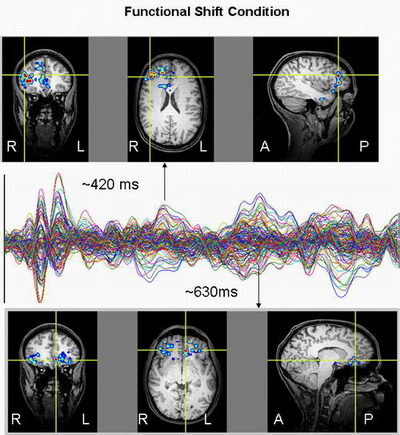
There have been plenty of studies that look at how Shakespeare effects your brain. Here’s another one. They try to determine if the brain is “hardwired” to appreciate the rhyme and rhythm of poetry, such as (but not only) Shakespeare.

Your brain on Shakespeare.

I like the test. They read a specific kind of Welsh poetry to people who did not know the “rules” of that poetry (I suppose it would be a little something like trying to read Haiku to someone without explaining it?) If your poem follows the rules, even when the audience doesn’t know the rules, they rate it more highly than if you break them.

I can totally buy that. It’s not really a big stretch to think of the brain as a giant pattern matching machine, and what is rhythm but “this line follows the same pattern that the last line did?”  You can’t really explain it, you just kind of feel it.  I’m reminded of Dead Poet’s Society where Robin Williams’ students march in a circle, walking in step. They spontaneously begin clapping in rhythm as well.  But Williams never told them to do that.  It just felt more natural to do so. It takes more effort to go against the rhythm than to just go with it.

Can we make the leap that iambic pentameter mimics the beating of the human heart (thump THUMP, thump THUMP)? I’m not sure I’m quite willing to go that far. For starters, that would imply that poetry that is not iambic would feel worse, and that’s not true. I love me some Dr. Seuss and his meter is entirely different.