My Reputation Proceeds Me (and I Love It)

My company’s got about 100 people in it. That doesn’t mean I’ve met or interacted with many of them.  As a pretty solid introvert I’m not one to just start conversations, or introduce myself to people first.    I probably know you and what you do, but chances are unlikely that we’re going to sit together at lunch unless I’m there first and you sit down.

Anyway.  Yesterday at work one of the guys from downstairs, who is firmly in this category, is suddenly behind me.  Turns out that a random test email broke one of our filters and he was trying to chase down who’d created it.  Since it had football words in it he came to me / my boss, since we both follow football and are involved in pools and fantasy.  But no, it was not us who had created the test email, so we pointed him at another football fan on our floor who might be his culprit.

As he was leaving I said, “If you ever get one that’s a Shakespearean character, that’s probably me though.”

To which he replied, “Well, yeah, we know that.”

(What’s funny is that’s the second time that’s happened.  Even the people who I’ve never spoken with know me as the Shakespeare guy.)

Can I Get A Cape? I Think I’d Look Good In A Cape

This morning in the kitchen at work I was talking politics with the CEO, and Shakespeare came up. Why? Because he acknowledged the Shakespeare stickers on the front of my laptop.  He said something about Shakespeare hundreds of years ago already having said some wise things about all politicians.  I said that just recently I’d forwarded around an article comparing Joe Biden’s advice to Hillary Clinton, and Shakespeare’s.

Then it got interesting.  He told me that one of his (four) daughters is in college, and she’s studying Shakespeare, and that *he* (her father, my CEO) was assigned homework.  They’re studying Hamlet’s girlfriend’s father’s speech – what’s his name?

“Polonius.”

Right, Polonius. He has that whole soliloquoy about neither a borrower not a lender be or however it goes, and we’re supposed to write back with what advice we sent out kids off to college with.  And here I am thinking, “What else can I say? This guy said it pretty good!”

That was about the end of that conversation, but it got me thinking.  Later in the day, when he was back at his desk but his door was open, I knocked, and here’s what I said:

In case I haven’t made it obvious, I always thought it kind of goes without saying, but if you, or really anybody here, if your kids ever have Shakespeare homework or ever need any kind of help with the subject, you absolutely come and you get me. The idea that there might be kids that don’t get it, while I’m around and could help them? That bothers me.  I can’t have that. When it comes to homework I might not always have the answer that they need, because usually the teacher isn’t asking questions about your gut feeling or your personal interpretation of the play, they want the academic answer that comes straight out of the textbook, and I don’t always have that. But in that case what I do have is thousands of followers on social media, many of whom are PhDs and academics who do this stuff full time and know a lot more than I do, and I can ask them and then I can play middle man and I can translate. Then we all learn something.

Shakespeare Man!

Funny how life’s changed in the decade I’ve been doing this.  I used to cringe to open my mouth about Shakespeare because I always just assumed that whoever was interested enough in talking to me about the subject would by default also know more about the subject than me, and I was always worried about saying the wrong thing.  Somewhere along the line I embraced that. I don’t have all the answers, and I never will.  When I don’t, I ask, and then I learn, and maybe I’ll have the answer next time somebody asks me.  Because chances are very good that the people asking me questions don’t ever get a chance to ask questions of the Shakespearean professionals that I have access to at this point.

What I do have is a deep seated belief that Shakespeare can be experienced and understood by everybody, and that doing so makes life better, and that when I’m able to help that mission in any way I can, it makes me very happy indeed.

How Far That Little Candle Throws His Beams

I’ve got a question for you.

I’m going to assume, since you’re reading this, that you like Shakespeare.  Maybe you’re a theatre geek in general, or maybe like me you’ve got no particular connection to the theatrical world, you just love Shakespeare’s work.  You’ve probably got a bunch of it memorized, too, if by pure repetition if nothing else.

So here’s my question.  How many friends have you got that you talk about Shakespeare with?  Sure, if you’re in a theatre group in the first place the answer to this question might be obvious.  But what about your friends, your family, your coworkers? If your life is anything like mine, most folks you encounter have little more than a passing high school knowledge of the man and his work. Most will never bother to learn any more than that, because they’re adults now and their time for being told what they have to learn is over.  There’s bills to be paid and fantasy football teams to draft.

Why can’t we change that?

Why can’t we introduce Shakespeare and his work to children from the time that they’re born?  Fine, there’s plenty of stuff in Shakespeare that’s over the head of most college students, let alone toddlers.  Dr. Seuss wrote propaganda cartoons during World War II, too.  But I’ll bet we can all quote Cat in the Hat.

How great would the world be if everybody you ran into on a daily basis was as familiar with “I know a bank where the wild thyme blows, where ox-lips and the nodding violet grows” as they are with “One fish two fish, red fish blue fish?”

“To be or not to be” and “Wherefore art thou” have tipped over into cliche, but wouldn’t you love to hang out with somebody who not only recognized “Be not afeard, the isle is full of noises,” but could complete it with, “sounds and sweet airs that give delight and hurt not?”

Shakespeare is poetry.  Children learn language through rhyme and poetry.

Shakespeare painted pictures with words.  Children learn words through association with images.

There’s absolutely no reason why somebody can’t take Shakespeare’s poetry and Shakespeare’s pictures and put them in the hands of new parents to read to their children from day one. You know what happens when that happens?  Those kids like it. Those kids ask for it. Those kids want more.
Most importantly, those kids grow up with Miranda and Ariel and Titania and Oberon in their brains right next to Winnie the Pooh and Piglet and the Wild Things and the Lorax and Alice and the Mad Hatter…

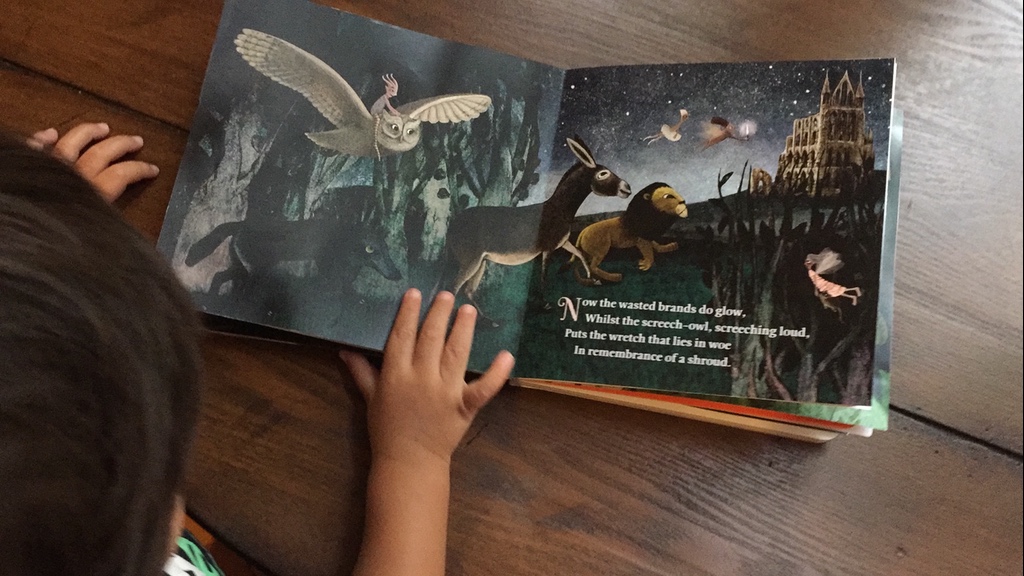
Before that little candle can throw its beams, somebody has to light it, and that is precisely what Erin is trying to do.

I know I’ve bugged you all about this already, but her Kickstarter deadline draws near, and she hasn’t hit the goal yet, so she still needs help.  Back this project.  Get this book into existence. I don’t care if you’ve got kids.  Mine aren’t going to read this.  But I backed it. Because I want others to be able to read it. Imagine one day going to the store (if they still have bookstores!) and seeing Shakespeare in the baby book section. Even better imagine buying it and giving something you love as a give to someone you love.

 

I Think I Resent This Article

I’ve often said “The mission is working” when random friends and coworkers bring me Shakespeare references.  I smile and think, “I’ve had an impact on this person’s life. If they didn’t know me, they would never have recognized and paid special attention to that Shakespeare.”

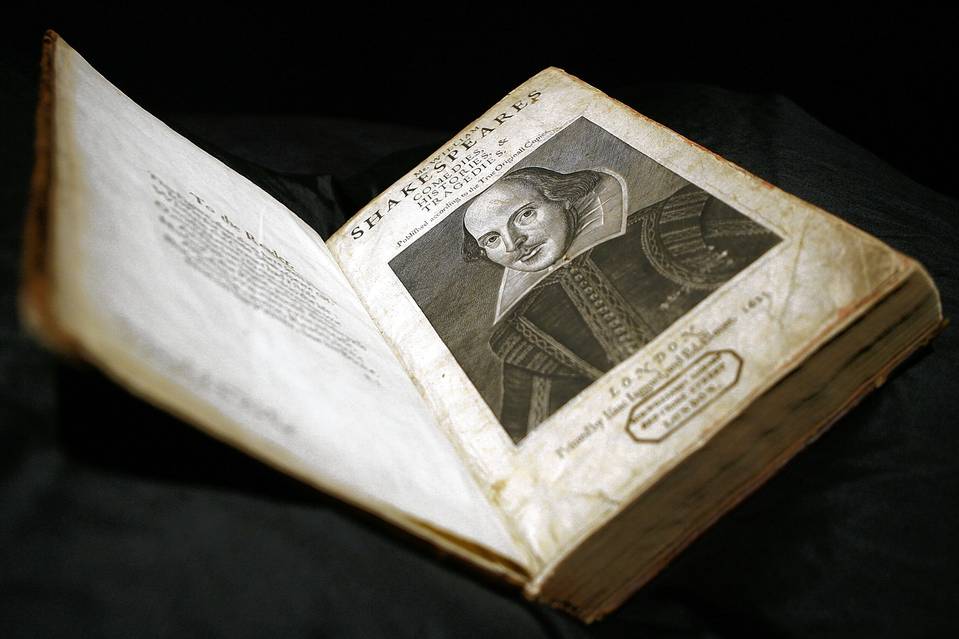
So it was when my coworker Bryce tapped on the aquarium-like glass wall of my cubicle this morning, holding up a copy of the Wall Street Journal emblazoned with a huge First Folio image.  I immediately waved him over.

Conspicuous Consumption for Shakespeare Junkies

I don’t know how to describe the tone of the article, but I don’t like it.  “It’s called one of the rarest books in the world,” it begins, “but it’s not – not by a longshot.”  After all, 233 copies exist and “more are always turning up.”

If you cringe at the term “bardolatry” you’re going to have a conniption over “bibliographic fetishization” that “can’t be explained in rational terms.” Because, you see, most modern editions of Shakespeare don’t even follow the First Folio, because it’s so full of printing errors. The theory that all the punctuation and spelling choices are Shakespearean directorial choices is a “dubious” one at best, you see, because Shakespeare died before the FF was published and no original manuscripts exist.

It goes on like that, questioning whether there’s any scholarly purpose for the Folger collection to even exist, and making it a point to let the reader know that Charlton Hinman’s implausible theory of five compositors is “nothing of cosmic importance” and can only lead to the conclusion, “So what?”

I feel like the entire article is trolling us, and I’m not going to respond. I’m going to forget the author’s name (which I have not bothered to include here), and will promptly forget it myself in the morning.  If Shakespeare makes life better, as we believe, I hope the author is happy with his average life. He doesn’t understand what he’s missing.

No, you know what? I’m not going to end there.  I’m going to remind my readers of the time I got to see the Most Beautiful Book in the World, and something a different co-worker said to me:

“You look so happy!” she said. “Look how happy you look! It must be amazing to be that passionate about something that it can make you that happy.”

The author of this article will never understand that.

How To Think Like Shakespeare

Scott Newstok is a name I recognize. He was one of the very first contributors to Shakespeare Geek, dating all the way back to January 2008 when he sent me a copy of his book about Kenneth Burke.  This was at a time when I was still re-blogging links to Wikipedia pages and pretending that I knew anything at all about the subject 🙂

So when I saw everybody sharing How To Think Like Shakespeare by Scott Newstok I thought, “Hey, I know him!” Sure enough, by the time I got home from work there was an email from Scott waiting for me.

Scott’s article, taken from a convocation address he delivered, is what I mean when I say, “Shakespeare makes life better.” I’ve always seen our mission statement as having a great deal in common with “The unexamined life is not worth living.” It’s not about “How will memorizing passage X, Y and Z get me a job that pays 10% more than the other guy?” That’s such small thinking, I’ve never understood what to do with that. It’s about a picture so much bigger than that, and I love pointing to places where people smarter than I have said it better than I can.

Through Shakespeare, Scott reminds the class of 2020 that they have “an enviable chance to undertake a serious, sustained intellectual apprenticeship. You will prove your craft every time you choose to open a book; every time you choose to settle down to write without distraction; every time you choose to listen, to consider, and to contribute to a difficult yet open conversation.”

“Do not cheat yourselves,” he tells them. I tell that to everyone I meet, whenever the subject comes up. Oh, you never paid attention to Shakespeare in school? So what, what’s stopping you now? There comes a time when you are in charge of your own education, and it never ever stops. Why would you ever miss an opportunity to make your life worth living?

Great job, Scott! Always happy to show off your stuff.