Inside The Vault #2 : Quartos Quartos Quartos

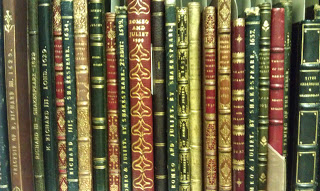
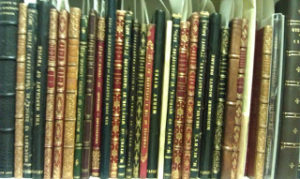
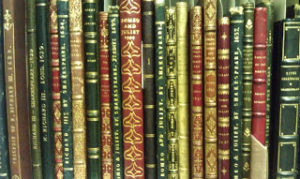
So there we are in the vault.  Georgianna goes digging for something to show us next, and Garland tells me, “Around the corner are the Quartos.”  I take my oldest, and we head around the corner.  Yes, you could say that there are Quartos.

Since we were just looking and no one was explaining the significance of these particular volumes, I can’t really say what we are looking at.  I highly doubt that “original” (or close to it) editions are shoved on top of each other like that.  If you look carefully you will see a Romeo and Juliet dated 1599, however.  That’s pretty cool!  These are almost certainly not original bindings, so maybe it’s not such a big deal to have them rubbing up against each other.  It’s what’s on the inside that counts. Don’t judge a quarto by its cover!
Oh, and Bardfilm also suggested that I ask about the only known Q1 edition of Titus Andronicus in existence.  There’s a big Titus on the far right end of that first picture. Think that’s it?
 
I had no idea they were so small.  Well, I mean, I knew they were small, but after having seen the Folios all spaced out on their own shelves with nothing else surrounding, to turn the corner and see all these tiny books at once.
 
“You can’t be back there!” I hear Georgianna call.  “Sorry, it’s the rules, I’m not back there with you.  That’s actually why there’s two of us here, Garland is my backup.”
 
“Yes,” says Garland, “Technically I’m supposed to tackle you if you make a break for it.”
 
What’s funny is that I don’t know if this is really a rule, or if they didn’t appreciate my sense of humor.  See, in arranging this visit I was going back and forth over email with Garland, and conferring with Bardfilm (who has been to Folger) on what I should see.  What he jokingly suggested, and what I jokingly wrote back to Garland, was

Oh, and @Bardfilm said you’ve got Quartos just lying around and asked me to grab him one on the way out. 🙂

Now it all makes sense!The trip continues…


Inside The Vault #1 : Folios Folios Folios

Through a bank vault door, down a haunted elevator, and we were there.  Led by Georgianna and backed up by Garland we made our way into what appeared to be another average library room.  Shelf after shelf of books.  A table that runs the length of the room, on which several books are strewn about.

“Back there are the Folios,” Georgianna says.

There, along the back wall of the room and around a corner, is a wall of books, all laying flat.  Various colors, sizes and bindings.  First Folios.  I was there.

As Bard as my witness I had an honest to goodness weak in the knees moment.  I grabbed the shoulders of whichever child I’d been leading into the room a little tighter. My eyes widened. My smile widened.  I whipped my head around to look at Garland, in what I can only hope was the wordless “Oh My God I’m Actually Here” face I was attempting, and then whipped back around to look at my wife with the pure and utter bliss I had in that moment.  Center of the universe.

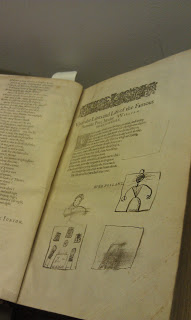
Georgianna had chosen a particular Folio for us to look at – #78.  Why?


This particular Folio has a number of child’s drawings throughout.  I love it.  I love the idea that all 82 of their copies has its own individual story.  Also shows that my tour guides knew a little something about how to keep children occupied, always showing them things that children would find interesting (not something you might expect in a Shakespeare research center!) and keeping them in the conversation.

And this was just the first of many memorable moments.  To be continued….

Shakespeare’s Most Shocking Moment?

While discussing Emilia’s big final scene over in another post, I thought of a good question.

There’s plenty of killing in Shakespeare’s works.  Macbeth kills Duncan in his sleep, Hamlet kills Polonius (thinking him the king) in front of his mother, Tybalt kills Mercutio (accidentally?) and Romeo kills Tybalt (probably not accidentally).

Which do you feel is Shakespeare’s most shocking moment? The one that you absolutely do not see coming?  Plenty of people die in Macbeth, but I’m not sure if any of the deaths is shocking.  After all, when people aren’t dying or killing, they’re talking about it.  Lot of blood in that one.  The murder of Macduff’s family is scary, but you also know that the murderers have been dispatched, so you see it coming (even if you do see it from between your fingers, underneath your seat).

Mercutio’s death is pretty shocking, no doubt. Once upon a time we talked at length about how, up until this point, Romeo and Juliet is a romantic comedy. And then when the audience is least expecting it? Bang, likeable sidekick, dead. I think in fact that this one is so shocking that it takes a little while to sink in.  There’s still half a play left to go.

Hamlet’s attack on a defenseless arras is certainly up there.  He’s talking to his mom.  He hears a noise.  Thinking it *her husband*, not to mention *his uncle*, and oh by the way, *the frickin king*, he jumps up and without another word blindly stabs him. For a guy that’s spent the entire first half of the play saying “Let’s think this through…” it’s a pretty bold move.

But I think I’m going to give the prize to Iago murdering his wife Emilia right in front of everybody, to shut her up.

You think that we’ve already hit the climax of the play. Othello has
killed his wife, Emilia has discovered the truth, the authorities are
now on the scene and we’ve essentially moved into what I love calling
“the Horatio scene” where we wrap up all the loose ends before we go
home.  Or are we?

EMILIA

O thou dull Moor! that handkerchief thou speak’st of
I found by fortune and did give my husband;
For often, with a solemn earnestness,
More than indeed belong’d to such a trifle,
He begg’d of me to steal it.

IAGO

Villanous whore!

EMILIA

She give it Cassio! no, alas! I found it,
And I did give’t my husband.

IAGO

Filth, thou liest!

EMILIA

By heaven, I do not, I do not, gentlemen.
O murderous coxcomb! what should such a fool
Do with so good a woman?

OTHELLO

Are there no stones in heaven
But what serve for the thunder?–Precious villain!

He runs at IAGO
IAGO, from behind, stabs EMILIA, and exit

GRATIANO

The woman falls; sure, he hath kill’d his wife.

We know that Iago is an evil bastard before this, of course.  But he’s always been the schemer and manipulator. Now he’s in a room filled with the equivalent of a police squad ready to arrest him for his crimes.  Does he just run?  No, he *stabs his wife in front of everyone* first, and then he runs. That is just full on crazy, right there.  Afterward you can argue “Sure, it was always clear he was capable of something like that,” but that’s a world apart from seeing it coming.

I love to read Gratiano’s line as, “WTF, did he just kill his wife?!” like even the characters on stage can’t believe what just happened.

Any other contenders?  Make your case.

How Much Marlowe?

How often did Shakespeare lift whole lines right from Marlowe’s (or others’, I suppose) work?  I’m curious.  Currently reading a novel about Shakespeare’s life, and Kit Marlowe is a character.  Just this evening I read a funny bit where Marlowe is complimenting Shakespeare on his Henry VI and says, “I particularly liked the such-and-such part…….wait, didn’t I write that?”

Review : The Tragedy of Arthur

[ Ok, so I’m a little late on this one. I have to admit I was highly confused when, within days of even *receiving* my copy, my feeds were flooded with everybody else in the world putting up their review. How do these people read so fast??]

This will make the third book I’ve read on the “What would happen if a new work of Shakespeare turned up?” idea. The first two attempted to be glorified Da Vinci Codes complete with murder, car cases, and twist endings.
The Tragedy of Arthur is very much not that kind of book, and I love it. It is not about finding a lost work like Cardenio or Love’s Labour’s Won. It is about a man named Arthur Phillips (which also happens to be the name of the author) who is handed a previously unknown Shakespeare play called, appropriately enough, The Tragedy of Arthur. The only known copy, as a matter of fact – which means that he would be the copyright holder, and thus in financial control of the world’s most valuable artistic discovery.

But! There’s a catch. Arthur’s father gave him the book. Arthur’s father also happens to be a professional counterfeit man who has spent his life in jail for those crimes. He swears, however, that the book is an original that he really did find, not forge.

What to do, what to do?

I ended up quite loving this book. It starts with the story of the children, Arthur and Dana, as they’re raised by their debatably criminal father, who also happens to be a lifelong fan of Shakespeare. Arthur, the narrator, never really gets into Shakespeare. Dana, his twin sister, takes to it like, well, a Shakespeare geek. Truthfully, Dana is a far more interesting character than Arthur. A struggling novelist himself, Arthur spends way too much of this memoir whining about his relationship with his father and how he’s taking the memoirist’s privilege of making difficult memories seem easier, etc etc etc…

Meanwhile, I’d like my girls to grow up like Dana. It is 9yr old Dana who goes to visit her father in jail, and then promptly recites the courtroom scene from Merchant of Venice loudly enough for the guards to hear. Later in life, when Dana goes through her inevitable teenage rebellion from her father, she does something so unthinkably rebellious that I laughed out loud. She becomes an anti-Stratfordian. (Ok, maybe I take back what I said about my kids growing up like her!) I can just imagine, her poor dad is in prison and their entire conversation is through written letters, and she’s taunting him with her theories about the Earl of Oxford. I think I would have planned an escape.

Is the plot believable? When I heard that it was about a counterfeit-man who claimed to have a Shakespeare play, the ending sounds pretty obvious. Of course it’s fake, right? Well, that’s what’s cool – the book’s not going to tell you. Some of the characters think that it is, some don’t.

There’s much to geek out over. We learn about how to test paper and ink not just for age but for materials and composition. We learn all about Shakespeare’s word choices, what he would and wouldn’t do, how his early years differ from his later years. We learn about merchandising, and copyright law. Professor Crystal makes a cameo and gets to say cool things like “All the rhymes rhyme in original pronunciation! That’s good!” If you understand who that is and what that sentence means, you’re probably going to love this book 🙂

And then? Here’s where the author takes it over the top. He actually wrote an entirely new, five-act Shakespeare play. You heard that right. The play in question? Is actually included. Obviously it’s not going to pass the ink and paper tests 🙂 but the most hardcore geeks among us can have a grand old time digging through word choice and narrative structure and decide for themselves whether this one could pass for the real thing. I have to admit that I have not yet read through the play (it is not required to complete the book), but I look forward to doing so.

A very refreshing change indeed from the car-chase-laden Da Vinci Code meets Cardenio that I’ve been subjected to in the past. I’m glad I got to read it.