What If Shakespeare Wasn’t Public Domain?

A few years back, i had a coworker that ran a Hemingway site. He was, other than the difference in authors, a lot like many of us. He had no special academic background in the subject, he was just a rabid fan. Read what he could. Collected books. New opportunities to discuss new ideas? Jumped all over them. Hosted a forum where he posted his ideas to get discussion going, answered questions when he knew the answers, and so on.

Big, big difference? Hemingway is not public domain. Imagine all the things about Shakespeare that we take for granted – how often we freely cut and paste as many pieces of text, as long as we want, whenever we need to make a point. Need video? There’s almost always a YouTube clip of somebody reciting the sonnet or performing the scene that you need. He had none of that. He dreamed of the sort of concordances and textual analyses that we take for granted with Shakespeare. How many different words did Hemingway use? How did his vocabulary change during his career? Can’t do it.

So I wonder … how would your life be different if Shakespeare were not public domain? Let’s say that, like Winnie the Pooh, somebody along the line *had* the rights to Shakespeare’s works, and sold them. And that the entity who now owns them has aggressively marketed them, and rigorously defended their copyright. How would your life be different?

I’m pretty sure this blog wouldn’t exist. I can go out and buy a book on Shakespeare like anybody else, but what I really needed was the forum where we could talk about it. I’m not a theatre person or an academic, so I am not normally surrounded with Shakespearean resources (be they scripts or people). So if you suddenly took away my ability to make my point in text by preventing me from cutting and pasting a portion of a scene from a play? Or, worse, hung the spectre of the takedown notice over my head so that whenever I did cite text I could potentially receive such a scary lawyer letter? I can’t see how it would ever get off the ground.

UPDATED: If you’re coming in from Twitter, don’t be shy!  How do you think the world would be different if Shakespeare were not public domain?

A professor on Twitter wanted to make sure that everybody knew that not every *edition* of Shakespeare is public domain, and that her notes and emendations were copyrighted!  I pointed out that, if Shakespeare were not public domain to begin with, she wouldn’t have had anything to write notes on 🙂  No response.

The Shakespeare Tavern said that their budget would go up, which is certainly true since now they’d have to pay for rights to produce the plays :).  But, I wonder, if Shakespeare wasn’t so universal, would there even be a market anymore for full-time Shakespeare houses?

My Mini Macbeth

Haven’t told a kid story in awhile. Turns out my 4yr old boy may be the biggest geeklet of them all.

Over the weekend, he was trying to figure out when he had school again. “Do I have school today?”

“No,” I said, this being Saturday, “not today.”

Him: “Tomorrow?”

Me: “Nope, not tomorrow either.”

Him: “Tomorrow and tomorrow?” That’s his way of saying “two days from now.”

Me: “Not quite. One more day.” He actually has Monday off as well as Sunday.

Him: “Tomorrow and tomorrow and tomorrow?”

Me:”Creeps in this petty pace from day to day to the last syllable of recorded time.”

Him: “….What?”

Me: “Macbeth. That’s a line from Macbeth you just recited.”

Him: “….ELIZABETH!” His sister is seated next to him at the breakfast table. “When I said Tomorrow and tomorrow and tomorrow THAT WAS FROM MACBETH!”

He’s also gotten into the habit of making his elders feel stupid. The other day he runs up to his grandmother (my wife’s mother) and says, “To be or not to be, Gammie! Do you know who said that?”

“Was it Macbeth?” she asks.

“No, Gammie, it wasn’t *Macbeth*,” he says, “It was Hamlet!” And then runs off. He does this to his preschool teachers as well.

Drive-by 4yr old Shakespeare. I couldn’t be more proud.

Top Twenty Shakespearean Faux Pas (Guest Post by Bardfilm)

The author of Bardfilm thought it would be fun to compose a guest post here at Shakespeare Geek. And I thought it would be fun to let him! Here we are, then:

Bardfilm’s list of the Top Twenty Shakespearean Faux Pas:

  1. Inviting Lady Macbeth to a dinner party and constantly telling her where she can wash up.
  2. Inviting Macbeth to a dinner party and constantly saying, “What a great Banquo!” instead of “What a great Banquet.”
  3. Asking Henry V “Whatever happened to Richard II? We hardly ever see him around anymore!”
  4. Telling Rosalind she looks just like a boy actor playing a girl pretending to be a boy acting like a girl.
  5. Asking the two noble kinsmen which one is the noblest.
  6. Casually mentioning to Macduff that your wife and children weren’t butchered by a desperate megalomaniac.
  7. Inviting Claudius to see Agatha Christie’s The Mousetrap with you.
  8. Trying to compliment Hamlet by referring to him as “The Great Dane.” He hates that.
  9. Shouting “No! It’s your imagination!” whenever Macbeth starts on that “Is this a dagger?” nonsense.
  10. Answering all of Hamlet’s rhetorical questions in a sarcastic tone of voice (viz. “What’s Hecuba to him? He dated Hecuba in high school!”).
  11. Standing in the way of Richard III’s ascent to the throne.
  12. Offering Othello a handkerchief after he sneezes. It’s kind of like offering Lady Macbeth a moist towelette.
  13. Singing the Beatles’ “I Want to Hold Your Hand” when Lavinia (from Titus Andronicus) is in the room.
  14. Slipping a fake spider into the martini glass of Leontes (from The Winter’s Tale).
  15. Referring to Gertrude as “Hamlet’s father’s brother’s wife.”
  16. Requesting the pianist at a bar to play “We Don’t Need Another Hero” when Claudio is right there.
  17. Showing up at a social occasion wearing the same cloth-of-gold of tissue dress as Cleopatra.
  18. Serving Caesar a salad . . . over and over again . . . every single time he comes to your place.
  19. Proposing marriage to Isabella—even though you know she’s almost finished taking her vows to be a nun.
  20. Asking King Lear about his 401(k).

Our thanks to kj, the author of Bardfilm. Bardfilm is a blog that comments on films, plays, and other matters related to Shakespeare in a relatively-informal manner.

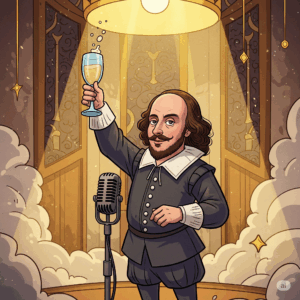
Shakespeare Toasts: Get Inspired with Quotes from the Bard

Shakespeare Toasts

Have you ever found yourself in a situation where you needed to give a toast but had no idea what to say? You can’t go wrong with Shakespeare toasts. Here are a few lines from Shakespeare to keep in your back pocket (figuratively, by memorizing them, or have them written on a card in your back pocket :)) to help you out.

Set It Up

“Shakespeare said.”  Remember those words.  It may be more accurate to say that Duke Orsino said it in Twelfth Night, but most of your audience will typically not get that.  Everyone in the crowd, however, is guaranteed to recognize the name Shakespeare and pay attention to what you’re about to say. Of course, you can phrase it however you like.  “As Shakespeare once said…” or “In his romantic comedy Twelfth Night, William Shakespeare wrote….”  You get the idea.  That’s just a matter of style. Below, each quote cites the character who said it, the play, and the act/scene where it can be found, in case you want to work this information into your Shakespeare toasts.

Openers / Ice-breakers for Shakespeare Toasts

“Men of few words are the best men.”
[Boy, Henry V.  Act 3, Scene 2]

“…so, I’ll keep it brief.”  Or, if you prefer the self-deprecating style, “Shakespeare said that men of few words are best men. I guess that doesn’t say much for me because I’ve got about 20 index cards of notes to get through.”

“Brevity is the soul of wit.”
[Polonius, Hamlet. Act 2, Scene 2]

This line serves the same general purpose as the one above if you like it better.  It’s the more popular quote, so your audience may recognize it.  That may make it too cliché for you, though.  Judgment call.

“Though I am not naturally honest, I am sometimes by chance.”
[Autolycus, The Winter’s Tale. Act 4, Scene 4]

On the other hand, not too many people will recognize the source of this quote.  But hopefully, they get the joke – that you lie so often that when you do tell the truth, it’s probably a mistake. You can then go on to say whatever complimentary words you like and leave them wondering whether or not you meant any of it!

“Better a witty fool than a foolish wit.”
[Feste, Twelfth Night, Act 1, Scene 5]

If you were worried that dropping some Shakespeare into your toast would make you feel silly, here’s your out. Everybody knows the expression “better to have them laughing with you than at you,” this is just Shakespeare’s version. You can try to say something smart and end up sounding ridiculous, or you can start by setting the expectation that you might say something ridiculous, and leaving everyone pleasantly surprised.

“All the world’s a stage, and all the men and women merely players.”
Jaques, As You Like It, Act 2, Scene 7

This is one of your great “everybody will recognize this one” Shakespeare toasts, so it’s a sure bet to get people’s attention. Of course, what you follow it up with is up to you. It literally sets the stage for whatever sentiment you want to convey. You can carry it through with more of the speech, too, if you want:

They have their exits and their entrances;
And one man in his time plays many parts.

The perfect set up for any significant life event – a graduation, a new job … even a wedding. Life is all about change, and Shakespeare toasts are always appropriate.

Best Wishes

There are plenty of ways to say “Best Wishes” in the works of Shakespeare.  Here are but a few.

“Your heart’s desires be with you.”
[Celia, As You Like It. Act 1, Scene 2]

“Lack nothing: be merry.”
[Shallow, Henry IVp2. Act 5, Scene 3]

“All days of glory, joy and happiness.”
[Lewis, King John. Act 3, Scene 4]

“Fair thought and happy hours attend you.”
[Lorenzo, Merchant of Venice. Act 3, Scene 4]

“I wish you all the joy you can wish.”
[Gratiano, Merchant of Venice. Act 3, Scene 2]

This one’s a personal favorite. It’s modern enough that it doesn’t feel like Shakespeare, and generic enough that it can fit any occasion. I write it on a lot of cards, but it’s even more powerful when you get to look someone in the eye and say it.

“Heaven give you many, many merry days.”
[Mistress Page, Merry Wives of Windsor. Act 5, Scene 5]

“Heaven send thee good fortune.”
[Mistress Quickly, Merry Wives of Windsor. Act 3, Scene 4]

Wrap It Up

“I drink to the general joy of the whole table.”
[Macbeth, Macbeth. Act 3, scene 4]

Shakespeare toasts are just a way of getting between the guests and their drinks, so the less you talk, the better.  People also love knowing when it’s over, so they’ve got permission to get back to drinking.  Use this line as your closer, drink, and sit down.

In conclusion, Shakespeare toasts offer a delightful way to add depth, eloquence, and a touch of literary charm to any celebration. By drawing inspiration from the works of William Shakespeare, you can craft memorable toasts that resonate with your audience and leave a lasting impression. Whether it’s a wedding, anniversary, or simply a gathering of friends, incorporating Shakespeare’s timeless words elevates the art of toasting, creating moments of connection, celebration, and appreciation. So, raise your glasses and let the Bard’s words inspire your next heartfelt and captivating toast, making your special occasions truly unforgettable. Cheers to the power of Shakespearean toasts!

Based on material from the book Hear My Soul Speak: Wedding Quotations from Shakespeare, now available on Amazon! The definitive guide to Shakespeare toasts, wedding quotes, and readings.

Which Play Is The Most Romantic?

Might Twelfth Night be Shakespeare's most romantic play?

Going over edits for my Shakespeare wedding quotes book, I’m curious about which play provided the most romantic quotes.  That’s a fairly arbitrary measure, of course, but it’s an interesting question. I’m not thinking of the storyline. I mean, which play has the most passages that you could pull out of context and use elsewhere and still have them sound romantic?

From where I sit, As You Like It and A Midsummer Night’s Dream both have a great deal of stuff to say on the subject of love and romance.  But they’re both … light? about it.  Neither, in my book, expresses the sort of ups and downs that come with what love’s really all about.  Don’t get me wrong, A Midsummer Night’s Dream is damned near perfection from some angles, but half the time, the lovers are in the grip of a magic potion and in love with the wrong person.  As You Like It, I find just too corny.  Cute but corny. Life’s not as easy as that one makes it out to be.

I think I’ll put my money on Twelfth Night. I love the discussion we had on music being the food of love.  Orsino has got some amazing insight about what love’s really all about, and that place where it can actually cause you pain, and yet you still want more of it.

“They are in the very wrath of love, clubs cannot part them.”

“Love sought is good, but given unsought is better.”